A quick note: Prudent Hearing Solutions is an RCI-registered hearing-aid clinic for people with hearing loss. We run hearing tests and fit medical hearing aids. We do not sell AirPods, TWS or consumer earbuds. If you are looking to buy earbuds, you are in the wrong place, but if you are struggling to hear, we can genuinely help.
Educational information, not medical advice. This article is written to help you understand common ear and hearing issues. It is not a substitute for professional diagnosis or treatment. If your symptoms are severe, sudden, or persistent, please consult a qualified doctor or audiologist. For urgent symptoms (sudden hearing loss, bleeding from the ear, severe pain with dizziness, or a head injury), seek medical care the same day.
Apple's five-minute AirPods hearing test screens 250 Hz to 8 kHz. How close it gets to a clinic audiogram, what it cannot detect, and its status in India.
Quick answer
Apple's AirPods Pro 2 hearing test is a five-minute at-home screen (250 Hz to 8 kHz) that gives a rough indication of mild-to-moderate loss and can enable the Hearing Aid feature. It is a useful screener, not a diagnosis: it cannot measure bone conduction or speech-in-noise or find the cause of a loss, and its India availability depends on Apple's regional software rollout. Any real concern still needs a clinic audiogram.
Key takeaways
- It is a 5-minute screener (250 Hz to 8 kHz), not a diagnostic audiogram.
- It can indicate mild-to-moderate loss and switch on the AirPods Hearing Aid feature.
- It cannot test bone conduction, speech-in-noise, or diagnose the cause of a loss.
- India availability depends on Apple's regional software rollout.
- Sudden, one-sided or worsening loss needs a proper clinic test, not an app.
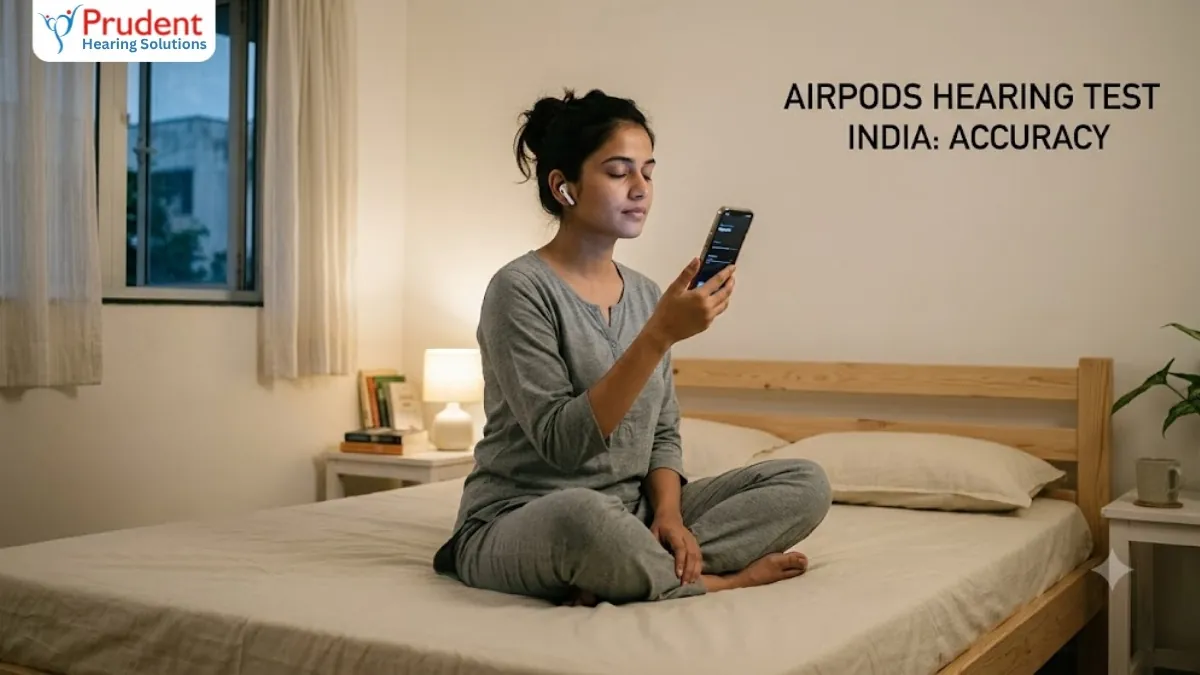
Apple's Hearing Test on AirPods Pro 2 is a five-minute pure-tone screening from 250 Hz to 8 kHz that saves an audiogram to the Health app. It launched in India in 2026. It screens; it does not diagnose, because it cannot check the eardrum, the middle ear or bone conduction.
What are the three Hearing Health features on AirPods Pro 2?
People say "the AirPods hearing feature" as if it were one thing. Apple ships three, and each is released country by country because each is regulated separately.
- Hearing Test: a pure-tone screening played through the AirPods, taking roughly five minutes, covering 250 Hz to 8 kHz, and producing an audiogram stored in the Health app.
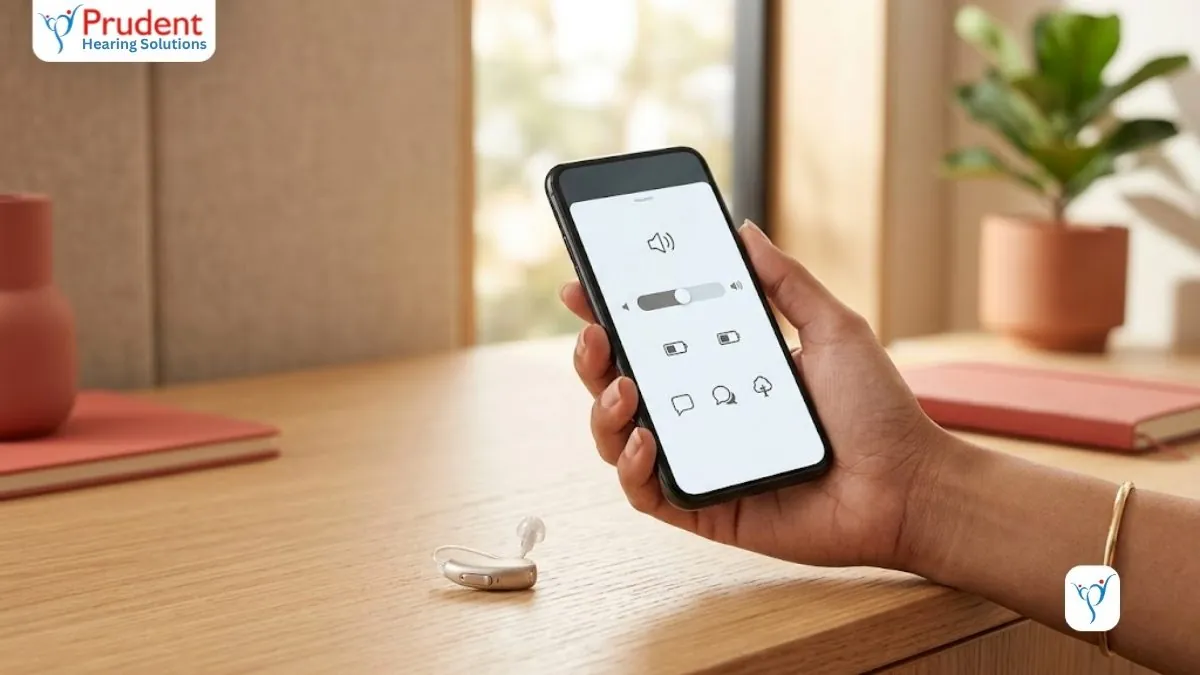
- Hearing Aid feature: uses that audiogram to shape amplification of the sound around you, intended by Apple for *perceived mild to moderate* loss, with adjustable amplification, balance and tone.
- Hearing Protection: reduces loud environmental sound across Transparency, Adaptive Audio and Active Noise Cancellation.
All three need AirPods Pro 2 or Pro 3 on current firmware, paired with an iPhone or iPad running iOS 18.1 or iPadOS 18.1 and later, the release these features actually shipped in. Apple states the Hearing Test and Hearing Aid features are intended for people aged 18 and over.
Is the AirPods hearing test available in India?
Yes. Apple announced in May 2026 that the Hearing Test for AirPods Pro is available in India, and India appears in the Hearing Test list on Apple's own feature-availability page for AirPods Pro (apple.com/in/airpods-pro/feature-availability/).
The Hearing Aid feature is a different matter. Checked on 29 July 2026, India was not listed on that page under the Hearing Aid feature, nor under Hearing Protection, for either AirPods Pro 2 or Pro 3. These are regulated health features and they reach each country only after local authorisation.
Regulatory listings change quietly, so check for yourself rather than trusting any article, including this one. First confirm you are on iOS 18.1 or later with up-to-date AirPods firmware. Otherwise, a missing toggle tells you nothing about your region. Then open Settings, tap your AirPods, and look under Hearing Health.
How does the AirPods Pro hearing test actually work?
It uses pure-tone audiometry, the same basic principle as the pure tone audiometry test an audiologist performs. Before it starts, the iPhone samples background noise in the room and checks the ear-tip seal, refusing to proceed if either is poor. It then plays quiet tones from 250 Hz up to 8 kHz in each ear, and you tap the screen each time you hear one.
Results arrive as an averaged decibel figure per ear, a classification, and a frequency-by-frequency audiogram you can export as a PDF. Apple's bands are: up to 25 dB HL little to no loss, 26–40 dB HL mild, 41–60 dB HL moderate, 61–80 dB HL severe. These are Apple's bands, not the clinical grading.
Clinically, 41–55 dB HL is moderate, 56–70 dB moderately severe, 71–90 dB severe and above 90 dB profound, so a result Apple calls "moderate" at the top of its range is moderately severe in a clinic and usually needs a fitted aid rather than an earbud. Our guide to understanding your audiogram walks through the symbols.
How accurate is the AirPods hearing test compared with a clinic audiogram?
Reasonably accurate as a screening tool in the one small published validation (25 adults), and only on ears already cleared of other pathology. That caveat is the whole story.
A validation study published in *Otolaryngology–Head and Neck Surgery* compared the feature against audiologist-administered pure-tone audiometry in 25 adults with self-reported mild-to-moderate loss. Most AirPods thresholds fell within 10 dB HL of the clinical result, and repeat testing was consistent. Put the other way round, roughly one threshold in seven differed from the clinical result by more than 10 dB. That is acceptable for a screening decision (see someone, or not yet) but not for deciding gain, candidacy, or whether an asymmetry is real.
In Apple's own validation study, an audiologist first performed otoscopy, tympanometry and bone-conduction testing to rule out conductive loss before participants were enrolled. In other words, the feature was validated on ears where the conditions it cannot detect had already been excluded. On an unscreened ear, a number in the Health app tells you how much you are hearing, not why.
What can the AirPods hearing test not detect?
The AirPods measure air conduction only. A clinic assessment adds several things a phone has no way of doing, and those additions are what turn a number into a diagnosis.
- Otoscopy: a look into the canal. Impacted wax can produce a "loss" on AirPods that a clinician clears in minutes under direct vision. A perforated eardrum or an active infection also shows up as loss, but those need treatment, not removal. Do not try to clear wax yourself: cotton buds push it deeper and ear candling causes burns and perforations, and wax must never be syringed in an ear with a known or suspected perforation.
- Bone conduction: separates conductive loss (outer or middle ear, often treatable) from sensorineural loss (inner ear, usually permanent). AirPods cannot distinguish the two at all.
- Tympanometry and acoustic reflexes: measure middle-ear pressure and eardrum movement, picking up glue ear and Eustachian tube dysfunction. Combined with an air-bone gap and absent reflexes they also raise suspicion of otosclerosis, which tympanometry alone cannot diagnose.
- Masking: stops the better ear answering for the worse one. Without it, a genuinely asymmetric or one-sided loss can be badly misread.
- Speech testing and speech-in-noise: how well you understand words, which tracks real-world difficulty far better than tones alone.
This is why we describe the AirPods test as a prompt to act, not an answer. Our page on types and causes of hearing loss explains why the conductive-versus-sensorineural distinction changes the treatment entirely.
When should you skip the app and see a doctor instead?
Some presentations are not screening situations. If any of these apply, do not spend five minutes on a phone test. Get seen.
- Sudden hearing loss in one ear, over hours or a couple of days, is a medical emergency. Steroid treatment works best the earlier it is started (ideally within the first week and in any case within two weeks of onset), and salvage treatment can still help up to about six weeks. Go to an ENT the same day. If it has already been several days or weeks, still go: it is not automatically too late. See sudden and noise-induced hearing loss.
- Ear pain, discharge or bleeding from the canal needs examination, not amplification.
- Marked asymmetry, where one ear is clearly worse, warrants ENT review to rule out retrocochlear causes.
- Vertigo or spinning alongside hearing change: see vertigo, BPPV and Meniere's.
- Pulsatile tinnitus: a whooshing in time with your pulse needs ENT assessment and usually imaging.
Also see a doctor rather than an app for facial weakness, numbness or unsteadiness alongside hearing change; rapidly progressive or fluctuating hearing; persistent one-sided tinnitus; and recent head injury, ear surgery or a known perforation. Neither the Hearing Test nor the Hearing Aid feature is intended for anyone under 18. Children with suspected hearing loss need paediatric audiology. Every Prudent Hearing Solutions clinic is a full-scale diagnostic centre offering BERA/ABR, VEMP, ECochG and Tinnitus Retraining Therapy.
Can the same AirPods work as a hearing aid?
Where Apple has enabled it (not India, as at 29 July 2026), the Hearing Aid feature reuses your audiogram to shape amplification of Transparency mode for perceived mild to moderate loss. Beyond roughly 55–60 dB HL, and for single-sided or complex loss, a fitted prescription aid does what earbuds cannot: real-ear verification, all-day battery, custom fit and directional noise programmes. We cover that comparison properly in AirPods Pro 2 as a hearing aid.
Two safety points. Do not amplify an ear you have not had examined: if the loss is conductive (wax, fluid, a perforation, cholesteatoma), amplification makes you comfortable enough to postpone treatment while the underlying problem progresses. Never insert an ear tip into an ear that is painful, discharging or known to be perforated. And because nothing verifies the output in your ear canal, turn amplification up only as far as speech is clear and comfortable. If you keep increasing it, or sound becomes sharp or uncomfortable, stop and get assessed.
Does AirPods Hearing Protection replace earplugs?
Not for hazardous noise. Hearing Protection reduces loud environmental sound across Transparency, Adaptive Audio and Active Noise Cancellation. This is active, battery-dependent reduction rather than passive attenuation. It is a reasonable everyday benefit in traffic, restaurants or crowds. It is not occupational hearing protection: it has no certified attenuation rating a safety officer can use, it only works while the buds are in and charged, and it must not be used in place of rated earmuffs or moulded plugs at work.
Apple states plainly that it is not suitable for extremely loud impulse sounds: gunfire, fireworks, jackhammers. AirPods Pro 3 add a certified protection variant in some markets that also limits media playback level; that certification is region-specific, so check Apple's own documentation for units sold in India. Hearing Protection is region-gated as well, and India was not listed for it on Apple's availability page on 29 July 2026. Noise damage is cumulative and permanent: nothing on the market, hearing aids included, restores hair cells once they are gone.
How should you use your AirPods audiogram in India?
Treat it as evidence, not a verdict. If the result says little to no loss but you still ask people to repeat themselves in restaurants, that mismatch is itself informative: speech-in-noise difficulty often appears before tones shift, and the AirPods do not test it. See signs you need a hearing test. If it comes back mild or moderate, export the PDF and bring it to a clinic.
At Prudent Hearing Solutions the 45-minute digital hearing test is free and covers otoscopy plus pure-tone audiometry (air and bone conduction) on calibrated equipment; tympanometry and specialist tests such as BERA/ABR, VEMP and ECochG are arranged separately as needed. Audiometry test cost in India sets expectations if you go elsewhere, and what level of hearing loss needs a hearing aid covers what happens next.
One thing to be clear about: hearing aids manage hearing loss, they do not cure it. Untreated hearing loss is associated with faster cognitive decline, but whether treating it prevents that is not settled: the largest randomised trial to date found no overall benefit at three years, with a possible effect in higher-risk older adults. Better audibility and less listening effort are worth having on their own terms; we do not promise a cognitive outcome. The evidence is summarised in hearing loss and cognitive decline.
"A five-minute test on your phone can tell you that something has changed. Only a clinical assessment can tell you what changed and what to do about it."
If your AirPods have flagged something, or you simply suspect your hearing is not what it was, book a free 45-minute digital hearing test at Prudent Hearing Solutions. We are RCI-registered and have been fitting hearing aids since 2004, with clinics in Pune (Viman Nagar), Delhi (Rohini and Green Park) and Bengaluru (Jayanagar), plus home visits where travelling is difficult.
Bring your Health app PDF, as it is genuinely useful to us. Hearing aids are GST-exempt in India, we offer up to 30–50% off manufacturer MRP with 0% EMI and free lifetime programming, and you can try a hearing aid in the clinic before you buy. Book a free clinic hearing test or see hearing aid prices: call +91 9429690093 or WhatsApp +91 8485096505.
Continue reading
Frequently asked questions
Is the AirPods hearing test available in India?
Yes. Apple made the Hearing Test for AirPods Pro available in India in May 2026, and India is listed for it on Apple's feature-availability page. You need AirPods Pro 2 or Pro 3 on current firmware with an iPhone or iPad running iOS 18.1 or later. The Hearing Aid feature is separate and was still not listed for India when we checked on 29 July 2026.
How accurate is the AirPods hearing test?
In a small published validation study of 25 adults, most AirPods thresholds fell within 10 dB HL of audiologist-administered pure-tone audiometry, with consistent repeat testing. Put the other way, roughly one threshold in seven differed by more than 10 dB. That is fine for deciding whether to get seen, but not for deciding gain, candidacy or whether an asymmetry between ears is real.
Can the AirPods hearing test replace a hearing test at an audiology clinic?
No. The AirPods measure air conduction only. A clinic assessment adds otoscopy to check for wax or perforation, bone conduction to separate conductive from sensorineural loss, tympanometry and acoustic reflexes for middle-ear function, masking for asymmetric ears, and speech-in-noise testing. Those additions turn a set of thresholds into a diagnosis. Use the AirPods result as a prompt to get properly assessed.
What frequencies does the Apple Hearing Test cover and how long does it take?
It uses pure-tone audiometry across 250 Hz to 8 kHz in each ear and takes about five minutes. Before starting, the iPhone measures background noise and checks the ear-tip seal, and refuses to run if either is inadequate. Results appear as an averaged decibel figure per ear, a classification, and a full audiogram stored in the Health app that you can export as a PDF.
Are Apple's hearing loss categories the same as a clinic's?
No, and the difference matters. Apple uses up to 25 dB HL for little to no loss, 26–40 mild, 41–60 moderate and 61–80 severe. Clinically, 41–55 dB HL is moderate, 56–70 moderately severe, 71–90 severe and above 90 profound. So a result Apple calls moderate at the top of its range is moderately severe in a clinic and usually needs a fitted, verified hearing aid.
Does AirPods Hearing Protection replace earplugs at loud events?
No, not for hazardous noise. It is active, battery-dependent reduction with no certified attenuation rating, it works only while the buds are in and charged, and Apple states it is unsuitable for impulse sounds such as gunfire, fireworks or jackhammers. It is fine as an everyday benefit in traffic or crowds, but at work or at very loud events use rated earmuffs or moulded plugs instead.
When should I see a doctor instead of taking a phone-based hearing test?
Sudden hearing loss in one ear is a same-day emergency; steroid treatment works best started early, ideally within the first week and in any case within two weeks, with salvage options to about six weeks. Also see an ENT for ear pain, discharge or bleeding, marked asymmetry, vertigo, pulsatile tinnitus, facial weakness, or rapidly fluctuating hearing. None of these are screening situations.
Should I bring my AirPods audiogram to a hearing clinic?
Yes, it is genuinely useful. Export the PDF from the Health app and bring it along. It gives the audiologist a baseline and a sense of what prompted your visit. We then repeat pure-tone audiometry on calibrated equipment and add the checks AirPods cannot perform, such as otoscopy and bone conduction. The 45-minute digital hearing test at Prudent Hearing Solutions is free.
Sources & further reading
We cross-checked this article against the following authoritative sources. Guidance and figures reflect the most recent public guidance available at the time of last review (July 2026). Clinical review by the Prudent Hearing clinical team.
- Hearing Aids (National Institute on Deafness and Other Communication Disorders (NIDCD, NIH))
- Hearing tests (NHS UK)
Free consultation
Ready to hear the difference?
Book a free 45-minute hearing test at any Prudent Hearing clinic: no obligation, honest advice, expert audiologists.