Educational information, not medical advice. This article is written to help you understand common ear and hearing issues. It is not a substitute for professional diagnosis or treatment. If your symptoms are severe, sudden, or persistent, please consult a qualified doctor or audiologist. For urgent symptoms (sudden hearing loss, bleeding from the ear, severe pain with dizziness, or a head injury), seek medical care the same day.
A plain-language guide to the three types of hearing loss (conductive, sensorineural and mixed), the degrees from mild to profound, the causes we see most in India, and an honest look at what is reversible.
Quick answer
Hearing loss comes in three types. Conductive loss is a blockage in the outer or middle ear, like wax or fluid, and is often treatable. Sensorineural loss is damage to the cochlea or nerve, usually permanent and managed with hearing aids. Mixed loss is both together. A hearing test tells you which type you have.
Key takeaways
- The three types are conductive (outer or middle ear), sensorineural (cochlea or nerve), and mixed (both together).
- Conductive loss is often treatable and sometimes reversible; sensorineural loss is usually permanent but managed well with hearing aids.
- Degrees run from mild (26 to 40 dB) to profound (91 dB and above) on your audiogram.
- Sudden loss in one ear is a medical emergency; get seen within days, not weeks.
- Only a hearing test can tell your type and degree; symptoms alone cannot.
Hearing loss is not one condition. It comes in three main types, and the type decides most of what follows: whether it can be treated, whether it comes back, and what a hearing aid can and cannot do for you.
This page explains those types in plain words, the degrees from mild to profound, the causes we see most often in Indian clinics, and what is honestly reversible and what is not. If you take away one thing, take this: a hearing test tells you which type you have. Guessing from symptoms alone does not.
The three types of hearing loss
There are three types of hearing loss: conductive, sensorineural, and mixed. Conductive loss is a mechanical problem in the outer or middle ear, like wax, fluid, or a hole in the eardrum, that blocks sound from reaching the inner ear. Sensorineural loss is damage inside the inner ear (the cochlea) or along the hearing nerve, usually from ageing, noise, or certain drugs.
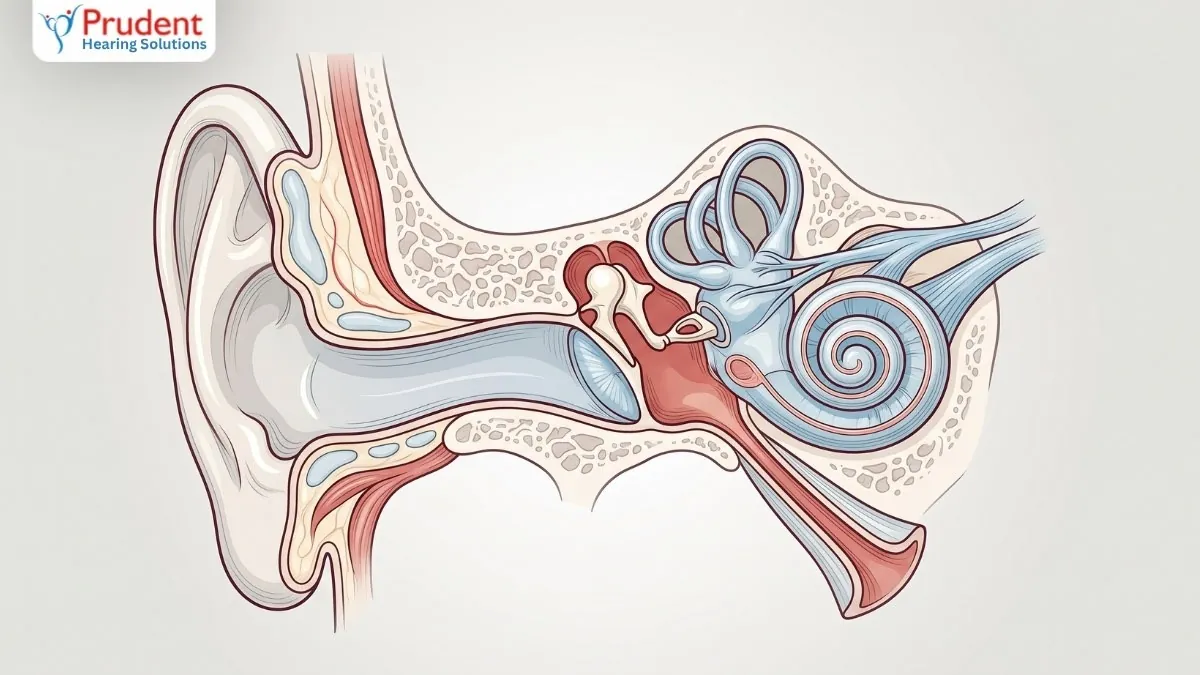
Mixed loss is both together in the same ear. The reason we separate them is simple. Conductive loss is often treatable, sometimes fully. Sensorineural loss is usually permanent and managed rather than cured. To find which one you have, we compare how you hear through air against how you hear through bone, and it helps to know the parts of the ear so you can see where the fault sits.
Conductive hearing loss (outer or middle ear)
Conductive hearing loss happens when something stops sound from passing cleanly through the outer or middle ear. The inner ear is usually fine; the sound just cannot get to it. People often describe it as muffled hearing, or an ear that feels blocked or full. The good news is that many conductive problems are treatable, and some clear up completely. Ear wax can be removed.
Middle ear fluid and infections settle with treatment. A perforated eardrum often heals on its own or can be repaired surgically. Otosclerosis, a stiffening of the tiny middle ear bones, can sometimes be corrected with surgery or helped with a hearing aid. This is the type most likely to be reversible, which is exactly why you should not sit on a blocked-feeling ear for months.
- Ear wax packed against the eardrum
- Middle ear fluid or infection, common in children
- A perforated (torn) eardrum from infection or injury
- Otosclerosis, where the middle ear bones stiffen
- A foreign object, or occasionally an insect, in the ear canal
Sensorineural hearing loss (cochlea or nerve)
Sensorineural hearing loss is damage to the hair cells inside the cochlea, or to the hearing nerve that carries sound to the brain. These hair cells do not grow back once they are gone, which is why this type is usually permanent. It is also the most common type in adults. The volume drops, but clarity drops too, so speech can sound mumbled even when it seems loud enough.
Background noise makes it worse. We cannot rebuild the cochlea, but we manage this type well with properly fitted hearing aids, and for very severe cases, with cochlear implants. The aim is to give the brain back the sounds it is missing, especially the high pitches that carry consonants and word clarity. Our guide to hearing aids for sensorineural hearing loss explains which style suits each degree.
- Ageing (presbycusis), the gradual loss many people notice after 60
- Loud noise from workplaces, headphones, weddings, or firecrackers
- Ototoxic medicines, such as some strong antibiotics and chemotherapy drugs
- Genetics and family history
- Sudden sensorineural loss, which is a medical emergency
Mixed hearing loss (both together)
Mixed hearing loss is exactly what it sounds like: a conductive problem and a sensorineural problem in the same ear at the same time. For example, someone with age-related nerve loss can also get a wax blockage or an ear infection on top of it.
The conductive part may be treatable, so clearing it can bring back some hearing, but the sensorineural part stays and is managed with a hearing aid. On an audiogram we can see both. That is one reason a full test matters, rather than a quick look or a guess.
Degrees of hearing loss, from mild to profound
Hearing loss is graded by how loud a sound has to be before you can just hear it, measured in decibels (dB) on an audiogram. The softest sound you can detect is your threshold, and the higher that number, the more hearing you have lost. Normal hearing sits at roughly 25 dB or better. From there the grades run mild, moderate, moderately severe, severe, and profound.
These are approximate bands, and your loss can differ between low and high pitches and between the two ears. That is why an audiologist reads the whole shape of the graph, not a single number. If you want to understand your own report, our guide to reading an audiogram walks through it line by line.
- Normal: -10 to 25 dB. Soft speech is comfortable.
- Mild: 26 to 40 dB. You miss soft speech and struggle in noise.
- Moderate: 41 to 55 dB. Normal conversation is hard without help.
- Moderately severe: 56 to 70 dB. Speech has to be loud to follow.
- Severe: 71 to 90 dB. Even loud speech is difficult.
- Profound: 91 dB and above. Hearing aids or a cochlear implant become essential.
Common causes of hearing loss in India
The causes we see most in our clinics reflect everyday Indian life. Untreated ear infections in childhood are common and can leave lasting damage. Noise is everywhere: traffic, factory floors, wedding processions, loudspeakers, and hours of earphones at high volume. Age-related loss rises steadily after 60. Diabetes, which is widespread here, is linked with faster hearing decline.
Some strong medicines used for TB, serious infections, and cancer can harm hearing. In families where marriage between close relatives is common, inherited hearing loss in newborns is seen more often. These are broad patterns from clinical experience, not exact figures, but they show up again and again at the test bench.
- Repeated or untreated ear infections, especially in children
- Noise exposure from work, traffic, celebrations, and headphones
- Ageing after 60
- Diabetes and other long-term health conditions
- Ototoxic medicines for TB, severe infection, or cancer
- Inherited and birth-related causes
One ear or both ears?
Hearing loss can affect one ear or both, and the pattern is a clue to the cause. Age and noise usually affect both ears fairly evenly. A wax plug, an infection, or a perforation often hits just one ear. A sudden drop in one ear over hours or a day, sometimes with ringing or a blocked feeling, is different.
Sudden sensorineural hearing loss is a medical emergency. Steroid treatment works best when it starts within the first few days, and it should not wait beyond about two weeks. Do not sit and hope it clears on its own. If one ear suddenly changes, get seen quickly, and read our page on sudden and noise-induced hearing loss to know the warning signs.
Is hearing loss reversible? An honest answer
Here is the honest version. Conductive hearing loss is often reversible, because the problem is a blockage or a mechanical fault we can treat: remove the wax, clear the infection, repair the eardrum, and hearing frequently returns. Sensorineural hearing loss is usually not reversible, because the hair cells and nerve do not regenerate.
We manage it, and manage it well, with hearing aids fitted to your specific audiogram. The one urgent exception is sudden sensorineural loss, where prompt steroid treatment can recover some or all of the hearing if you act within days. Anyone who promises to fully cure long-standing nerve deafness with drops, oils, or exercises is not being straight with you.
"The simple rule: if the problem is a blockage, we can usually fix it. If the cochlea itself is worn or damaged, we manage it with the right hearing aid, but we do not pretend to reverse it."
What to do next
You cannot tell conductive from sensorineural, or mild from severe, by how it feels. Only a test can. At Prudent Hearing Solutions we offer a free 45-minute hearing test at our RCI-registered clinics in Pune (Viman Nagar), Delhi (Rohini and Green Park), and Bengaluru (Jayanagar).
You get your audiogram, a plain explanation of your type and degree, and honest advice on whether treatment or a hearing aid makes sense for you. If aids are the right step, genuine digital models start around Rs 11,000 per ear, and you can try the aids in the clinic before you buy. Call +91 9429690093 to book, or first check the common signs you need a hearing test.
Continue reading
- the heart-health and hearing connection
- reading an audiogram
- sudden and noise-induced hearing loss
- parts of the ear
- signs you need a hearing test
- Presbycusis explained
- Bone conduction and BAHA devices
- Otosclerosis: surgery or hearing aids?
- Which levels of loss need a hearing aid
- Can hearing loss be reversed naturally?
- AirPods hearing test accuracy
- diabetes and hearing loss
- perforated eardrum, causes and healing
Frequently asked questions
What is the difference between conductive and sensorineural hearing loss?
Conductive hearing loss is a mechanical block in the outer or middle ear, such as wax, fluid, an infection, or a torn eardrum, and it is often treatable. Sensorineural hearing loss is damage to the inner ear or hearing nerve, usually from ageing, noise, or certain medicines, and it is usually permanent. We tell them apart with a hearing test that compares air and bone conduction.
Is hearing loss reversible?
It depends on the type. Conductive loss is often reversible, because we can remove wax, treat infection, or repair an eardrum and hearing returns. Sensorineural loss is usually not reversible, because the cochlea's hair cells do not regrow, but it is managed well with hearing aids. Sudden sensorineural loss is the exception, where prompt steroid treatment within days can recover hearing. No drop or oil cures long-standing nerve deafness.
What do the degrees of hearing loss mean?
Degrees describe how much hearing you have lost, measured in decibels on an audiogram. Normal is up to about 25 dB. Mild is 26 to 40 dB, moderate 41 to 55, moderately severe 56 to 70, severe 71 to 90, and profound 91 dB or above. The higher the number, the louder a sound must be before you hear it. Your two ears can sit at different levels.
Why do I have hearing loss in only one ear?
One-sided loss usually points to a local cause, like a wax plug, an ear infection, or a perforated eardrum, which is often treatable. Age and noise damage tend to affect both ears more evenly. A sudden drop in one ear over hours or a day is a warning sign of sudden sensorineural loss and needs urgent care within days. Get it checked quickly.
Can a hearing test tell which type I have?
Yes. A standard hearing test measures how you hear sounds through air and through bone, and the gap between them shows whether the problem is conductive, sensorineural, or mixed. It also grades the degree from mild to profound and checks each ear separately. The result is your audiogram. Our 45-minute test is free at our clinics in Pune, Delhi, and Bengaluru.
Sources & further reading
We cross-checked this article against the following authoritative sources. Guidance and figures reflect the most recent public guidance available at the time of last review (October 2026). Clinical review by the Prudent Hearing clinical team.
- Deafness and hearing loss (World Health Organization (WHO))
- Understanding your audiogram (American Speech-Language-Hearing Association (ASHA))
- Hearing Aids (National Institute on Deafness and Other Communication Disorders (NIDCD, NIH))
Free consultation
Ready to hear the difference?
Book a free 45-minute hearing test at any Prudent Hearing clinic: no obligation, honest advice, expert audiologists.