Educational information, not medical advice. This article is written to help you understand common ear and hearing issues. It is not a substitute for professional diagnosis or treatment. If your symptoms are severe, sudden, or persistent, please consult a qualified doctor or audiologist. For urgent symptoms (sudden hearing loss, bleeding from the ear, severe pain with dizziness, or a head injury), seek medical care the same day.
Turning the TV up, missing consonants at the dinner table, avoiding phone calls: the quiet signals hearing loss sends before you notice it.
Quick answer
The five earliest signs of hearing loss are turning the TV louder than others prefer, asking people to repeat themselves in busy places, missing high-pitched sounds like doorbells or birdsong, struggling more on phone calls than in person, and ringing (tinnitus) in one or both ears. Any two of these signs, or any one that lasts more than a few weeks, is a reason to book a 45-minute audiogram.
Key takeaways
- Adults should get a baseline hearing test by age 50, then every 2–3 years.
- High-frequency loss makes consonants (S, F, TH, SH) fade before vowels, so speech sounds muffled, not quiet.
- Tinnitus (ringing) is one of the earliest warnings and often accompanies mild loss.
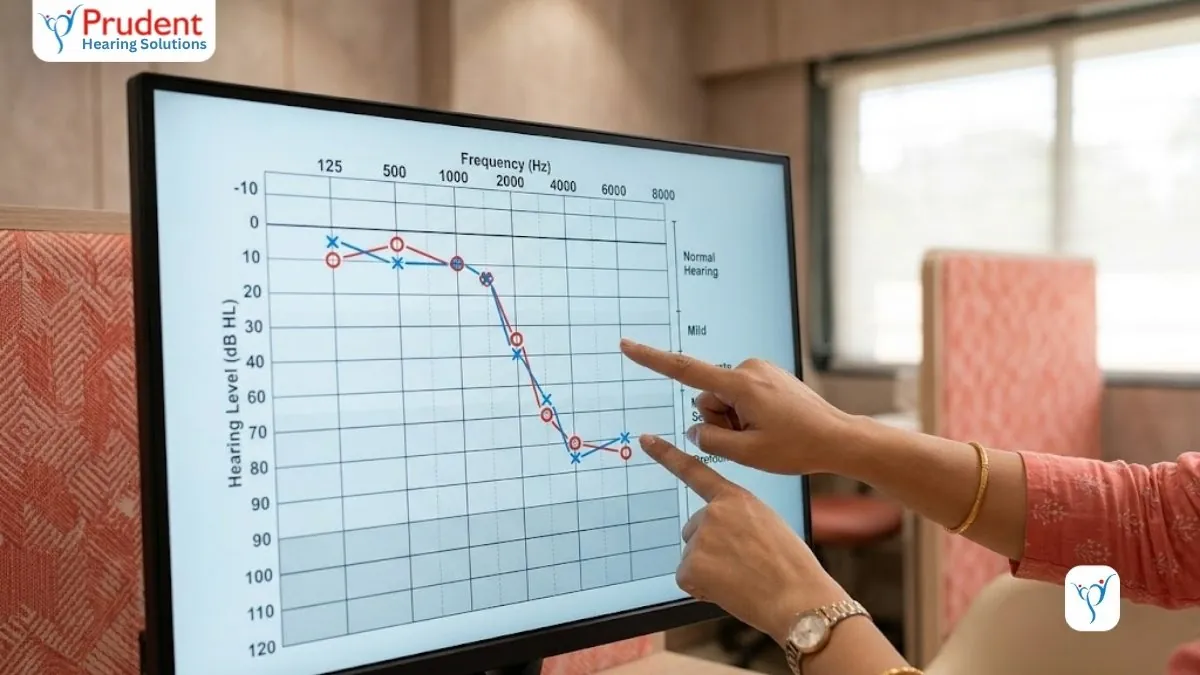
- A full diagnostic audiogram takes ~45 minutes, is painless and covers pure-tone plus speech-in-noise testing.
- Untreated hearing loss is linked to higher risk of social isolation and cognitive decline.
Age-related hearing loss usually creeps up over years, not weeks. By the time family members start commenting, the brain has already been straining for a long time. The good news: a 45-minute test is enough to catch it, and today's hearing aids are near-invisible.
1. You turn up the TV, and people complain
If your family regularly asks you to lower the volume while you feel it's still not loud enough, that's the clearest early sign. High-frequency sounds like S, F, TH and consonants fade first, so speech feels muffled even when volume is high.
2. Conversations in restaurants are exhausting
Struggling to follow a friend at a busy café while hearing is fine at home is classic sensorineural loss. The brain is working overtime to filter speech from background noise, a symptom audiologists call the cocktail-party effect.
3. You ask people to repeat themselves, often
"Sorry, what?" more than once or twice a day is worth investigating. Many patients unconsciously start lip-reading or nodding along without fully understanding, which slowly limits social confidence.
4. Ringing, buzzing or humming in the ears
Tinnitus is often the very first symptom of hearing loss. Roughly 60–80% of people with tinnitus also have measurable hearing loss on an audiogram. Treating the underlying loss usually reduces the ringing.
5. You avoid phone calls
Phone audio is compressed and stripped of visual cues. If you find yourself dodging calls or asking people to WhatsApp instead, your ears are telling you something.
What to do next
Book a free, painless 45-minute hearing test at any Prudent Hearing clinic. You'll walk out with your audiogram, an honest recommendation, and, if you need hearing aids, a trial with no obligation.
Continue reading
Frequently asked questions
How do I know if my hearing loss is getting worse?
Look for changes over months, not days. Turning the TV up higher than you used to, struggling in places that were once easy, more 'sorry, what?' moments, or new or louder ringing all point to a shift. The only way to be sure is to compare audiograms, so if your last test was over a year ago, book another and put the two side by side. A sudden drop in one ear is different and needs same-day attention.
What are the earliest signs of hearing loss in adults?
The earliest signs are turning up the TV louder than others prefer, struggling to follow conversations in busy places, frequently asking people to repeat themselves, missing high-pitched sounds like doorbells or birdsong, and finding phone calls harder than in-person chat. Ringing in the ears (tinnitus) is another common early clue.
At what age should I get my hearing tested?
Adults should have a baseline hearing test at age 50, and then every 2–3 years. Get tested sooner at any age if you notice symptoms, work in noise, have diabetes or cardiovascular disease, take ototoxic medicines, or a family member says your hearing has changed.
How long does a hearing test take?
A full diagnostic hearing test takes about 45 minutes and includes case history, video otoscopy, pure-tone audiometry in a sound-treated room, and speech-in-noise testing. You leave with a printed audiogram and a clear explanation of what the results mean.
Is a hearing test painful?
No. A hearing test is completely painless and non-invasive. You sit in a quiet room wearing headphones and press a button whenever you hear a tone. There is no needle, no radiation and nothing goes deep into the ear.
Sources & further reading
We cross-checked this article against the following authoritative sources. Guidance and figures reflect the most recent public guidance available at the time of last review (July 2026). Clinical review by the Prudent Hearing clinical team.
- Deafness and hearing loss (World Health Organization (WHO))
- Hearing Aids (National Institute on Deafness and Other Communication Disorders (NIDCD, NIH))
- Hearing tests (NHS UK)
Free consultation
Ready to hear the difference?
Book a free 45-minute hearing test at any Prudent Hearing clinic: no obligation, honest advice, expert audiologists.