Educational information, not medical advice. This article is written to help you understand common ear and hearing issues. It is not a substitute for professional diagnosis or treatment. If your symptoms are severe, sudden, or persistent, please consult a qualified doctor or audiologist. For urgent symptoms (sudden hearing loss, bleeding from the ear, severe pain with dizziness, or a head injury), seek medical care the same day.
A parent's guide to hearing loss in children: why the first years matter, the signs at each age, how newborn screening works in India, and what to do if you are worried.
Quick answer
Hearing loss in children is easiest to help in the first years, because hearing drives speech and language. Watch for a baby not startling at loud sounds or not turning to your voice by six months, and older children mishearing or falling behind. Newborn screening (OAE, then BERA if needed) is quick and painless. If you are worried, see a paediatric audiologist for a proper test.
Key takeaways
- Hearing drives speech, so the first two to three years matter most for a child's outcomes.
- Newborn screening uses OAE, and BERA or ABR if needed. Both are quick and painless.
- Signs change with age: no startle in babies, unclear speech in toddlers, mishearing in school-age children.
- Common causes include genetics, birth complications, ear infections and glue ear, mumps or measles, and some medicines.
- A paediatric audiologist can test any age. Early hearing aids and speech therapy change how well a child learns to talk.
Children do not always tell you they cannot hear. A baby who does not startle at a loud sound, a toddler who is slow to talk, a seven-year-old who keeps asking you to repeat yourself: all of these can be signs of hearing loss. The first years matter more than most parents realise, because hearing is how a child learns to speak. This guide covers what to watch for at each age, how newborn screening works in India, and what you can do about it.
Why the first years matter most
Hearing drives speech and language. In the first two to three years the brain builds its speech pathways from the sounds a child hears every day. If those sounds are missing or muffled, speech and language fall behind, and catching up later is harder. This is why early detection makes such a difference. A child whose hearing loss is found and treated in the first months often develops speech close to other children their age. The same loss found at three or four usually means slower progress and more therapy. None of this is cause for panic. Early action simply gives the brain the sound it needs while it is still wiring itself for language.
Newborn hearing screening in India
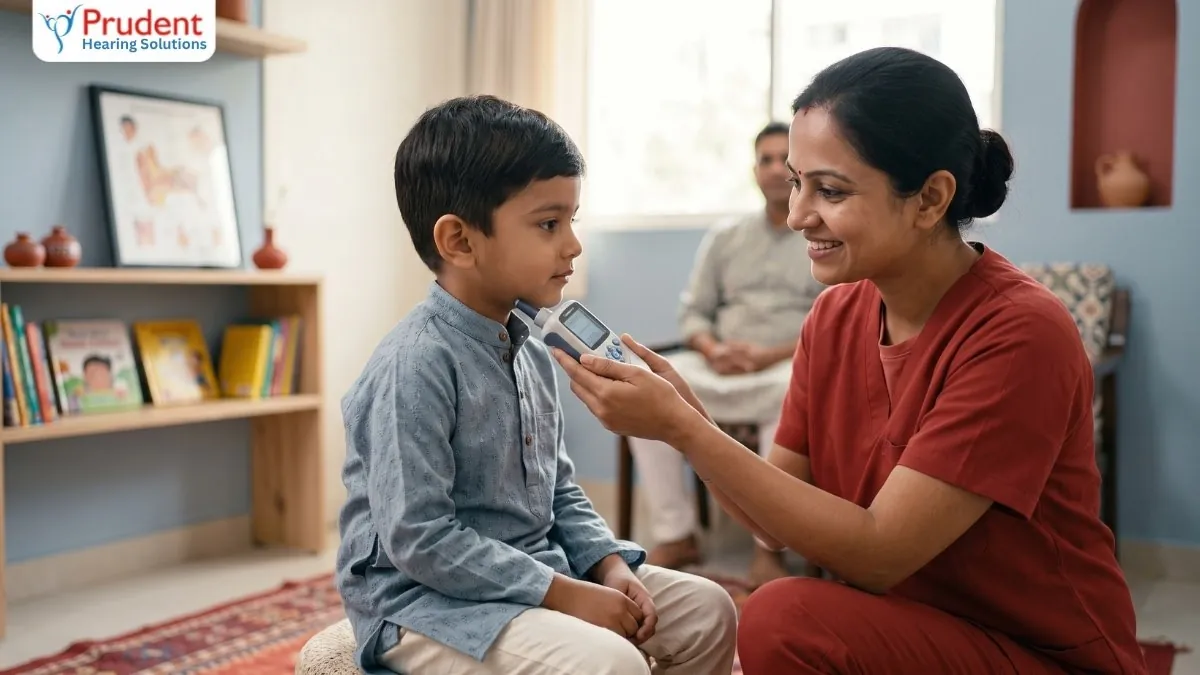
Most Indian hospitals now offer newborn hearing screening, usually before the baby goes home or at the first check-up. The first test is OAE (otoacoustic emissions). A soft probe sits in the baby's ear and measures the echo a healthy inner ear gives back. It takes a few minutes, does not hurt, and is often done while the baby sleeps. If the OAE result is not clear, the baby is called back for a second test, often BERA, also called ABR. BERA checks how the hearing nerve carries sound to the brain. A first 'refer' result does not mean deafness. Fluid in the ear or a restless baby can cause it, which is why the repeat test matters.
What the two tests involve
- OAE: a small earpiece plays soft sounds and records the inner ear's response. Quick, painless, no needles.
- BERA or ABR: soft stickers on the head record the hearing nerve's activity while sounds play through tiny earphones. The baby usually sleeps through it.
- Both are safe for newborns and can be repeated as often as needed.
Signs of hearing loss by age
Babies (birth to about 12 months)
- Does not startle or blink at a sudden loud sound.
- Does not settle or turn towards your voice, especially by around six months.
- Stops babbling, or the babbling does not grow into new sounds.
- Wakes to touch but not to noise.
Toddlers (about 1 to 3 years)
- Speech is delayed, or words are unclear for their age.
- Does not respond to their name unless you are in view.
- Wants the TV very loud, or sits very close to it.
- Watches your face and hands closely to work out what you mean.
School-age children
- Falling behind in class for no obvious reason.
- Mishears words, or often asks you to repeat yourself.
- Says 'what?' a lot, or gives answers that do not fit the question.
- Struggles much more in noisy places, like a busy classroom.
What causes hearing loss in children
The causes fall into a few groups. Some children are born with hearing loss. Others develop it later, which is why a clear newborn screen does not rule it out for good.
- Genetic: hearing loss can run in families, sometimes with no other affected relative.
- Birth complications: premature birth, low birth weight, lack of oxygen, jaundice needing treatment, or infection around the time of birth.
- Ear infections and glue ear: repeated infections or fluid trapped behind the eardrum, common in young children and often treatable.
- Childhood infections: mumps, measles and meningitis can damage hearing.
- Ototoxic medicines: a few strong antibiotics and other drugs can affect hearing, usually where there is no safer option.
What to do if you are worried
See a paediatric audiologist and get a proper hearing test. Do not wait to see if the child grows out of it, and do not rely on clapping behind them at home, which is easy to misread. A trained audiologist uses tests suited to your child's age, from BERA in babies to play-based testing in toddlers. If ear infection or glue ear is the cause, treating that may be all that is needed. If the loss is permanent, the audiologist will explain the options clearly. The point of testing is not a label. It is to know exactly what your child can and cannot hear, so the help can be matched to them.
Hearing aids and therapy for children
Children are not small adults, and their hearing aids are fitted differently. The settings come from the child's own test results, the earmoulds are remade as the ear grows, and the fit is checked as the child develops. Alongside aids, speech and auditory therapy teaches the child to use the sound they now hear and to build language. Started early, this pairing lets many children with hearing loss speak, learn, and attend a regular school. At Prudent we offer paediatric audiology and speech and auditory therapy for children across our clinics.
"Finding hearing loss early is good news, not bad. The sooner a child gets the right sound, the closer their speech and learning can stay to other children their age."
What to do next
If your baby did not pass newborn screening, or your child shows any of the signs above, book a hearing test rather than waiting. Prudent Hearing Solutions runs RCI-registered clinics in Pune (Viman Nagar), Delhi (Rohini and Green Park) and Bengaluru (Jayanagar), and the first 45-minute hearing test is free. You can call us on +91 9429690093. If your child needs aids, you can try the aids in the clinic before you buy. Acting early is one of the most useful things you can do.
Continue reading
Frequently asked questions
My newborn passed the hearing screening. Can hearing loss still develop later?
Yes. A clear newborn screen is reassuring, but some hearing loss appears after birth, from ear infections, glue ear, childhood illnesses like mumps or measles, or certain medicines. That is why the age-based signs still matter. If your child stops responding to sound the way they used to, or speech slows down, get a hearing test even if the newborn screen was normal.
At what age can a child's hearing be tested?
At any age, including newborns. Babies are tested with OAE and BERA or ABR, which need no response from the child and can be done while they sleep. From around two to three years, audiologists add play-based tests where the child does a small action each time they hear a sound. There is no age too young to check hearing properly.
Is hearing loss in children always permanent?
No. A lot of childhood hearing loss is temporary and treatable. Glue ear and ear infections, which are common in young children, often clear with treatment and hearing returns. Permanent hearing loss from genetics, birth complications or some infections does not reverse, but hearing aids and therapy help a great deal. A proper test tells you which type your child has.
Does hearing loss cause speech delay?
Often, yes. If a child cannot hear speech clearly, they cannot copy it, so words come late or sound unclear. Speech delay is one of the most common reasons hearing loss is first noticed in toddlers. It is worth ruling out a hearing problem before assuming a child is simply a late talker. A hearing test is quick and settles the question.
How much do hearing aids for children cost in India?
It varies with the technology. Genuine digital hearing aids start from around Rs 15,000 per ear. Mid-range rechargeable or Bluetooth models run about Rs 35,000 to 70,000 per ear, and premium aids from roughly Rs 1,20,000 to 2,00,000 per ear. Children's aids also need earmoulds remade as the ear grows. We offer an in-clinic trial before you buy.
Sources & further reading
We cross-checked this article against the following authoritative sources. Guidance and figures reflect the most recent public guidance available at the time of last review (July 2026). Clinical review by the Prudent Hearing clinical team.
- Deafness and hearing loss (World Health Organization (WHO))
- Hearing Aids (National Institute on Deafness and Other Communication Disorders (NIDCD, NIH))
Free consultation
Ready to hear the difference?
Book a free 45-minute hearing test at any Prudent Hearing clinic: no obligation, honest advice, expert audiologists.