Educational information, not medical advice. This article is written to help you understand common ear and hearing issues. It is not a substitute for professional diagnosis or treatment. If your symptoms are severe, sudden, or persistent, please consult a qualified doctor or audiologist. For urgent symptoms (sudden hearing loss, bleeding from the ear, severe pain with dizziness, or a head injury), seek medical care the same day.
A practical guide to preventing hearing loss in India: 60/60 earphone rule, protection for weddings, Diwali, traffic and factory noise, and when to test.
Here is the honest answer: most hearing loss cannot be reversed once it happens, but a very large share of it can be prevented before it happens. Noise is the biggest preventable cause, and in India we are surrounded by it: wedding DJs, festival loudspeakers, firecrackers, horns, generators, factory floors. The good news is that prevention does not need money or gadgets.
It needs distance, shorter exposure, a ten-rupee pair of foam earplugs, and the sense to walk away from a speaker. This guide explains exactly what to do, in the situations you actually face. And to be clear from the start: no oil, supplement, exercise or device restores hearing that is already damaged. A hearing aid manages hearing loss, it does not cure it. Prevention is the only thing that truly protects what you have.
Why noise damages hearing: the simple version
Inside your inner ear are tiny hair cells that convert sound into signals for your brain. Loud sound physically overworks them. Once they die, they do not grow back.
Two things decide the damage: how loud the sound is, and how long you are in it. A very loud blast can hurt in seconds. A moderately loud sound can hurt over hours. That is why a firecracker and an eight-hour shift near a compressor can both cause harm.
The third thing to understand is that damage adds up. Every loud wedding, every loud commute, every loud shift stacks on top of the last one. Most hearing loss builds up over twenty years of functions rather than one. But a single very loud blast (a firecracker at close range, or standing right in front of a speaker stack) can cause permanent damage on its own. You can read more about how this pattern differs from a sudden event in our guide to noise-induced and sudden hearing loss.
Earphones and headphones: the 60/60 rule
Earphones are the one noise source you fully control. Use the 60/60 guideline: keep the volume at roughly 60% of maximum, and try to keep total earphone listening to about 60 minutes a day. If you listen for longer, drop the volume further and take regular breaks.
A practical test: if someone at arm's length has to raise their voice for you to hear them over your earphones, you are too loud.
Why noise-cancelling headphones genuinely help
This surprises people. Noise-cancelling headphones protect your ears not because they are gentle, but because they remove the reason you turn the volume up. On a Mumbai local, in an auto on a main road, or on a flight, most people push the volume high just to beat the background roar. Cut the background, and you listen comfortably at a much lower level. That is real protection.
Children and volume limits
Every phone and tablet has a volume-limit setting. Switch it on for your child's device and keep the password to yourself. Children's ears are not tougher than yours, and they have many more decades of listening ahead. If you notice a child asking "what?" often, turning the TV up, or falling behind in class, do not wait. See our guide on signs of hearing loss in children.
Indian noise, situation by situation
General advice is easy to ignore. Here is what to do in the settings you will actually be in this year.
- Wedding DJs and bands: The danger zone is directly in front of the speaker stack. Stand behind or to the side of the speakers, and step out of the hall for ten minutes every hour. Doubling your distance from a speaker cuts the sound reaching you substantially. Distance is the cheapest protection there is.
- Dhol, processions and festival loudspeakers: Dhol played at close range is extremely loud. Keep a few metres of gap, and never let a small child sit on your shoulders right beside the drums. Their ears are at speaker height.
- Diwali firecrackers: Bombs and ladi are impact noise. The damage happens faster than you can react. Watch from a distance, let someone else light them, and use properly fitting earmuffs for small children. Adult foam earplugs are a choking risk and do not seal a small ear canal, though foam plugs are fine for older children and adults. Do not cup hands over ears as your only plan; it is not enough for a close blast.
- Traffic and horns: Riding a two-wheeler through peak traffic every day is a genuine cumulative exposure. A properly fitted full-face helmet cuts wind noise noticeably, but it does much less against horns and traffic, so treat it as comfort, not hearing protection. Keep car windows up on highways.
- Generators, pumps and DG sets: If you work or live beside a running generator, do not stand next to it to talk. Move away, or wear plugs while you are near it.
- Factory and industrial work: This is the highest-risk group in India, and the most under-protected. If you must shout to be heard by a person one metre away, that area needs hearing protection all day, every day, not just on inspection days.
"If you have to raise your voice to talk to someone standing an arm's length away, the noise around you is loud enough to damage hearing."
What protection to actually buy
You do not need anything expensive. You need something you will actually wear.
- Foam earplugs: Cheap, widely available, and genuinely effective. Roll them thin, pull the ear up and back, insert, and let them expand (for a young child, pull the ear down and back). Keep a pair in your bag, your bike storage and your work bag. Replace them when they get dirty.
- Musician or filter earplugs: These reduce volume more evenly, so speech and music still sound clear rather than muffled. Worth it for DJs, band members, sound engineers, event staff and anyone who needs to hear conversation in a loud room.
- Earmuffs: The right choice for industrial and construction work, and easy for supervisors to check at a glance. Employers in noisy industries should be providing these free of cost, along with training on using them.
The warning sign most people ignore
After a loud wedding or concert, you come home and your ears are ringing, or everything sounds slightly muffled, or you feel like your ears are stuffed with cotton. By morning it is gone and you forget about it.
Do not forget about it. That episode is called a temporary threshold shift, and it means your inner ear was pushed past its limit. It recovered this time. Repeat it often enough and the ringing stops going away, and the muffling stops lifting. Treat it as a warning to change your habits, not proof that your ears are strong.
Some symptoms need a doctor the same day, not a wait-and-watch: sudden hearing loss in one ear, ear pain, discharge from the ear, or dizziness with hearing change. See an ENT specialist promptly. Sudden hearing loss in particular is treated as an emergency.
Your general health protects your hearing too
The inner ear runs on a very fine blood supply, which is why whole-body health matters more than most people expect.
Uncontrolled diabetes and high blood pressure are both associated with hearing loss, and both are extremely common in India. Smoking is also linked with higher risk. Keeping sugar and BP in range, and stopping tobacco, are hearing-protective steps as much as heart-protective ones.
There is also a well-established association between untreated hearing loss and cognitive decline in later life, which is another reason not to postpone testing. We cover this in our article on the hearing loss and dementia link.
Medicines: ask, never self-medicate
Some medicines can harm hearing or cause tinnitus. These include certain antibiotics (particularly the aminoglycoside injections), some chemotherapy drugs, and very high doses of common painkillers. This is called ototoxicity.
Two rules. First, never self-medicate or accept an injection from a chemist without a doctor's prescription. Second, never stop a prescribed medicine on your own. For many patients the drug is treating something far more serious than the risk it carries, and the decision belongs to your doctor. If you notice new ringing or hearing change while on treatment, report it to the prescribing doctor promptly. Our detailed piece on medicines that affect hearing explains what to ask.
Everyday ear care
A lot of avoidable damage in India comes from things people do to their own ears with good intentions.
- No cotton buds. They push wax deeper and can injure the eardrum. Ears clean themselves.
- No oil. Warm mustard or coconut oil poured into the ear is a widespread habit and a bad one, especially if the eardrum is perforated or there is an infection.
- No ear candling. It does not remove wax and can burn you.
- Treat infections promptly. Repeated or neglected middle ear infections can leave lasting damage. Do not wait for discharge to dry up on its own. Get it checked.
If wax is genuinely blocking your ear, have it removed professionally rather than at home. Start with our guide on cleaning your ears safely.
Get a baseline test, before anything feels wrong
A hearing test is not only for people who already struggle. A baseline reading lets an audiologist compare later and catch change early.
Get tested if you are above 50, work in a noisy environment, have diabetes or high blood pressure, take long-term medication, or have noticed any change: struggling in restaurants, turning the TV up, or asking people to repeat themselves. Children should be screened, especially if speech is delayed.
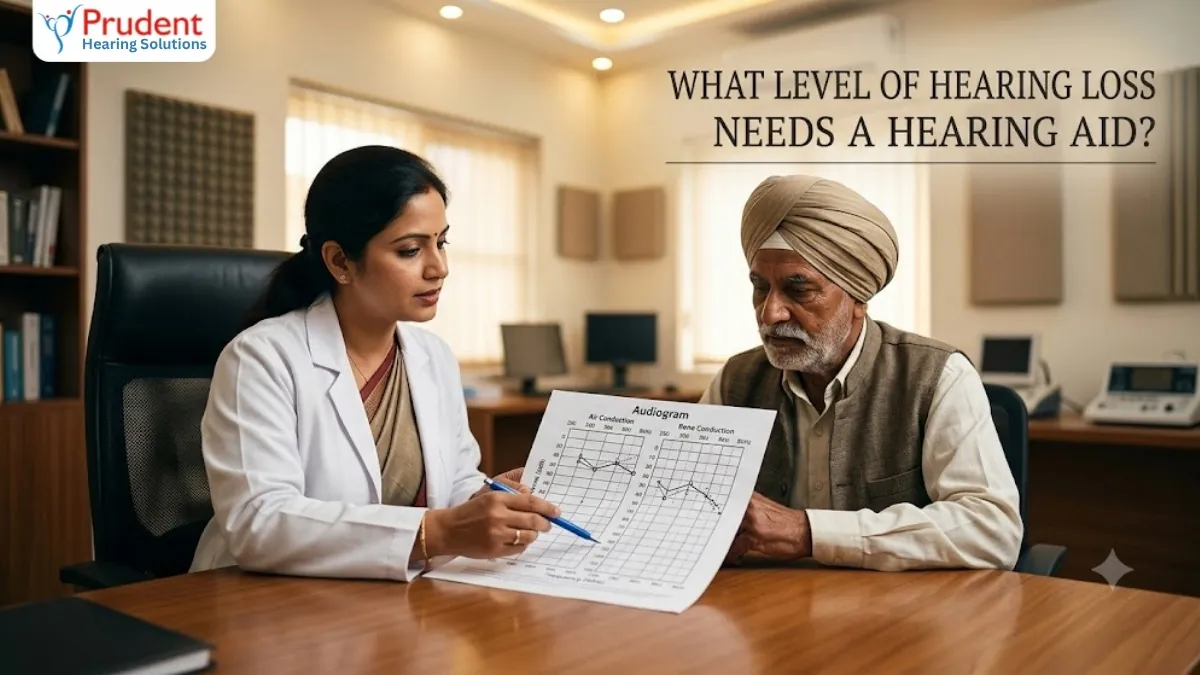
The standard test is pure tone audiometry, and it is quick and completely painless. Here is what a PTA test involves.
Where Prudent Hearing Solutions fits in
We have been fitting and testing since 2004, with RCI-registered audiologists at our clinics in Pune (Viman Nagar), Delhi (Rohini and Green Park) and Bengaluru (Jayanagar). The hearing test is free and takes about 45 minutes, and you will get a clear explanation of your audiogram rather than a sales pitch.
If a hearing aid is genuinely needed, you can trial it before buying, hearing aids are GST-exempt in India, we offer up to 30-50% off MRP, 0% EMI is available, and lifetime programming is free. Details are on our pricing page. If your ears are healthy, we will tell you that and send you home. That is the outcome we prefer.
Book a free hearing test, find your nearest clinic on our locations page, or call +91 9429690093. Protecting hearing costs almost nothing. Replacing it is not possible.
Continue reading
Frequently asked questions
Can hearing loss caused by noise be reversed?
No. Once the hair cells in the inner ear are damaged by noise, they do not regrow, and no oil, supplement, exercise or device restores them. A hearing aid manages the loss by making sound clearer and easier to follow, but it does not cure it. This is exactly why prevention matters so much: the ears you protect today are the ears you keep.
How loud is too loud in everyday Indian settings?
Use the arm's-length test. If you have to raise your voice to be heard by someone standing an arm's length away, the noise is loud enough to cause damage over time. That is usually true right in front of DJ speakers, next to dhol players, beside a running generator, and on many factory floors.
My ears rang after a wedding but it went away by morning. Is that a problem?
Yes, treat it as a warning. That is a temporary threshold shift, and it means your inner ear was pushed past its safe limit. It recovered this time, but repeated episodes accumulate and eventually the ringing or muffling stops going away. Change how you stand and how long you stay near speakers.
Do noise-cancelling headphones protect hearing or harm it?
They usually protect it, because they remove the background roar of traffic, trains and flights. Without that roar, you naturally listen at a much lower volume instead of pushing it up to compete. The protection comes from the lower volume you end up using, so stick to roughly 60% of maximum and try to keep total listening near an hour a day.
Should I stop a medicine if I think it is affecting my hearing?
Never stop a prescribed medicine on your own. Some antibiotics, chemotherapy drugs and very high-dose painkillers can affect hearing, but the doctor prescribing them is weighing that against a condition that may be far more serious. Report new ringing or hearing change to the prescribing doctor promptly and let them decide.
Who should get a hearing test even if hearing feels normal?
Anyone above 50, anyone working in noise, and anyone with diabetes or high blood pressure should get a baseline test. So should people on long-term medication and children with delayed speech or school difficulty. A baseline gives the audiologist something to compare against later, which is how change gets caught early. Our 45-minute test is free at all clinics.
Free consultation
Ready to hear the difference?
Book a free 45-minute hearing test at any Prudent Hearing clinic: no obligation, honest advice, expert audiologists.