Educational information, not medical advice. This article is written to help you understand common ear and hearing issues. It is not a substitute for professional diagnosis or treatment. If your symptoms are severe, sudden, or persistent, please consult a qualified doctor or audiologist. For urgent symptoms (sudden hearing loss, bleeding from the ear, severe pain with dizziness, or a head injury), seek medical care the same day.
Pure tone audiometry (PTA) is the standard hearing test: soft beeps through headphones, plotted on an audiogram. Here is how it works, what air and bone conduction reveal, how the Weber and Rinne tuning-fork tests fit in, and how to read your result.
Quick answer
Pure tone audiometry (PTA) is the standard hearing test. You wear headphones and respond each time you hear a soft beep, across pitches from 250 to 8,000 Hz, and a bone vibrator then checks the inner ear directly. The softest level you hear at each pitch is plotted on an audiogram. It is painless, takes about 30 to 45 minutes, and shows the type and degree of any hearing loss.
Key takeaways
- PTA measures the softest sound you can hear at each pitch, in each ear.
- Air conduction (headphones) plus bone conduction (a vibrator) reveal whether a loss is conductive, sensorineural or mixed.
- It is painless and takes roughly 30 to 45 minutes.
- Results are plotted on an audiogram in dB HL; 0–25 dB is normal adult hearing.
- A baseline PTA is worth having by age 50, or sooner if you struggle to hear in noise.
PTA full form: Pure Tone Audiometry. PTA is the standard hearing test that finds the softest beep you can hear at each pitch, one ear at a time, and plots the result on a graph called an audiogram. On some reports PTA also stands for pure tone average, a single number per ear; our PTA symbols and audiogram chart guide explains both.
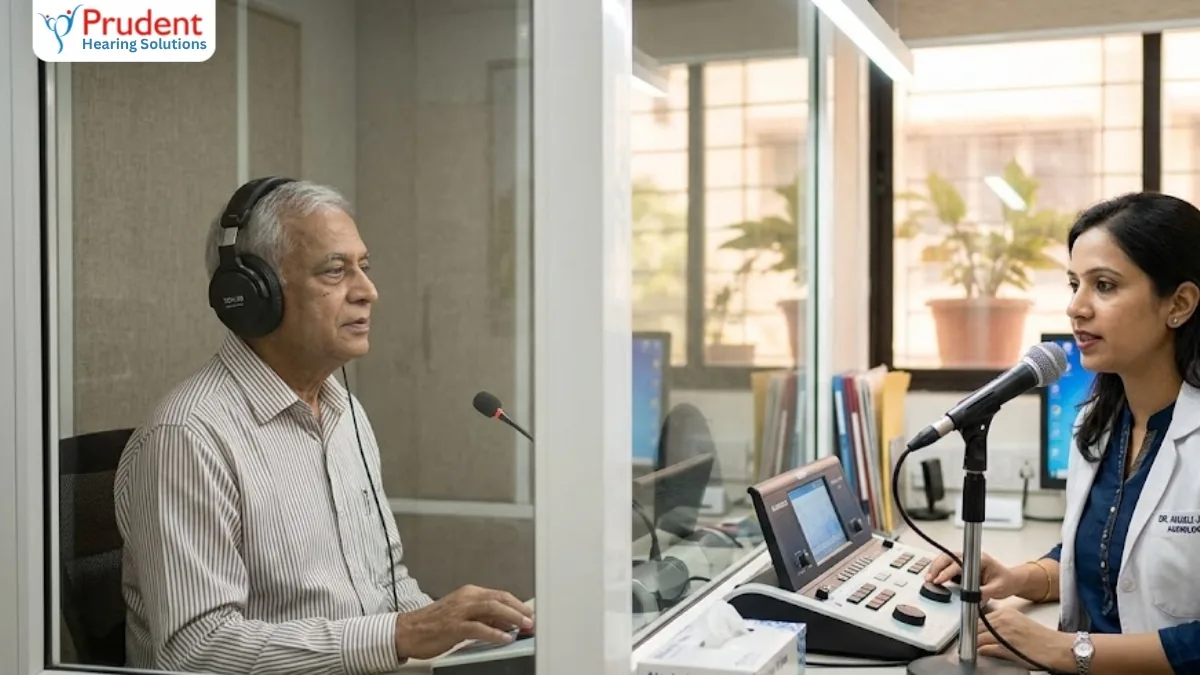
If your ears feel muffled, you keep asking people to repeat themselves, or a doctor has suggested a hearing test, pure tone audiometry is the test you will most likely be given. Pure tone audiometry (PTA) is the standard hearing test: you sit in a quiet, sound-treated room, wear a set of headphones, and press a button each time you hear a soft beep at a different pitch.
It is painless, usually takes about 20 to 30 minutes, and the results are drawn onto a simple chart called an audiogram that shows how well each ear hears. At Prudent, this assessment is free and we set aside about 45 minutes, so there is time to test carefully and explain the result to you.
What is pure tone audiometry (PTA)?
PTA stands for Pure Tone Audiometry. The "pure tone" part refers to the type of sound used: a clean, single-pitch beep, more like a steady note than speech or music. During the test an audiologist plays these tones across a range of pitches, from low, rumbly sounds to high, whistly ones, and gradually makes each one softer until they find the quietest level you can just hear.
That quietest level is your hearing threshold for that pitch. Because it measures each ear separately and across the speech range, PTA gives a fuller picture than a quick conversation or a phone screening app. If you want a sense of the price and what is included, we cover that in audiometry test cost in India.
How the PTA test works, step by step
- You sit in a quiet, sound-treated room so background noise cannot affect the result.
- You wear headphones over your ears, or small soft foam inserts inside them.
- The audiologist plays soft beeps at different pitches, testing one ear at a time.
- You press a button, raise your hand, or say "yes" every time you hear a tone, even a very faint one.
- A small vibrating device is then rested on the bone behind your ear to test bone conduction.
- Every response is marked on your audiogram to map your hearing threshold at each pitch.
There are no needles, no dyes, and nothing that hurts. The trickiest part for most people is resisting the urge to press the button when they only think a beep might be coming. The whole thing usually takes 20 to 30 minutes. Children, older adults, and people who find sitting still difficult can all do it, and the method is simply adjusted to suit them; for very young children, play-based versions are used. You do not need to fast beforehand or stop any of your medicines.
Air conduction vs bone conduction
PTA measures your hearing in two ways, and the difference between them is what makes it so useful. Air conduction uses the headphones and sends sound the normal route: down the ear canal, through the eardrum and the tiny middle-ear bones, into the inner ear. Bone conduction uses the small vibrator behind your ear, which bypasses the ear canal and middle ear and stimulates the inner ear directly.
If your bone conduction is normal but air conduction is reduced, the issue tends to sit in the outer or middle ear, a conductive loss (often linked to wax, fluid, or an infection). If both are reduced together, the loss is usually sensorineural, in the inner ear or hearing nerve. This is how an audiologist tells the two apart, and you can read more in types and causes of hearing loss.
Weber and Rinne: the tuning fork tests
Before the full PTA, a doctor or audiologist may do two quick bedside checks with a tuning fork, a small metal instrument that hums when tapped. These are the Weber and Rinne tests. They take seconds and need no machine, so they are handy as a first screen, but they only give a rough impression. They cannot measure how much hearing you have lost or plot an audiogram, which is why pure tone audiometry remains the fuller test.
- Weber test: the humming fork is placed in the middle of your forehead. If the sound seems louder in one ear, that gives a hint about the type of loss (with a conductive loss the sound tends to move toward the poorer ear; with a sensorineural loss it tends to move toward the better ear).
- Rinne test: the fork is held first on the bone behind your ear, then beside your ear, to compare which is louder. Normally the sound beside the ear is louder; if the bone is louder, it can suggest a conductive problem.
- Both are screening tools only: useful clues, not a measurement and not a diagnosis on their own.
What your audiogram shows
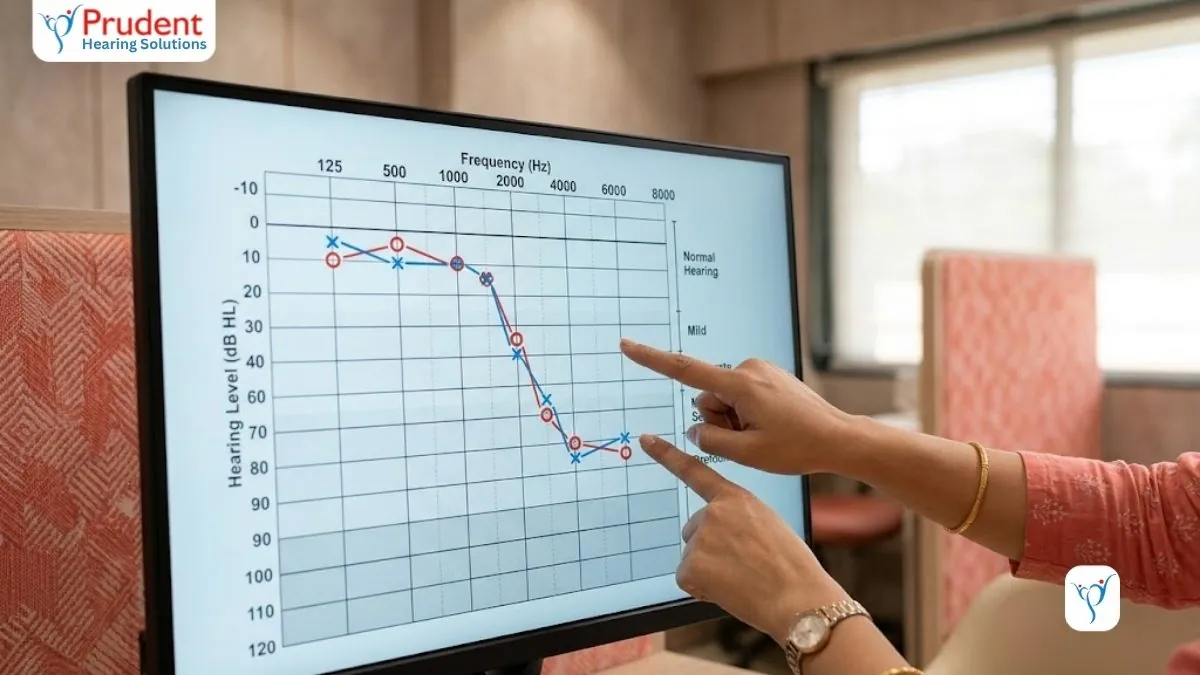
The result of a PTA is a graph called an audiogram, and two things are plotted on it: loudness and pitch. Loudness is measured in decibels (dB) up the side of the chart, with quiet sounds near the top and loud sounds lower down.
Pitch, or frequency, is measured in hertz (Hz) across the bottom, with low pitches (a bass drum, a deep voice) on the left and high pitches (a bird, a doorbell, the soft "s" and "th" sounds in speech) on the right; you can see how the ear picks up this range in how hearing works and the parts of the ear.
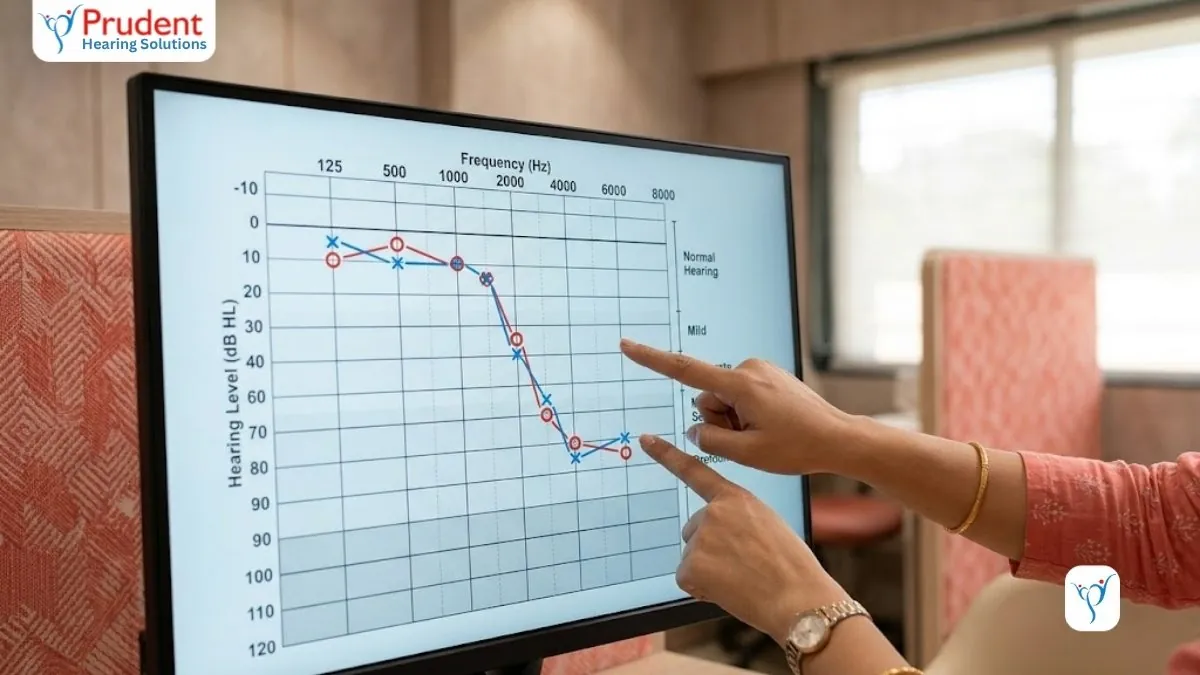
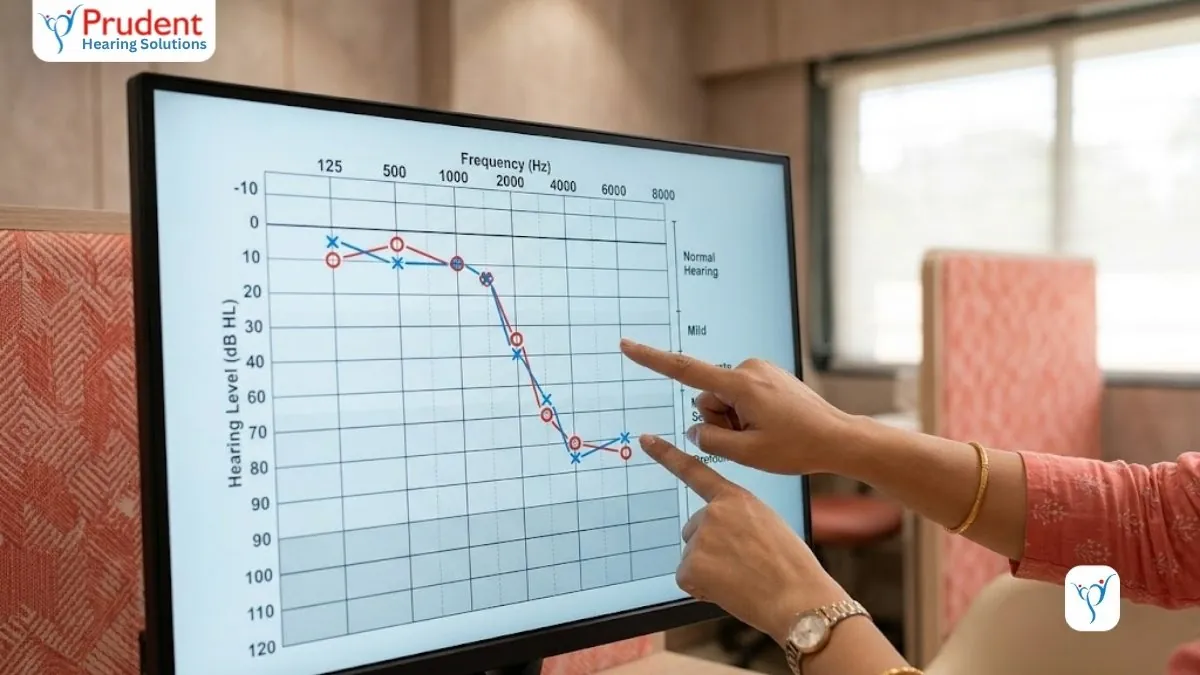
Your thresholds are marked with symbols, usually an "O" for the right ear and an "X" for the left. The lower the marks sit, the louder a sound has to be before you hear it. We walk through a real chart symbol by symbol in understanding your audiogram.
- Marks near the top of the chart (roughly 0 to 25 dB) mean hearing in the normal range.
- Marks that sit lower show the degree of loss, described as mild, moderate, severe, or profound.
- A dip mainly on the right side of the chart is a high-frequency loss, common with age and noise, and it can make speech sound mumbled even when it seems loud enough.
- A gap between the air conduction and bone conduction marks points to a conductive component that a doctor may be able to treat.
Who should have a PTA test?
- Anyone noticing the everyday signs you need a hearing test: asking people to repeat themselves, or turning the TV up louder than others prefer.
- You struggle to follow conversation in noisy places like restaurants or family gatherings.
- You have constant ringing or buzzing in your ears (tinnitus), which often travels alongside hearing loss.
- You work around loud machinery, use earphones at high volume, or have had heavy noise exposure.
- You are over 60, or a parent wondering about a child's speech, responses, or school performance.
- A doctor has asked for a baseline hearing test, or one is needed before fitting a hearing aid.
When to see a doctor
A hearing test measures hearing; it does not treat the cause behind it. Prudent is an audiology clinic, so anything that needs medicine or surgery is something we will refer to an ENT doctor. Our role is to measure any effect on your hearing and, if a loss remains, to help with hearing-aid and rehabilitation solutions. Most hearing changes are not emergencies, but a few warning signs deserve prompt medical attention. See a doctor without delay if you notice any of the red flags below.
- Sudden hearing loss in one or both ears, especially over hours or a single day. This should be treated as urgent, so see a doctor the same day, and read sudden or noise-induced hearing loss.
- Ear pain, discharge, fever, or a blocked feeling that follows a cold or infection.
- Hearing loss in only one ear, or a hearing change that comes with dizziness, spinning, or weakness on one side of the face.
- Ringing in one ear only, or any hearing change after a head injury.
"A hearing test is not a verdict, it is information. Knowing what your ears can and cannot hear is simply the first step toward hearing more of the life around you."
PTA and impedance (PTA + IA): why both are often done
Many ENT doctors order PTA together with an impedance test, written on reports as "PTA + IA" or "PTA with impedance". PTA measures how well you hear. Impedance (tympanometry) checks how your eardrum and middle ear move. Done together, they show whether a hearing loss comes from the middle ear, such as fluid or a stiff eardrum, or from the inner ear and nerve. See what tympanometry checks, and how impedance results appear on a report in our PTA chart guide.
Booking a PTA test at Prudent
Pure tone audiometry is the core of what we do. A qualified audiologist runs the full test, air and bone conduction, in a sound-treated room, then explains your audiogram in plain language the same day. The assessment is free and takes about 45 minutes, with clinics in Pune, Delhi and Bengaluru. If the result points to something that needs medical or surgical care, we will guide you to an ENT doctor.
If it shows a hearing loss that a device can help with, we can talk through the options, keeping in mind that hearing aids manage hearing loss rather than cure it, though for the right person they can make a genuine difference. There is never any pressure to buy. Book your free hearing test, or contact us to ask a question first, and if you are already exploring devices, see our range of hearing aids and current prices.
Continue reading
- speech audiometry: hearing vs understanding
- newborn hearing screening (OAE and BERA)
- Audiometry test cost in India
- Understanding your audiogram
- Signs you need a hearing test
- Types and causes of hearing loss
- Sudden and noise-induced hearing loss
- Human hearing range and parts of the ear
- What your dB level means for hearing aids
- what every PTA symbol means
Frequently asked questions
What is the full form of PTA in a hearing test?
PTA stands for Pure Tone Audiometry. It is the standard hearing test in which you listen to soft, single-pitch beeps (pure tones) through headphones and respond each time you hear one. The results map the quietest sound you can hear at each pitch and are plotted on a chart called an audiogram.
How long does a pure tone audiometry test take?
The test itself usually takes about 20 to 30 minutes for both ears, including air and bone conduction. At Prudent, we set aside about 45 minutes for the free assessment so there is time to test carefully and then explain your audiogram to you the same day.
Is the pure tone audiometry test painful?
No. PTA is completely painless. You simply wear headphones, listen for soft beeps, and respond when you hear one. A small vibrating device rests on the bone behind your ear for the bone-conduction part, which feels like a gentle buzz. There are no needles and nothing that hurts, so it is comfortable for children and older adults alike.
What is a normal PTA test result?
Hearing is generally considered normal when your thresholds sit within roughly 0 to 25 dB across the tested pitches, meaning you can hear soft sounds in both the low and high ranges. Marks that sit lower on the audiogram indicate mild, moderate, severe, or profound loss. Your audiologist will explain exactly what your own chart means.
What is the difference between the Weber and Rinne tuning fork tests?
Both use a humming tuning fork as a quick screen. The Weber test places the fork on the middle of the forehead to see whether the sound leans to one ear. The Rinne test compares sound behind the ear (bone) with sound beside the ear (air). They give a rough clue about the type of loss but cannot measure it, which is why pure tone audiometry is used for a fuller assessment.
How much does a PTA hearing test cost in India?
Prices vary by clinic and city, and a basic PTA is generally affordable. At Prudent the hearing test is free and takes about 45 minutes. For a fuller breakdown of what different tests cost and what is included, see our guide to audiometry test cost in India.
What is PTA with impedance (PTA + IA)?
It means pure tone audiometry and an impedance test (tympanometry) done in the same visit. PTA measures how well you hear at each pitch; impedance checks how the eardrum and middle ear move. Together they show whether a hearing loss comes from the middle ear, such as fluid or a stiff eardrum, or from the inner ear and nerve.
Sources & further reading
We cross-checked this article against the following authoritative sources. Guidance and figures reflect the most recent public guidance available at the time of last review (October 2026). Clinical review by the Prudent Hearing clinical team.
- Understanding your audiogram (American Speech-Language-Hearing Association (ASHA))
- Hearing tests (NHS UK)
- Deafness and hearing loss (World Health Organization (WHO))
Free consultation
Ready to hear the difference?
Book a free 45-minute hearing test at any Prudent Hearing clinic: no obligation, honest advice, expert audiologists.