Educational information, not medical advice. This article is written to help you understand common ear and hearing issues. It is not a substitute for professional diagnosis or treatment. If your symptoms are severe, sudden, or persistent, please consult a qualified doctor or audiologist. For urgent symptoms (sudden hearing loss, bleeding from the ear, severe pain with dizziness, or a head injury), seek medical care the same day.
Hearing aids are usually advised from mild loss (26 dB HL) onward, if it affects daily life. Here is what each audiogram level means in India, and what else decides.
Quick answer
Hearing aids are usually advised from mild loss (about 26 dB HL and above) once it affects daily life: following conversation in noise, phone calls, TV or work. Moderate loss (41 to 55 dB) almost always benefits, and severe-to-profound loss needs powerful aids or, in some cases, a cochlear implant. The audiogram number alone does not decide it; your lifestyle and difficulty matter as much.
Key takeaways
- Normal hearing is 0 to 25 dB HL; an aid is usually considered from ~26 dB (mild) upward.
- Moderate loss (41 to 55 dB) almost always benefits from hearing aids.
- Severe-to-profound loss needs power aids or, sometimes, a cochlear implant.
- The number alone does not decide it: daily difficulty and lifestyle count as much.
- Waiting has a cost: untreated loss is linked to isolation and faster cognitive decline.
The short, honest answer: hearing aids are usually recommended from mild hearing loss onward, roughly 26 dB HL and above, but only if that loss is actually getting in the way of your day. The number on your audiogram is where the conversation starts, not where it ends.
We have fitted people with 30 dB loss who genuinely needed help, and we have told people with the same 30 dB reading to come back in a year. Same graph, different lives, different advice. This guide explains the dB HL scale, what each level feels like in real Indian daily life, and the four things that matter as much as the number itself.
| Your hearing level | dB HL | Is a hearing aid usually recommended? |
|---|---|---|
| Normal | 0–25 | Usually not; if you still struggle, we check speech-in-noise, wax and other causes |
| Mild | 26–40 | Worth a trial if daily life is affected; otherwise retest in 6–12 months |
| Moderate | 41–55 | Almost always, in both ears if both are affected |
| Moderately severe | 56–70 | Yes |
| Severe | 71–90 | Yes, usually high-power aids |
| Profound | 91 and above | High-power aids, plus an ENT discussion about implant options |
First, what the dB HL scale actually means
A hearing test plots the softest sound you can detect at each pitch, in decibels Hearing Level (dB HL). Zero is not silence. It is roughly the softest sound a young, healthy ear detects. So a higher number means a worse result: 60 dB HL means sound has to be quite loud before you register it at all.
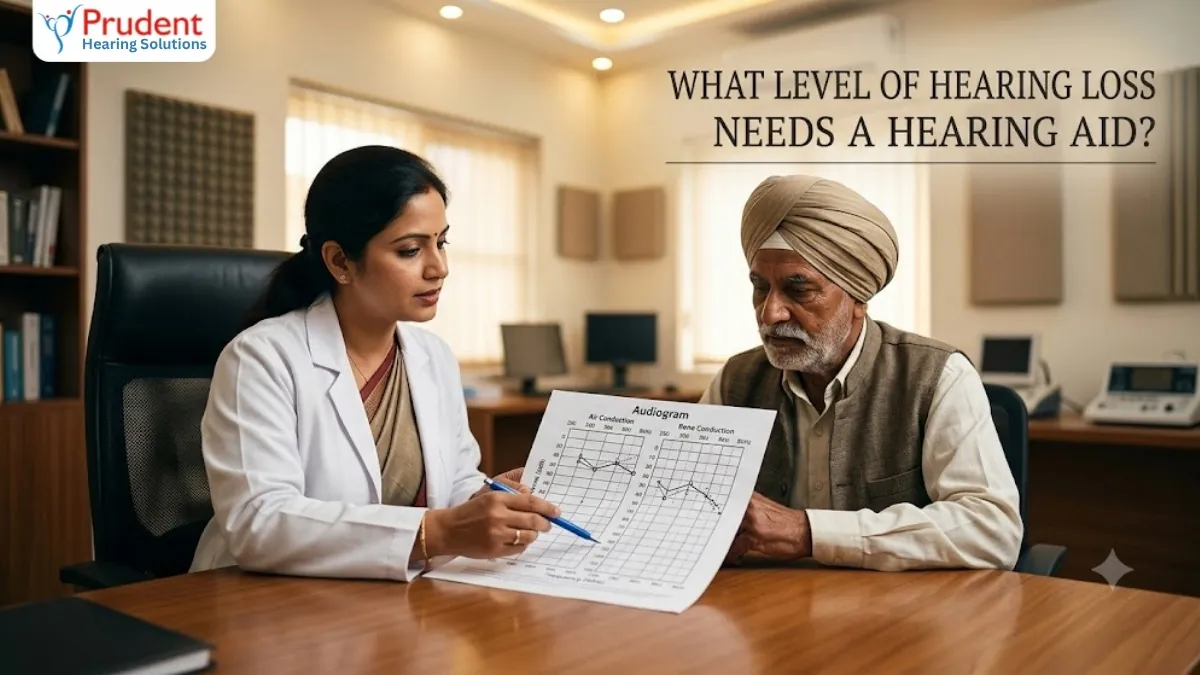
Your audiologist averages your thresholds across the speech frequencies to place you in a category. The standard adult categories are (classifications vary slightly between clinics):
- Normal: up to about 25 dB HL. You hear soft speech, a clock, a whisper across the room.
- Mild: 26 to 40 dB HL. Detection is mostly fine. Clarity is not.
- Moderate: 41 to 55 dB HL. Normal conversation at normal volume starts slipping away.
- Moderately severe: 56 to 70 dB HL. Even raised voices are hard work.
- Severe: 71 to 90 dB HL. Only loud speech close to the ear registers.
- Profound: 91 dB HL and above. Very little usable hearing without help.
One important exception: these categories are for adults. Children are aided at much lower levels, because even a slight or one-sided loss can hold back speech and schooling while the brain is still learning language. Any suspected hearing loss in a child needs prompt assessment by an audiologist and an ENT, never a wait-and-watch approach. See signs of hearing loss in children.
If you already have a report in hand and the symbols and lines mean nothing to you, our walkthrough on understanding your audiogram explains every mark on it. The test itself is described in our guide to pure tone audiometry.
What each level feels like in real life
Mild loss (26–40 dB)
This is the sneaky one. You hear that people are speaking. You just miss what they said. Soft consonants go first: s, f, th, k, sh. "Saat" and "aath" start sounding alike. You manage one-to-one at home but a restaurant in Viman Nagar, a wedding, or a crowded office cabin leaves you exhausted. You turn the TV up and someone in the family complains. Children's voices and female voices become harder than male voices. Most people call this "a little problem" for years before they act.
Moderate loss (41–55 dB)
Now ordinary conversation at ordinary volume is genuinely missed. You ask for repeats several times a day. Phone calls become stressful. You stop contributing in meetings because by the time you work out what was said, the topic has moved. Family members start speaking for you. At this level, almost everyone benefits from amplification.
Moderately severe to severe (56–90 dB)
People have to raise their voice for you to follow anything, and even then only in a quiet room. Doorbells, pressure cookers, autorickshaw horns behind you: these get missed, and that is a safety issue, not just a social one. Hearing aids here are not optional comfort; they are the difference between participating and withdrawing.
Profound loss (91 dB and above)
Very little speech comes through by sound alone. Lip-reading, gestures and written notes carry most of the conversation. Powerful hearing aids may still help some people at this level, but this is also the point where a cochlear implant discussion becomes relevant. That is an ENT and audiology decision together, not a shop decision.
So why does the number alone not decide it?
Because hearing is not just detection. Two people can have identical audiograms and need completely different things. Here is what we weigh alongside the number.
1. Your speech discrimination score
This is the single most under-discussed part of a hearing test. Alongside tones, we check how many words you repeat back correctly when they are made comfortably loud for you. That is your speech discrimination: clarity, not volume. Someone with mild loss but poor discrimination struggles far more than someone with moderate loss and excellent discrimination. It also tells us how much benefit to honestly expect from a hearing aid, because a hearing aid can make sound louder; it cannot rebuild a damaged inner ear.
2. One ear or both
A loss in one ear only is a different problem. Even with one perfect ear, you lose the ability to tell where sound is coming from, and noisy places become very hard. It also needs medical attention first, because one-sided loss can point to a cause that must be investigated. Solutions differ too. See single-sided deafness and CROS/BiCROS options.
3. What your day demands of your ears
A schoolteacher, a lawyer, a call-centre or BPO employee, a shopkeeper, a doctor: these people need help at 30 dB. A retired person who lives quietly with family, watches TV with subtitles and does not travel much may be comfortable at the same 30 dB for a while longer. Listening demand is a real clinical factor, not a sales pitch.
4. How long it has been there
A loss that came on gradually over ten years and one that appeared last month are handled very differently. Sudden hearing loss is a medical emergency: see an ENT the same day, not an audiologist next week. The same applies if there is ear pain, discharge, blood, spinning dizziness, or loss in one ear only.
"We do not fit a hearing aid to an audiogram. We fit it to a person who has to get through a particular kind of day."
When a hearing aid is not the right answer at all
This matters, and some sellers skip it. If your loss is conductive, meaning sound is being blocked on its way in rather than the inner ear being damaged, the correct first step is medical, not commercial. Common causes include:
- Impacted ear wax. Removal can restore hearing straight away. Nothing to buy.
- Fluid behind the eardrum, often after a cold or a middle ear infection, which frequently settles with treatment.
- A perforated eardrum, which may heal on its own or need repair.
- Otosclerosis, a fixation of the tiny middle ear bones, where surgery is a genuine alternative. We compare both routes in otosclerosis: surgery or hearing aids.
- Chronic ear infection or discharge, which must be treated before anything is placed in the ear.
A proper test tells us whether your loss is conductive, sensorineural or mixed. If it is conductive, we will say so and refer you to an ENT. Selling a hearing aid to someone whose real problem is treatable is not a service.
Why waiting has a cost
People routinely wait years, and the usual reasoning is "it is not that bad yet." Two things are worth knowing honestly.
First, the hearing pathway needs practice. When the brain stops receiving certain speech sounds for a long stretch, understanding those sounds gets harder even after amplification is provided later. The ear is only half the system; the brain has to keep hearing to stay good at hearing. This is why the same aid gives a smoother result at 40 dB than it does after ten more years of avoidance.
Second, research consistently associates untreated hearing loss in adults with a higher risk of cognitive decline. The mechanism is still being studied and nobody should promise that a hearing aid prevents dementia. It does not. But straining to follow every conversation, and slowly withdrawing from conversations altogether, is not neutral. We cover what is and is not established in the hearing loss and cognitive decline link.
And to be completely clear, because plenty of advertising is not: a hearing aid manages hearing loss. It does not cure or reverse it. No oil, supplement, exercise, diet or device restores a damaged inner ear.
The practical answer for you
Get tested if you are asking the question at all. That instinct is usually right. Most of the early signs are noticed by the person long before the audiogram confirms them. Then, roughly:
- Normal result but real difficulty: we look at speech-in-noise, wax, and other causes before recommending anything.
- Mild: a hearing aid is worth trialling if daily life is affected. If it is not, we can monitor and retest in six to twelve months.
- Moderate onwards: amplification is almost always recommended, in both ears if both are affected.
- Severe to profound: high-power devices, and a parallel ENT discussion about implant options.
At Prudent Hearing Solutions, our RCI-registered audiologists have been doing this since 2004, across Pune (Viman Nagar), Delhi (Rohini and Green Park) and Bengaluru (Jayanagar). The hearing test is free and takes about 45 minutes, and we will tell you plainly if you do not need a device yet. If you do, you trial it before you buy, hearing aids are GST-exempt in India, 0% EMI is available, and programming is free for life. See pricing for current options, or call +91 9429690093.
The audiogram is the starting point, not the verdict. The verdict comes from the graph plus a proper conversation about your life.
Continue reading
Frequently asked questions
At how many decibels do you need a hearing aid?
Hearing aids are typically considered from about 26 dB HL onward, which is the start of mild hearing loss. But the number alone does not decide it. If a mild loss is not affecting your work, family conversations or safety, your audiologist may suggest monitoring and retesting in six to twelve months instead. From moderate loss (41 dB HL and above) upwards, amplification is recommended for almost everyone. These thresholds apply to adults. Children are aided at much lower levels and need prompt assessment rather than monitoring.
Can two people with the same audiogram get different advice?
Yes, and it happens often. A teacher or a call-centre employee with 35 dB loss needs help far earlier than a retired person in a quiet home with the identical reading. Speech discrimination score, whether one or both ears are affected, and how long the loss has been present all change the recommendation.
What is a speech discrimination score and why does it matter more than the audiogram?
It measures how many words you repeat back correctly when speech is made comfortably loud for you. It tests clarity, not volume. Poor discrimination with a mild loss can cause more real-world difficulty than good discrimination with a moderate loss, and it helps your audiologist set honest expectations about how much a hearing aid will help.
Is a hearing aid always the answer for hearing loss?
No. Conductive losses caused by impacted wax, fluid behind the eardrum, a perforation, chronic infection or otosclerosis may be medically or surgically treatable. Those need an ENT, not a hearing aid shop. A proper test identifies whether your loss is conductive, sensorineural or mixed before any device is discussed.
Will a hearing aid restore or cure my hearing?
No. A hearing aid manages hearing loss by amplifying and shaping sound for your specific loss. It does not repair a damaged inner ear, and no oil, supplement, diet or exercise reverses sensorineural hearing loss. What a well-fitted aid does is make speech accessible again so your brain keeps getting the input it needs.
Does a free hearing test in India mean pressure to buy?
It should not. At Prudent Hearing Solutions the 45-minute test is free, and if your result does not warrant a device we will say so and tell you when to retest. If a device is appropriate, you trial it before buying. You can book at our Pune, Delhi or Bengaluru clinics or call +91 9429690093.
Sources & further reading
We cross-checked this article against the following authoritative sources. Guidance and figures reflect the most recent public guidance available at the time of last review (October 2026). Clinical review by the Prudent Hearing clinical team.
- Deafness and hearing loss (World Health Organization (WHO))
- Understanding your audiogram (American Speech-Language-Hearing Association (ASHA))
- Hearing Aids (National Institute on Deafness and Other Communication Disorders (NIDCD, NIH))
Free consultation
Ready to hear the difference?
Book a free 45-minute hearing test at any Prudent Hearing clinic: no obligation, honest advice, expert audiologists.