Educational information, not medical advice. This article is written to help you understand common ear and hearing issues. It is not a substitute for professional diagnosis or treatment. If your symptoms are severe, sudden, or persistent, please consult a qualified doctor or audiologist. For urgent symptoms (sudden hearing loss, bleeding from the ear, severe pain with dizziness, or a head injury), seek medical care the same day.
Hearing aid vs cochlear implant: one amplifies sound, the other bypasses damaged hair cells with surgery. How they differ, who qualifies for an implant, what each costs in India and the ADIP help for children.
Quick answer
A hearing aid amplifies sound for the hair cells that still work; a cochlear implant is placed in an operation and bypasses damaged hair cells to stimulate the hearing nerve directly. Hearing aids suit most mild to severe hearing loss. An implant is considered for severe to profound loss when well-fitted aids still give poor speech understanding. In India an implant costs about ₹6 to 15 lakh per ear.
Key takeaways
- Hearing aids need no surgery and can be tried first; an implant needs an operation and months of tuning and listening practice.
- UK NICE guidance treats adults as candidates when they hear only sounds louder than 80 dB HL at two or more frequencies in both ears and score under 50% on a word test with aids.
- Try properly fitted power hearing aids for at least three months before an implant decision.
- An implant costs roughly ₹6 to 15 lakh per ear in India, all-inclusive; a replacement processor costs about ₹3 to 7 lakh.
- ADIP pays up to ₹7 lakh per implant for eligible children aged 1 to 5, and up to ₹6 lakh for ages 5 to 18 with acquired loss.
A hearing aid makes sound louder so the hair cells still working in your inner ear can pick it up. A cochlear implant is placed in an operation and bypasses damaged hair cells to stimulate the hearing nerve directly. Hearing aids suit most people with mild to severe hearing loss. An implant is considered when the loss is severe to profound and well-fitted hearing aids still leave you understanding little speech.
If someone has told you that a hearing aid "might not be enough" and mentioned a cochlear implant, it is natural to feel unsettled. These are two different tools for two different situations. Neither is better in a general sense: the right one depends on the type and degree of your hearing loss, which an audiologist works out with you after a full hearing test.
What a hearing aid actually does
A hearing aid amplifies sound. It picks up the sounds around you through a tiny microphone, processes them, and delivers them into your ear canal a good deal louder and clearer than they arrived.
The key point is that a hearing aid relies on your inner ear still being able to do its job. Deep inside the cochlea sit thousands of tiny hair cells that convert sound vibrations into signals your brain can read. A hearing aid makes the sound loud enough for those remaining hair cells to respond. If enough of them are working, amplification can make a real difference to how you follow conversation, hear the doorbell, or enjoy a phone call.
Modern hearing aids do far more than turn the volume up. They can lift speech out of background noise, soften sudden loud sounds, and connect to your phone or television. For most people with mild to moderately severe hearing loss, a well-fitted hearing aid is the first and often the only step needed.
What a cochlear implant does differently
A cochlear implant works on a different principle. Instead of making sound louder for damaged hair cells, it bypasses those cells entirely and stimulates the hearing nerve directly.
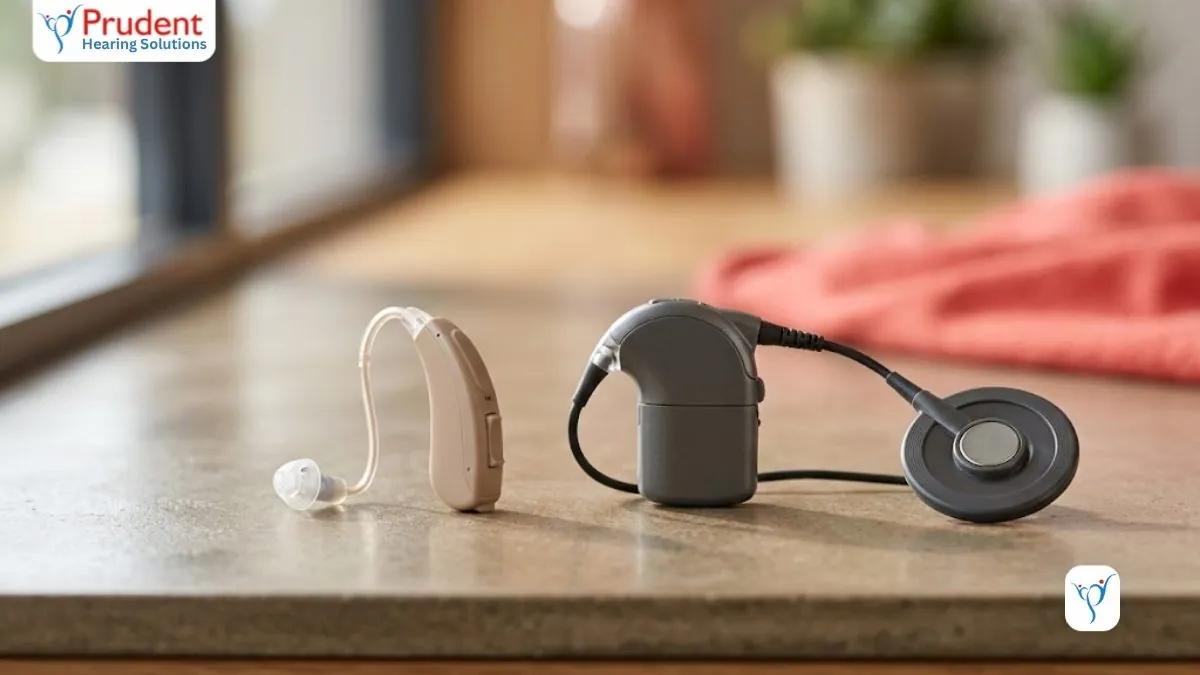
It has two parts. An external processor sits behind the ear and captures sound, much like a hearing aid does. But rather than sending amplified sound into the ear canal, it passes signals across the skin to an internal component that has been surgically placed. A slim array of electrodes, threaded into the cochlea during the operation, then stimulates the hearing nerve so that signals reach the brain.
So the comparison in cochlear implant vs hearing aid terms comes down to this. A hearing aid amplifies. A cochlear implant surgically bypasses the damaged part of the system. That single difference explains almost everything else, including why an implant needs an operation and why it is not offered to everyone.
Hearing aid vs cochlear implant at a glance
| Hearing aid | Cochlear implant | |
|---|---|---|
| How it works | Amplifies sound for the hair cells that still work | Bypasses damaged hair cells and stimulates the hearing nerve with electrodes |
| Usually suits | Mild to severe hearing loss | Severe to profound loss when aids give too little speech understanding |
| Surgery | None | Yes, followed by a healing period before switch-on |
| Getting used to it | A few weeks of regular wear | Months of tuning sessions and listening practice |
| Can you try it first? | Yes, with a trial at the clinic or at home | No; an implant team decides candidacy after tests |
| Typical cost in India (one ear) | ₹10,990 to about ₹4 lakh MRP, by technology level | About ₹6 to 15 lakh all-inclusive, more for premium models |
| Upkeep | Domes, wax filters and servicing; replaced every five to six years | Regular tuning (mapping); a replacement processor costs about ₹3 to 7 lakh |
When a hearing aid is usually the right choice
For a large majority of people with hearing loss, a hearing aid is the sensible starting point. If your inner ear still has usable function and amplification lets you understand speech reasonably well, there is often no reason to consider anything more involved.
Hearing aids are non-surgical. They can be adjusted, upgraded, and removed at will. You can trial them in the clinic, wear them daily once you buy, and have them fine-tuned as your hearing changes over the years.
Because they are so adaptable, they suit the full range of everyday hearing loss, from the early stages when you are only missing the odd word to more significant loss where you need considerable amplification. The decision is guided by your hearing test results and how well you understand speech when sounds are made louder for you. Our guide to hearing aids for sensorineural hearing loss explains which style suits each degree of loss, and you can start by booking a hearing test.
When a cochlear implant may be considered
A cochlear implant enters the conversation in a narrower set of situations. Broadly, it is considered when hearing loss is severe to profound and when hearing aids, even properly fitted and set to their limits, no longer let you understand speech clearly.
The reason is straightforward. If too many hair cells in the cochlea have stopped working, amplification has little left to amplify. Turning the sound up only makes an unclear signal louder, not clearer. That is the point at which bypassing the hair cells altogether can help.
There are important things to understand about who an implant suits. Candidacy is assessed through a detailed evaluation that looks at your degree of loss, how well you do with hearing aids, the health of your hearing nerve, imaging of the inner ear, and your overall suitability for surgery. A cochlear implant is a clinical decision made by a specialist team. It is not something a person can simply request because they feel their hearing aids are not doing enough.
If you are in this position, the honest next step is a thorough assessment so you understand exactly where your hearing stands. Before an implant decision, make sure you have tried properly fitted power aids; see hearing aids for severe and profound loss.
Who qualifies for a cochlear implant?
India has no single national rule, and each implant team sets its own criteria. A widely used reference is the UK's NICE guidance (TA566). It treats an adult as a candidate when they hear only sounds louder than 80 dB HL at two or more frequencies between 500 and 4,000 Hz in both ears, and score below 50% on a recorded word test even with well-fitted hearing aids.
It also expects a hearing aid trial of at least three months first. For children, the test is whether speech, language and listening are developing as expected for their age.
Your audiogram and a speech audiometry test show where you stand against these numbers. If you are close to them, ask for a referral to an implant team rather than buying more powerful aids.
What a cochlear implant costs in India, and the help available
A cochlear implant for one ear typically costs about ₹6 to 15 lakh in India, covering the device, surgery, hospital stay and initial therapy, and premium implant models cost more. The external processor usually needs replacing after some years, at about ₹3 to 7 lakh. Prices vary by brand, hospital and city, so get written quotes from two or three hospitals that name the implant model and list what the package includes.
For children, the government's ADIP scheme pays up to ₹7 lakh per implant for children aged 1 to 5 whose hearing loss began before they learned to speak, and up to ₹6 lakh for children aged 5 to 18 with acquired loss. That covers the implant, surgery, therapy, mapping, travel and the pre-implant assessment, for families within the scheme's income limit, at empanelled hospitals. Confirm the current terms with the Department of Empowerment of Persons with Disabilities before you apply; our ADIP scheme guide explains the paperwork.
Surgery, recovery and learning to hear again
It helps to be realistic about what an implant involves, because this often weighs on people the most.
There is an operation to place the internal component, followed by a healing period before the external processor is switched on. Then comes a stage that surprises many people. The sound from a cochlear implant is not the same as natural hearing at first. The brain has to learn to make sense of this new kind of signal, and that takes time, patience, and regular sessions with an audiologist to tune the device and support your progress.
A hearing aid, by contrast, asks far less of you upfront. You wear it, you adjust to it over a few weeks, and there is no surgery or recovery. This difference in effort and commitment is one of the real, practical reasons the two are not interchangeable.
See a professional promptly if any of these apply
Whatever device you eventually use, some symptoms should not wait. Please arrange to be seen quickly if you notice a sudden drop in hearing, especially in one ear, as sudden hearing loss can be a medical emergency where early treatment matters. The same applies to hearing loss with ear pain, discharge, or tinnitus that is only in one ear or that pulses in time with your heartbeat.
If ringing or buzzing is part of what you are dealing with, it is worth knowing that hearing devices can sometimes help with the perception of it, and you can read more on our tinnitus management service.
Making the decision with support
You do not have to sort this out alone, and you certainly should not try to self-diagnose which device you need. The comparison between a hearing aid and a cochlear implant only becomes meaningful once your actual hearing has been measured and, where relevant, once you have seen how far amplification can take you.
At Prudent Hearing Solutions, our audiologists carry out a full assessment, talk you through what your results mean in plain language, and explain which options genuinely apply to you. If a cochlear implant referral is appropriate, we help you understand that pathway too.
The most useful thing you can do today is find out where your hearing stands. You can book a hearing test or visit our clinics in Pune, Delhi and Bengaluru.
Continue reading
Frequently asked questions
What is the difference between a hearing aid and a cochlear implant?
A hearing aid amplifies sound so working hair cells can pick it up. A cochlear implant is surgically placed to bypass those hair cells and stimulate the hearing nerve directly. They suit very different degrees of hearing loss.
Is a cochlear implant better than a hearing aid?
Neither is universally better. The right choice depends on the degree and type of your hearing loss and is a clinical decision. Most people with mild-to-moderate loss are well served by hearing aids.
Does a cochlear implant require surgery?
Yes. A cochlear implant involves an operation and meeting candidacy criteria, followed by a period of learning to hear through it. A hearing aid needs no surgery.
Can I simply choose a cochlear implant instead of a hearing aid?
No. Cochlear implants are offered only when hearing aids can no longer give enough benefit and you meet medical candidacy criteria, assessed by a specialist team.
How do I find out which one I need?
Start with a full hearing test. It measures your loss and guides whether a hearing aid is the right step, or whether a referral to consider implant candidacy makes sense.
How much does a cochlear implant cost in India?
About ₹6 to 15 lakh for one ear, all-inclusive of the device, surgery, hospital stay and initial therapy, and more for premium implant models. The external processor usually needs replacing after some years at about ₹3 to 7 lakh. Get written quotes that name the implant model.
Who is a candidate for a cochlear implant?
Usually someone with severe to profound hearing loss in both ears who still understands little speech with well-fitted hearing aids after a proper trial. As a reference, the UK's NICE guidance uses hearing only sounds louder than 80 dB HL at two or more frequencies and a word-test score under 50% with aids. An implant team makes the decision.
Does the government pay for cochlear implants in India?
For children, yes, under the ADIP scheme: up to ₹7 lakh per implant for children aged 1 to 5 with hearing loss from before they learned to speak, and up to ₹6 lakh for ages 5 to 18 with acquired loss, for families within the income limit. Confirm current terms with the Department of Empowerment of Persons with Disabilities before applying.
Sources & further reading
We cross-checked this article against the following authoritative sources. Guidance and figures reflect the most recent public guidance available at the time of last review (October 2026). Clinical review by the Prudent Hearing clinical team.
- Cochlear implants for children and adults with severe to profound deafness (TA566) (National Institute for Health and Care Excellence (NICE), UK)
- Cochlear Implants (NIDCD (NIH))
- ADIP scheme: cochlear implant ceilings for children (₹7 lakh, ages 1-5; ₹6 lakh, ages 5-18) (Department of Empowerment of Persons with Disabilities, Government of Maharashtra)
- Hearing Aids (National Institute on Deafness and Other Communication Disorders (NIDCD, NIH))
Free consultation
Ready to hear the difference?
Book a free 45-minute hearing test at any Prudent Hearing clinic: no obligation, honest advice, expert audiologists.