Educational information, not medical advice. This article is written to help you understand common ear and hearing issues. It is not a substitute for professional diagnosis or treatment. If your symptoms are severe, sudden, or persistent, please consult a qualified doctor or audiologist. For urgent symptoms (sudden hearing loss, bleeding from the ear, severe pain with dizziness, or a head injury), seek medical care the same day.
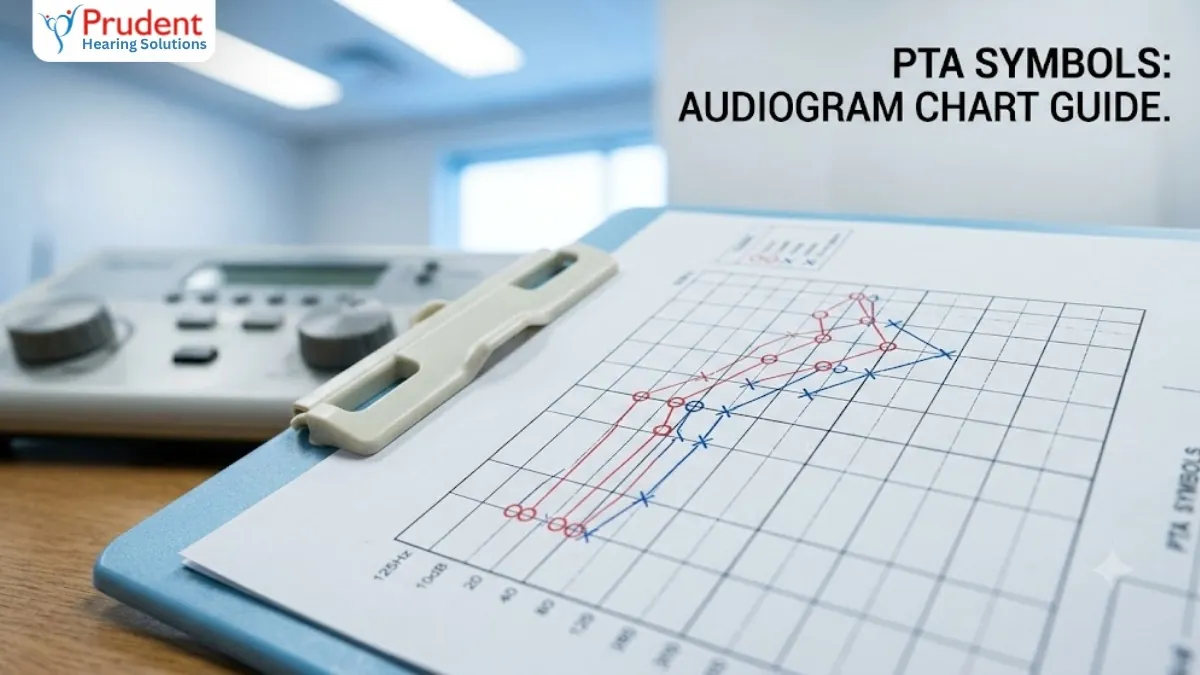
A plain-English decoder for every symbol, colour and abbreviation on a pure tone audiometry chart: O and X, bone conduction brackets, masking symbols, no-response arrows, the air-bone gap and the tympanogram types.
Quick answer
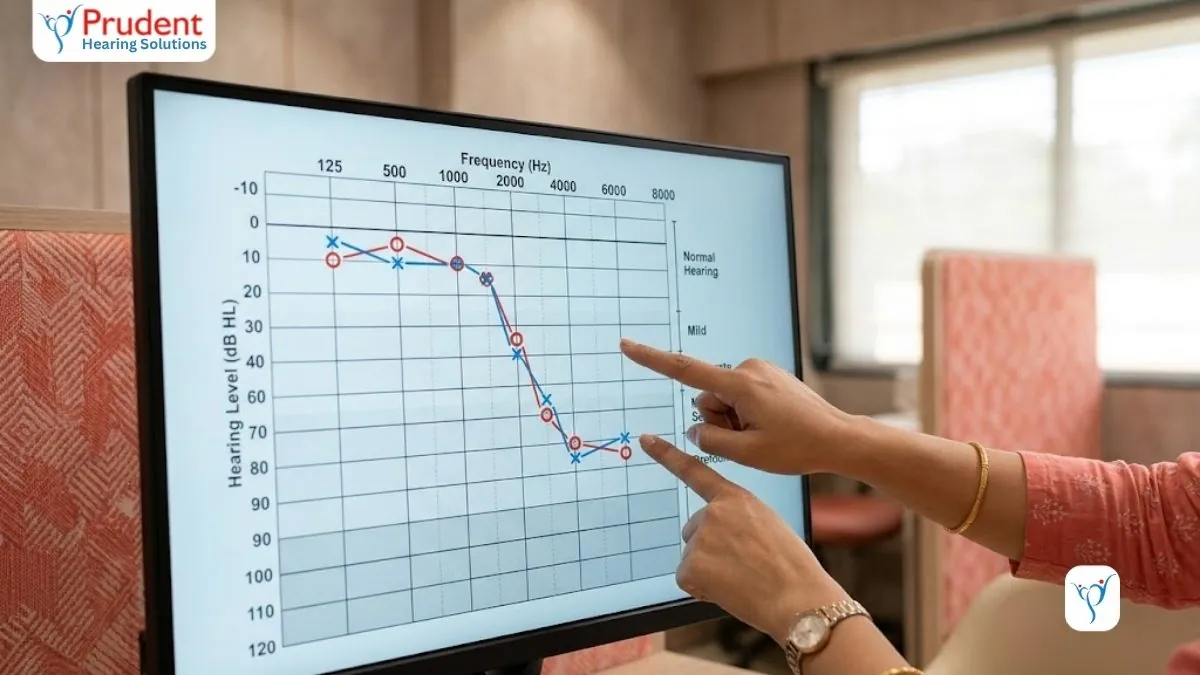
On an audiogram the horizontal axis is pitch (frequency, 250 to 8,000 Hz) and the vertical axis is loudness (dB HL). Right-ear air conduction is a red O, left-ear air conduction a blue X. Bone conduction uses < for the right ear and > for the left, with square brackets when masking is applied. A downward arrow means 'no response': no sound was heard even at the audiometer's loudest.
Key takeaways
- Red = right ear, blue = left ear; O and X are air conduction, < and > are bone conduction.
- The horizontal axis is frequency (250–8,000 Hz); the vertical axis is loudness in dB HL.
- An air–bone gap (bone better than air) points to a conductive, often treatable, loss.
- Downward arrows mean no response at the audiometer's maximum output.
- Masking symbols (brackets, triangles, squares) show the other ear was masked out for an accurate reading.
PTA stands for pure tone audiometry, the hearing test that produces an audiogram. On the chart, frequency in hertz runs across the top and hearing level in decibels (dB HL) runs downward. Right-ear results are red circles (O), left-ear results are blue crosses (X), and bone conduction uses angled brackets.
PTA symbols at a glance
Here is the quick key to the symbols you will see plotted on an audiogram, before we explain each in detail below:
| Symbol | What it means | Usual colour |
|---|---|---|
| O | Right ear, air conduction (headphones) | Red |
| X | Left ear, air conduction | Blue |
| < | Right ear, bone conduction, unmasked | Red |
| > | Left ear, bone conduction, unmasked | Blue |
| [ | Right ear, bone conduction, masked | Red |
| ] | Left ear, bone conduction, masked | Blue |
| △ / ▷ or □ | Masked air conduction, right / left (depends on the clinic's key) | Red / blue |
| ↓ arrow on a symbol | No response: nothing heard even at the machine's loudest output at that pitch | Same as the symbol |
| Gap between O/X and the brackets | Air–bone gap: a real gap points to a conductive (outer or middle ear) component | – |
What is the full form of PTA in medical and ENT reports?
PTA has more than one expansion, and which one applies depends on where you see it. In an audiology or ENT hearing report it almost always means one of the first two below.
- PTA = Pure Tone Audiometry: the behavioural test in which pure tones are presented at set frequencies and the softest level you can just detect is recorded. This is the meaning when a doctor writes "advise PTA" or "PTA + impedance".
- PTA = Pure Tone Average: a single number, usually the average of your thresholds at 500 Hz, 1000 Hz and 2000 Hz in one ear. A report may read "PTA right 42 dB HL". Same three letters, different thing.
- PTA = Peritonsillar Abscess: used in general ENT notes about throat infection (quinsy). If the note mentions dB, Hz or an audiogram, it is audiometry.
How the test itself is carried out is covered in our guide to the pure tone audiometry (PTA) test in India. This page stays on the chart and its symbols.
What do the two axes on an audiogram chart mean?
An audiogram is a threshold graph, not a picture of loudness. Every plotted point is the softest sound you could reliably detect at that pitch, in that ear, by that route.
- Horizontal axis: frequency (pitch) in hertz (Hz). Runs left to right from low to high: 250, 500, 1000, 2000, 4000 and 8000 Hz, with half-octave points at 750, 1500, 3000 and 6000 Hz added when needed. Most speech information sits between 500 and 4000 Hz.
- Vertical axis: hearing level in decibels (dB HL). Runs top to bottom, usually from −10 dB HL down to 110 or 120 dB HL. Lower on the chart means worse hearing, because the sound had to be made louder before you heard it.
- Why 0 dB HL is not silence. 0 dB HL is the reference threshold of healthy young adult ears under ANSI/ISO standards. Scoring −5 or −10 dB HL simply means you hear slightly better than that reference.
What are the PTA symbols for the right and left ear?
Air conduction is tested through headphones or insert earphones. It measures the whole pathway: outer ear, middle ear, inner ear and auditory nerve together. A handful of symbols cover it.
- O (red circle): right ear, air conduction, unmasked (unmasked means no masking noise was fed to the opposite ear during that measurement). Plotted at each frequency and joined by a solid line.
- X (blue cross): left ear, air conduction, unmasked.
- Triangle: right ear, air conduction, masked. Used when noise had to be fed to the left ear during testing.
- Square: left ear, air conduction, masked.
- S: sound field, unaided. A tone or noise played through a loudspeaker rather than headphones; it reflects the better ear, not one specific ear. A marks aided sound-field thresholds.
- Read shape first, colour second. Where the report is printed in colour, red is right and blue is left, the near-universal convention. Plenty of clinics print in black and white, so go by shape: O and < are right, X and > are left.
"Two mnemonics that stick: Right = Red = Round (O), and X marks the Left."
How are bone conduction symbols different?
Bone conduction (BC) is tested with a small vibrator placed on the mastoid bone behind the ear, or sometimes on the forehead. It largely bypasses the outer and middle ear, so it mainly reflects inner-ear (cochlear) sensitivity. Its symbols are brackets, not letters.
- < (red): right ear, bone conduction, unmasked.
- > (blue): left ear, bone conduction, unmasked.
- [ (red): right ear, bone conduction, masked.
- ] (blue): left ear, bone conduction, masked.
- Placement. Bone conduction symbols are drawn just off the vertical frequency line (right-ear symbols slightly to the left of it, left-ear symbols slightly to the right) so they do not sit on top of the air conduction symbol.
- Joining lines. Air conduction points are joined with solid lines. Bone conduction points are left unjoined or joined with dashed lines, and practice varies between clinics, so shape and colour carry the meaning, not line style.
What do the arrows on an audiogram mean?
An arrow attached to a symbol means no response: the audiometer reached its maximum output at that frequency and the tone was still not heard. It is not a threshold; the true threshold is at least that poor and possibly worse.
- Direction. The arrow hangs from the lower outer corner of the symbol and angles away from the midline: down and left for right-ear symbols, down and right for left-ear symbols.
- NR: no response, printed in the results table instead of drawing an arrow.
- CNT: could not test. Most often because the person could not give reliable responses (a very young child, illness, confusion between tinnitus and the test tone), and sometimes because of a physical barrier such as a discharging or blocked canal. CNT is not the same as no response: the frequency was never validly measured, so a retest or an objective test such as BERA/ABR is usually needed.
- DNT: did not test; the frequency was deliberately skipped, often to keep the session short for a child or an unwell patient.
What does masking mean in pure tone audiometry?
Sound presented loudly to one ear can cross the skull and be picked up by the other ear. That is cross-hearing, and it can make a poorer ear look better than it is. Masking prevents it: the audiologist feeds narrow band noise into the non-test ear while the test ear is measured.
- Interaural attenuation (IA): how much sound is lost crossing the head. Roughly 40 dB with supra-aural headphones, from about 55 dB as a conservative minimum up to 70–100 dB at the low frequencies with insert earphones, and close to 0 dB for bone conduction.
- When bone conduction is masked. Very often, because bone-conducted sound reaches both cochleae almost equally, so any meaningful air-bone gap normally triggers masking.
- What a masked symbol means. A triangle, square, [ or ] means the audiologist masked the opposite ear, so the reading should reflect that ear alone. Masking still has to be done correctly (under- or over-masking can distort a threshold), so a masked result that does not fit the clinical picture is worth rechecking.
What is the air-bone gap and how do you spot it?
The air-bone gap (ABG) is the vertical distance at a given frequency between the air conduction and bone conduction symbols for the same ear. It separates a middle ear problem from an inner ear one.
- No gap, both elevated: sensorineural pattern; the inner ear or auditory nerve is the site of the problem. Gap with elevated bone conduction: mixed pattern.
- Gap present, bone conduction within normal limits at the frequencies tested: conductive pattern. Sound is being blocked on its way in: wax, fluid, perforation, ossicular problems or otosclerosis.
- How big is significant? Most clinics treat a gap of 15 dB or more at two or more frequencies as meaningful; some use 10 dB. A 5 dB gap usually falls within normal test variability.
- A mixed-looking chart is not always permanent. A conductive condition can itself depress bone conduction (the Carhart notch in otosclerosis, deepest around 2000 Hz, is the classic example), so only an ENT surgeon or audiologist can separate a true inner-ear loss from a correctable one.
For what your own numbers mean in day-to-day terms, and the degree-of-loss bands, see understanding your audiogram. The mechanisms behind each pattern are covered in types and causes of hearing loss.
Can a normal PTA still miss a hearing problem?
A pure tone audiogram measures detection of simple tones in a quiet booth. It is not a complete picture of how you hear in daily life, and a report marked WNL does not always mean normal hearing function.
- Speech in noise. Struggling to follow conversation in a restaurant despite a normal audiogram is common and can be measured with a speech-in-noise test.
- Auditory neuropathy spectrum disorder. The hair cells respond but the signal reaching the nerve is disordered; otoacoustic emissions (OAE) and BERA/ABR are needed to show it.
- Retrocochlear problems. Nerve or brainstem pathology can sit behind near-normal thresholds, especially alongside one-sided tinnitus or asymmetry.
- Hidden high frequencies. Standard PTA stops at 8000 Hz, so early noise damage above that is missed unless extended high-frequency testing is done.
- What to do. If your symptoms and your audiogram disagree, ask your audiologist about speech testing, OAEs and BERA/ABR rather than accepting the chart as final.
What do the other abbreviations on a PTA report mean?
Indian audiology reports are compact and abbreviation-heavy. Here is the working glossary you need to read one.
- AC: air conduction. BC: bone conduction. ABG: air-bone gap. IA: interaural attenuation. NBN: narrow band noise.
- dB HL: decibels hearing level, the audiogram scale. dB SPL: sound pressure level, a physical scale used in calibration. dB SL: sensation level, decibels above your own threshold.
- SRT / SAT: speech reception threshold or speech awareness threshold. SRT should agree with the pure tone average within roughly 10 dB; a large mismatch prompts a recheck.
- SDS / WRS / SIS: speech discrimination, word recognition or speech identification score. The percentage of words repeated correctly at a comfortable level; it measures clarity, not volume.
- MCL / UCL / LDL: most comfortable level, uncomfortable level and loudness discomfort level. UCL guides how much output a hearing aid may safely deliver.
- SNHL / CHL / MHL: sensorineural, conductive and mixed hearing loss. B/L, Rt, Lt: bilateral, right, left. WNL: within normal limits.
What is a PTA with impedance test?
"PTA + impedance" means pure tone audiometry plus impedance (immittance) testing in the same sitting. It is objective (you do not respond to anything) and produces a tympanogram of how the eardrum and middle ear behave.
- Type A: normal peak, usually between about −100 and +100 daPa (some labs use −150 to +100). Exact normal ranges vary by clinic and equipment.
- Type As / Type Ad: a shallow, stiff peak (as in otosclerosis) or an unusually tall, floppy one (ossicular discontinuity, a very lax eardrum).
- Type B: flat, with no peak; typically fluid behind the eardrum. With a large ear canal volume it suggests a perforation or patent grommet instead. A one-sided Type B in an adult, especially with nasal blockage, blood-stained nasal discharge or a neck lump, needs ENT examination of the nasopharynx, not just reassurance about glue ear.
- Type C: peak shifted into negative pressure (below about −100 daPa), suggesting eustachian tube dysfunction. Often transient after a cold; persistent or one-sided Type C warrants ENT review.
- Acoustic reflex: stapedius contraction, usually recordable at around 70–100 dB HL. Reflexes absent or elevated despite a normal tympanogram need prompt ENT review, usually with BERA/ABR or imaging.
Impedance findings usually explain the air-bone gap seen on the audiogram. Costs for the combined workup are set out in our guide to audiometry test cost in India.
How is the pure tone average number worked out?
When a report quotes "PTA 46 dB HL (Rt)", that is an average calculated separately for each ear from the air conduction thresholds. Two versions are in common use, which is why the same ear can carry two slightly different figures.
- Three-frequency average (PTA3): the mean of 500, 1000 and 2000 Hz. The classic clinical figure and the one most Indian reports quote.
- Four-frequency average (PTA4): 500, 1000, 2000 and 4000 Hz. WHO grading of hearing impairment uses this version.
- Why the average can mislead. A steeply sloping loss can average out to a middling number that hides real difficulty with consonants and with speech in noise. Read the shape of the curve, not only the average.
- No-response frequencies. If a frequency produced no response, the average cannot honestly be computed; a good report says so instead of substituting the machine's maximum output.
Which patterns actually warrant a device is a separate question, covered in what level of hearing loss needs a hearing aid. If the frequency axis itself is new to you, start with the human hearing range and parts of the ear.
When should PTA findings send you to a doctor first?
An audiogram is a measurement, not a diagnosis. Some patterns need medical attention before anyone discusses amplification. Hearing aids manage hearing loss; they do not cure it, and they must never be used to paper over an untreated ear condition.
- Sudden hearing loss in one ear: typically a drop of 30 dB or more across three adjacent frequencies within 72 hours. Do not wait to work out whether it is sensorineural: see an ENT surgeon the same day. Steroid treatment works best when started within the first 72 hours and its benefit falls off sharply after about two weeks. More in our guide to sudden and noise-induced hearing loss.
- Marked asymmetry between the ears: a persistent difference should be investigated by an ENT specialist, sometimes with imaging, to rule out retrocochlear causes.
- A conductive pattern, or new one-sided middle ear fluid or blocked-ear sensation in an adult: see an ENT surgeon, including for examination of the nasopharynx. Wax, effusion, perforation and otosclerosis are often treatable.
- Ear pain, discharge, bleeding or facial weakness: see a doctor, not a hearing aid shop.
- Sudden one-sided tinnitus or vertigo with a hearing change: needs prompt assessment rather than watchful waiting.
Getting your PTA done and explained
Prudent Hearing Solutions has run audiology clinics staffed by RCI-registered audiologists since 2004, in Pune (Viman Nagar, head office), Delhi (Rohini and Green Park) and Bengaluru (Jayanagar). Each is a full-scale clinical diagnostic centre offering pure tone audiometry, impedance testing, BERA/ABR, VEMP, ECochG and tinnitus retraining therapy, plus home visits where an audiologist travels to the patient.
The free digital hearing test takes about 45 minutes; formal diagnostic audiometry with a written report is charged separately, and a hearing test on its own is not a diagnosis and cannot rule out ear disease.
Your audiologist will walk you through every symbol on your own chart before any device is discussed. If amplification is appropriate we fit all the major brands (Signia, Phonak, Oticon, Widex, ReSound, Starkey, Unitron and Interton), with up to 30–50% off manufacturer MRP depending on model and offer, 0% EMI, GST-exempt hearing aids, free lifetime programming on devices bought from us, and the chance to try a device in the clinic before you buy.
Book a free hearing test, call +91 9429690093 or WhatsApp +91 8485096505, or bring an existing PTA report and we will decode your audiogram with you. You can also see current hearing aid prices and offers.
Disclosure and disclaimer. This article is published by Prudent Hearing Solutions, a hearing care provider, and reviewed by its audiology team of RCI-registered audiologists. It is general information only and does not replace assessment by a qualified audiologist or ENT surgeon. Do not use it to self-diagnose, and do not use it to decide against seeking care.
Continue reading
Frequently asked questions
What do O and X mean on an audiogram?
O is a circle marking right-ear air conduction thresholds and X is a cross marking left-ear air conduction thresholds, both measured without masking noise in the opposite ear. Where the chart is printed in colour, red is right and blue is left. Many reports are printed in black and white, so read the shape first: O and < are right, X and > are left.
What are the bone conduction symbols on a PTA chart?
Unmasked bone conduction is written as a less-than sign for the right ear and a greater-than sign for the left ear. When masking noise is used in the opposite ear, these become square brackets: an opening bracket for the right ear and a closing bracket for the left. They are plotted just off the frequency line so they do not overlap the air conduction symbol, and are left unjoined or joined with dashed lines.
What does an arrow on an audiogram symbol mean?
An arrow means no response: the audiometer reached its maximum output at that frequency and the tone was still not heard. It is a floor, not a threshold, so the real threshold could be worse. The arrow hangs from the symbol and angles away from the midline, down and to the left for right-ear symbols and down and to the right for left-ear symbols. Some reports print NR instead.
What is masking in pure tone audiometry?
Masking means feeding narrow band noise into the ear that is not being tested, so loud tones crossing the skull are not mistakenly heard by the better ear. Interaural attenuation is around 40 dB with supra-aural headphones, from about 55 dB up to 70 to 100 dB at low frequencies with insert earphones, and close to zero for bone conduction, which is why bone conduction needs masking so often. A masked symbol still depends on the masking having been done correctly.
What does the air-bone gap on my audiogram tell me?
It is the vertical distance between the air conduction and bone conduction symbols for the same ear at the same frequency. Overlapping symbols with both elevated suggest a sensorineural loss. A gap of about 15 dB or more with normal bone conduction suggests a conductive loss, which is often treatable. A gap with elevated bone conduction suggests a mixed pattern, though otosclerosis can itself depress bone conduction. Show any gap to an ENT specialist.
Can my hearing still be a problem if the PTA is normal?
Yes. A pure tone audiogram tests detection of simple tones in a quiet booth and stops at 8000 Hz. Difficulty with speech in noise, auditory neuropathy spectrum disorder, retrocochlear problems and early noise damage above 8000 Hz can all sit behind a normal chart. If your symptoms and your audiogram disagree, ask about speech-in-noise testing, otoacoustic emissions and BERA/ABR rather than treating the chart as final.
What is a PTA with impedance test?
It means pure tone audiometry plus impedance or immittance testing in one sitting. Impedance testing is objective and produces a tympanogram of eardrum and middle ear behaviour. Type A is normal, Type B is flat and suggests fluid or a perforation, Type C shows negative pressure often from eustachian tube dysfunction, Type Ad is hypermobile and Type As is stiff. A one-sided Type B in an adult needs ENT examination of the nasopharynx.
Why does my report show two different PTA numbers?
Because pure tone average can be calculated over three frequencies (500, 1000 and 2000 Hz) or four, adding 4000 Hz as WHO grading does. The same ear therefore carries two slightly different figures. Averages can also hide a steeply sloping loss that is near-normal in the low pitches and severe in the high pitches, so always read the shape of the plotted curve alongside the number.
Sources & further reading
We cross-checked this article against the following authoritative sources. Guidance and figures reflect the most recent public guidance available at the time of last review (July 2026). Clinical review by the Prudent Hearing clinical team.
- Understanding your audiogram (American Speech-Language-Hearing Association (ASHA))
- Deafness and hearing loss (World Health Organization (WHO))
Free consultation
Ready to hear the difference?
Book a free 45-minute hearing test at any Prudent Hearing clinic: no obligation, honest advice, expert audiologists.