The normal audible range of the human ear in Hz and dB, the three tiny bones inside the middle ear, and how each part of the ear turns air into sound your brain understands.
Quick answer
A healthy young human ear hears frequencies from 20 Hz to 20,000 Hz (20 kHz) at loudness levels from 0 dB HL up to about 120 dB before pain. Speech sits between 500 Hz and 4,000 Hz. The ear has three parts: outer (pinna and canal), middle (eardrum plus the malleus, incus and stapes bones) and inner (cochlea and vestibular system), which convert sound waves into nerve signals for the brain.
Key takeaways
- Audible range: 20 Hz to 20 kHz; speech: 500 Hz–4 kHz.
- The stapes is the smallest bone in the human body.
- Age and noise damage high-frequency hair cells in the cochlea first.
- Normal hearing thresholds are 0–25 dB HL.
- The inner ear also houses the vestibular (balance) organ.
A healthy young human ear hears frequencies from 20 Hz to 20,000 Hz (20 kHz), at loudness levels roughly between 0 dB (the softest sound you can just detect) and 120–140 dB (painfully loud). Normal conversation sits around 60 dB. Anything above 85 dB for long periods causes permanent damage.
Normal hearing range in dB: quick reference
- 0–25 dB HL: normal hearing
- 26–40 dB HL: mild loss
- 41–55 dB HL: moderate loss
- 56–70 dB HL: moderately severe loss
- 71–90 dB HL: severe loss
- 91+ dB HL: profound loss
dB HL (hearing level) is the scale used on your audiogram. It measures the softest sound you can detect at each frequency, compared to a person with normal hearing.
The three parts of the ear
1. Outer ear
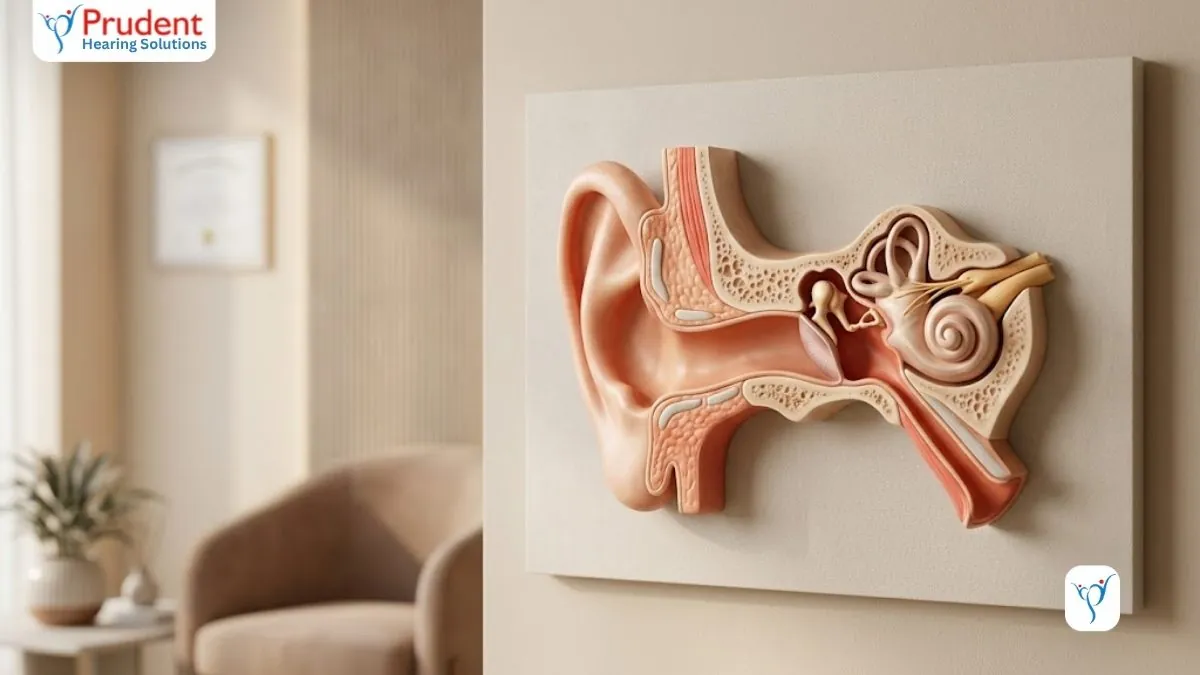
The visible pinna and the ear canal. Its job is to funnel sound waves onto the eardrum (tympanic membrane).
2. Middle ear
An air-filled chamber behind the eardrum containing the three smallest bones in the human body: the malleus (hammer), incus (anvil) and stapes (stirrup), collectively called the ossicles. So the answer to 'how many bones are in the ear?' is three per ear, six in total.
3. Inner ear
The snail-shaped cochlea and the balance organs (semicircular canals). Tiny hair cells inside the cochlea convert vibrations into electrical signals the auditory nerve sends to the brain.
Why the range shrinks with age
The high-frequency hair cells (around 4–8 kHz) are the most fragile. They fade first from noise exposure and age, which is why consonants like S, F, TH and SH become mumbled long before vowels do.
How we test all of this in the clinic
A pure-tone audiogram measures your threshold at 250, 500, 1000, 2000, 4000 and 8000 Hz in each ear. The 45-minute test at Prudent Hearing is free and painless, and you leave with a printed audiogram plus a plain-language explanation.
Frequently asked questions
What is the normal audible range of the human ear?
A healthy young human ear can hear frequencies from 20 Hz to 20,000 Hz (20 kHz) at loudness levels from 0 dB HL (softest detectable sound) up to around 120 dB before pain. The most important speech frequencies sit between 500 Hz and 4,000 Hz.
How many bones are in the ear?
There are three bones in each ear: the malleus (hammer), incus (anvil) and stapes (stirrup). They are the smallest bones in the human body and together are called the ossicles. That means six ear bones in total across both ears.
What is the normal hearing range in dB?
On a clinical audiogram, hearing thresholds between 0 and 25 dB HL are considered normal. 26–40 dB HL is mild loss, 41–55 dB HL moderate, 56–70 dB HL moderately severe, 71–90 dB HL severe, and 91 dB HL or worse is profound.
Why do older adults lose high frequencies first?
The hair cells inside the cochlea that detect high frequencies (4–8 kHz) are the most fragile. They are damaged first by age and noise exposure, which is why consonants like S, F, TH and SH fade before vowels. Speech starts to sound muffled long before conversations become quiet.
How is the hearing range tested?
With a pure-tone audiogram, which measures the softest sound you can hear at 250, 500, 1000, 2000, 4000 and 8000 Hz in each ear. Prudent's 45-minute test is free and painless, and you leave with a printed audiogram and a plain-language explanation.
Sources & further reading
We cross-checked this article against the following authoritative sources. Guidance and figures reflect the most recent public guidance available at the time of last review (July 2026). Clinical review by the Prudent Hearing clinical team.
- Deafness and hearing loss (World Health Organization (WHO))
- Understanding your audiogram (American Speech-Language-Hearing Association (ASHA))
Free consultation
Ready to hear the difference?
Book a free 45-minute hearing test at any Prudent Hearing clinic: no obligation, honest advice, expert audiologists.