Educational information, not medical advice. This article is written to help you understand common ear and hearing issues. It is not a substitute for professional diagnosis or treatment. If your symptoms are severe, sudden, or persistent, please consult a qualified doctor or audiologist. For urgent symptoms (sudden hearing loss, bleeding from the ear, severe pain with dizziness, or a head injury), seek medical care the same day.
Presbycusis is gradual, age-related hearing loss: sensorineural, in both ears, high pitches first. Here is why speech sounds mumbled and how it is managed.
Presbycusis is the gradual, age-related hearing loss that most people develop as they get older. It is a sensorineural loss, meaning it comes from changes inside the inner ear; it usually affects both ears fairly evenly; and it tends to take the high pitches first.
That is why a voice can seem loud enough while the words still sound mumbled, especially in a noisy room. It is very common after 60. It cannot be reversed or cured, but it is very manageable: modern hearing aids help most people a great deal, and getting help early matters more than most families realise.
Presbycusis meaning: the plain version
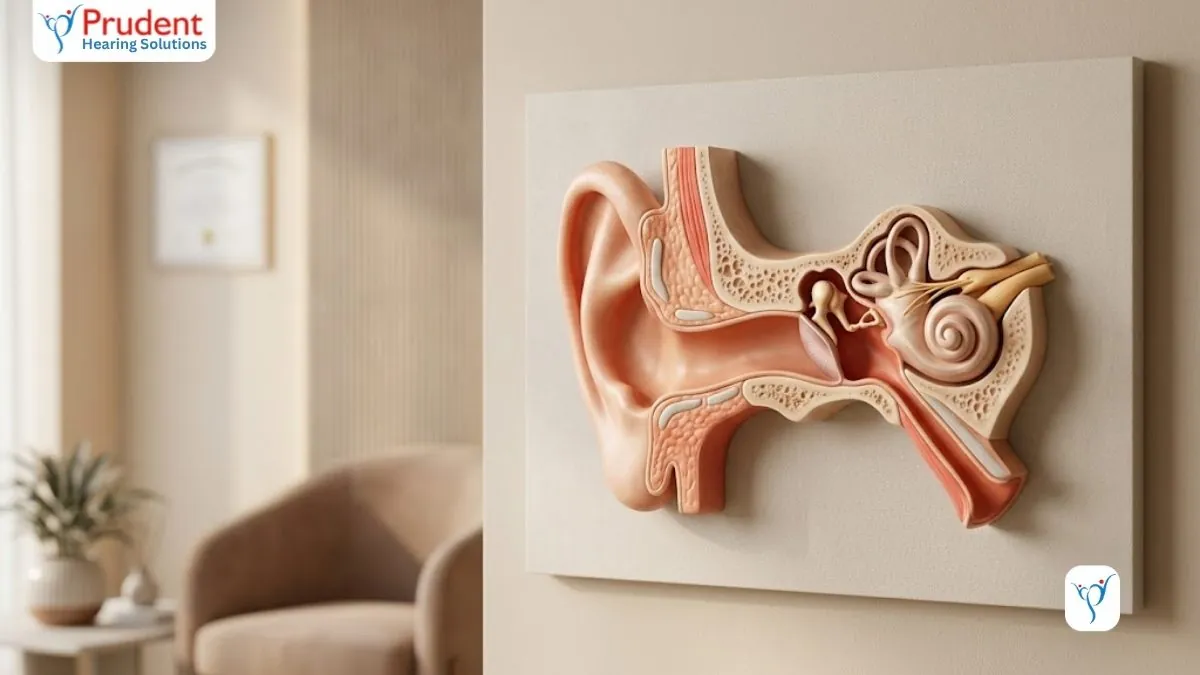
The word comes from Greek: presbys, meaning old, and akousis, meaning hearing. So presbycusis simply means the hearing changes that come with age. It is not an infection or an injury; it is the slow, natural ageing of the hearing system, mostly the tiny hair cells of the inner ear (the cochlea) that turn sound into signals the brain can read.
Because it builds up over years, many people do not notice the early stages themselves. A spouse, child or grandchild often points it out first. For how this sits alongside other kinds of loss, see our guide to the types and causes of hearing loss.
Why high pitches fade first, and speech turns to mumble
High-pitched sounds are handled by hair cells near the entrance of the cochlea, and these tend to wear out first. Low, booming sounds (traffic, a ceiling fan, a deep voice) still come through, so many people feel their hearing is basically fine. The trouble is that the soft, high consonants that give words their clarity (s, f, th, sh, k) sit in exactly the range that fades.
Lose those and sixty and fifty start to sound the same. Add background noise, a fast talker or a phone call, and following the words gets harder still. If you have seen your results on a chart and wondered what the downward slope meant, our guide to understanding your audiogram walks through it.
What causes age-related hearing loss
Presbycusis is rarely down to one thing. It is usually a lifetime of small factors adding up:
- A lifetime of use: the inner-ear hair cells slowly change and wear down, and once they are gone they do not grow back.
- Noise exposure over the years (noisy workplaces, loud traffic, machinery, and years of loud headphones or earbuds) can speed the process up.
- Genetics: if age-related loss runs in your family, you may notice it a little earlier.
- Health conditions: diabetes and heart or circulation problems can reduce blood supply to the inner ear and are linked with faster loss.
- Some medicines and a past history of ear disease can add to it, but never stop or change a prescribed medicine on your own; raise any worry with the doctor who prescribed it.
Signs of presbycusis to watch for
- You can hear that people are talking but often cannot make out the words, especially in a group or a noisy restaurant.
- You turn the TV or phone volume up louder than others in the house find comfortable.
- You ask people to repeat themselves, or feel that everyone mumbles.
- Women's and children's voices are harder to follow than deep male voices.
- Phone calls feel harder than talking face to face.
- You are starting to avoid gatherings because keeping up with the conversation is tiring.
Is presbycusis a disease? Can it be reversed?
Calling presbycusis a disease is a little misleading. It is a degenerative process, the natural ageing of the hearing system, rather than an infection you catch or a condition a tablet can clear. That also means there is no medicine, drop or surgery that reverses it, and no ear-cleaning that brings the clarity back.
What genuinely helps is hearing aids and rehabilitation. It is worth being honest here: hearing aids manage age-related loss, they do not cure it. But for the large majority of people they make speech clearer, conversations easier and daily life far less tiring.
A word on ear cleaning and safety
Because presbycusis creeps in slowly, some people first assume their ears are simply blocked with wax and try to clear them at home. Please do not push cotton buds into the ear canal. They tend to pack wax deeper and can injure the delicate eardrum.
Ear candling is not a safe option either; it does not remove wax and carries a real risk of burns and canal damage. If you think wax is part of the problem, have it checked and removed properly; our guide to microsuction versus syringing explains the safer methods. Wax removal will not fix age-related loss, but it clears one thing off the list before a hearing test.
Why treating it early matters
Age-related loss tends to creep, and it is tempting to wait until it gets bad. The problem with waiting is what happens in the meantime. People with untreated loss often start pulling back from conversations, phone calls and social events simply because they are exhausting. That withdrawal is linked with low mood and isolation, and research now connects untreated hearing loss with faster cognitive decline in later life.
There is more in our piece on the link between hearing loss and dementia. The encouraging part is that acting early keeps you in the conversation, and today there are comfortable, discreet options built for older users. See our guide to the best hearing aids for senior citizens.
What a hearing test shows
A hearing test is simple, painless and quick. At Prudent it is free and takes about 45 minutes. We start by looking inside your ears, then measure the softest sounds you can hear at each pitch (a pure-tone audiometry test) and plot them on an audiogram. Age-related loss usually shows a gentle downward slope, with the high pitches sitting lower than the low ones, in both ears.
We also check how well you follow speech, including speech in background noise, because that is where presbycusis bites hardest. If you are not sure whether it is time, our guide to the signs you need a hearing test can help you decide, or you can simply book a /hearing-test.
When to see a doctor: red flags
- Hearing that drops suddenly, over hours or a few days: treat sudden hearing loss as an emergency and see a doctor the same day.
- Loss, or ringing, in only one ear when the other is fine.
- Ear pain, discharge, or a blocked feeling that does not clear.
- Dizziness, spinning (vertigo) or loss of balance along with the hearing change.
- Hearing loss after an injury, or hearing loss that comes with weakness or numbness in the face.
Those signs point to something other than ordinary ageing, and they need a doctor or ENT specialist. Prudent does not treat infections, prescribe medicines or perform surgery. Our role is the hearing side: once any medical cause has been checked, we assess exactly how much hearing has been affected and, if there is a lasting loss, fit and fine-tune the right hearing aids and rehabilitation for you.
How Prudent Hearing Solutions helps
Prudent is an RCI-registered audiology team, with clinics in Pune, Delhi and Bengaluru. For age-related hearing loss we offer a free 45-minute hearing test, honest advice on whether you would actually benefit from hearing aids, and a wide range of devices suited to seniors (including simple, easy-to-handle models), fitted and adjusted to your own audiogram.
We also stay with you for follow-up care and rehabilitation, so the aids get worn rather than left in a drawer. Flexible payment options, including 0% EMI, are available on many devices. You can explore /hearing-aids, find your nearest clinic at /locations, or reach us on /contact to book.
"Age takes the treble before the bass, so the world does not go silent, it goes mumbled. That mumble is exactly the loss a well-fitted hearing aid is built to clear up."
Continue reading
Frequently asked questions
What is presbycusis in simple terms?
Presbycusis is the gradual hearing loss that comes with age. It is a sensorineural loss from changes in the inner ear, it usually affects both ears, and it tends to take the high pitches first, so speech can sound mumbled even when the volume seems fine. It is very common after 60.
At what age does presbycusis usually start?
Changes often begin quietly in the 50s and become common and more noticeable after 60. Because it builds up slowly over years, many people do not notice the early stages themselves. Family members usually spot it first.
Can presbycusis be cured or reversed?
No. Age-related hearing loss is a natural ageing of the inner ear, and there is no medicine, drop or surgery that reverses it. It is, however, very manageable. Hearing aids manage the loss and make speech clearer for most people, though they do not cure it.
Why can I hear people talking but not understand the words?
Presbycusis tends to take the high pitches first, and the soft high consonants (s, f, th, sh, k) that give words their clarity live in that range. You still hear low, booming sounds, so voices seem present, but the crisp detail is missing, which feels like mumbling, especially in noise.
Does age-related hearing loss affect one ear or both?
Presbycusis usually affects both ears fairly evenly. If hearing drops in only one ear, or drops suddenly, that is not typical age-related loss. See a doctor promptly, as it needs medical checking.
Can hearing aids help with presbycusis?
Yes, for most people they help a great deal. Modern aids boost the exact high pitches that fade and make conversation clearer and less tiring. A free hearing test and audiogram show how much loss there is and which device suits you. Hearing aids manage the loss, they do not cure it.
Free consultation
Ready to hear the difference?
Book a free 45-minute hearing test at any Prudent Hearing clinic: no obligation, honest advice, expert audiologists.