Educational information, not medical advice. This article is written to help you understand common ear and hearing issues. It is not a substitute for professional diagnosis or treatment. If your symptoms are severe, sudden, or persistent, please consult a qualified doctor or audiologist. For urgent symptoms (sudden hearing loss, bleeding from the ear, severe pain with dizziness, or a head injury), seek medical care the same day.
Vertigo is the false feeling that you or the room is spinning, and most of it starts in the inner ear. Here is how BPPV, Meniere's disease and other balance problems differ, when dizziness is an emergency, and why a hearing test helps sort it out.
Vertigo is the feeling that you or the room around you is spinning when nothing is actually moving, and most of the time it begins in your inner ear rather than your head. The three names you will hear most are BPPV (short bursts of spinning triggered by head movements, and very treatable), Meniere's disease (longer attacks that come bundled with hearing loss, ringing and a full feeling in one ear), and vestibular neuritis (a viral upset of the balance nerve).
Because the organs for hearing and balance sit side by side in the inner ear, a hearing test is often part of working out why you feel dizzy. A few warning signs, though, mean you skip the clinic and go straight to a hospital.
What vertigo actually means
Doctors use "dizziness" as an umbrella word, and pinning down what you actually feel is half the diagnosis. Vertigo is one specific type: a false sense of spinning, tilting or the ground shifting under you.
That is different from feeling faint or light-headed, which is usually a blood-pressure or heart issue, and different again from feeling unsteady on your feet, which can involve muscles, joints, vision or nerves. Telling your clinician which of these matches your experience points them straight toward the right organ, so it is worth describing it carefully.
- Vertigo: a spinning or rotating sensation, as if you were on a merry-go-round; usually the inner ear or its nerve.
- Light-headedness: a feeling that you might faint; often linked to blood pressure, dehydration or standing up too quickly.
- Unsteadiness: poor balance while walking; can come from vision, joints, nerves or several small problems adding up.
- Lingering wobbliness: an off-centre feeling that can hang around for hours or days once a spinning attack has passed.
BPPV: the most common reason the room spins
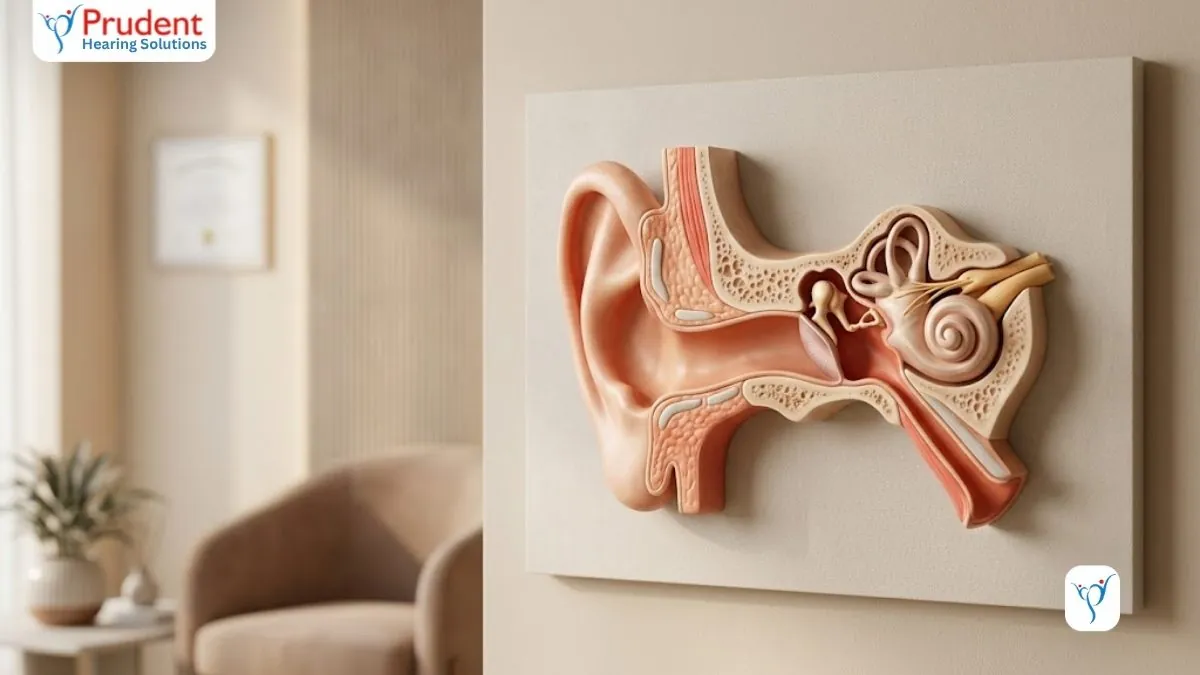
Benign paroxysmal positional vertigo, or BPPV, is behind a large share of inner-ear vertigo. Inside your inner ear are tiny calcium crystals that normally help sense head movement. In BPPV they come loose and drift into one of the fluid-filled balance canals, where they set off short, intense bursts of spinning whenever you move your head a certain way. The classic triggers are rolling over in bed, lying down, sitting up, bending forward, or tipping your head back to reach a high shelf.
- Sudden spinning that lasts seconds to about a minute, not hours.
- Attacks brought on by a change in head position rather than appearing out of the blue.
- Nausea, and sometimes a brief loss of balance, during the spin.
- Normal hearing: BPPV does not cause hearing loss or ringing, which helps separate it from Meniere's disease.
BPPV is usually confirmed with a positional test, where a clinician tips your head into the trigger position and watches your eyes for a brief, tell-tale flicker. It responds remarkably well to canalith repositioning: a set of slow, guided head and body movements (the Epley manoeuvre is the best known) that coax the loose crystals out of the balance canal to a spot where they stop causing symptoms.
Many people feel much better after one or two sessions. Tablets only take the edge off the nausea; they do not move the crystals, so the repositioning is what actually fixes it. Avoid attempting aggressive versions you find in a video on your own, because being guided matters and a wrong turn can push crystals into a different canal.
Meniere's disease: dizziness tied to your hearing
Meniere's disease is less common than BPPV but more disruptive, and it is the balance disorder that overlaps most with what an audiologist sees. It is linked to a build-up of fluid pressure in the inner ear, and it usually affects one ear at a time. The attacks last far longer than BPPV, anywhere from about 20 minutes to several hours, and they arrive with a distinctive cluster of ear symptoms rather than spinning alone.
- Vertigo attacks lasting roughly 20 minutes to a few hours, often severe enough to force you to lie down.
- Hearing that fluctuates, usually in the lower pitches first, and over years can become permanent.
- Ringing, roaring or buzzing (tinnitus) that often rises just before or during an attack.
- A feeling of fullness or pressure in the affected ear, as though it needs to pop.
There is no cure for Meniere's, but the episodes can usually be managed. An ENT specialist leads treatment, which often starts with a lower-salt diet, cutting back on caffeine, and being careful about smoking and dehydration, sometimes alongside medication to reduce fluid or settle the attacks. Because Meniere's damages hearing over time, an audiologist has a real role here: tracking your hearing with repeat tests, and, when the loss starts to get in the way, fitting hearing aids.
Hearing aids do not stop the vertigo and they do not cure Meniere's; they manage the hearing loss it leaves behind, and modern devices can also ease the tinnitus that so often comes with it. If ringing is your main complaint, our guide to hearing aids for tinnitus explains how that side of it works.
Other causes of dizziness
Not every spinning spell is BPPV or Meniere's. Vestibular neuritis and labyrinthitis are usually caused by a virus that inflames the balance nerve; they bring a single bout of intense, constant vertigo lasting days, and labyrinthitis can add hearing loss because it also touches the hearing part of the ear. Vestibular migraine causes vertigo with or without a headache and is easy to miss.
And some dizziness has nothing to do with the ear at all: low blood pressure, certain medicines, anaemia, thyroid problems and anxiety can all play a part, which is why a proper history matters as much as any test. If your dizziness comes packaged with new hearing loss, it helps to understand how the different types and causes of hearing loss behave.
Inner-ear vertigo compared at a glance
- BPPV: Typical trigger & pattern: Brief spins (seconds) when rolling over in bed, lying down, or looking up; Ear / hearing symptoms: Usually none. Hearing is normal; How it's diagnosed: Dix-Hallpike positioning test; Usual management: Canalith repositioning (e.g. Epley) by a trained clinician
- Meniere's disease: Typical trigger & pattern: Sudden attacks lasting 20 minutes to hours; can recur over years; Ear / hearing symptoms: Tinnitus, fluctuating hearing loss, ear fullness (often one ear); How it's diagnosed: Hearing test (audiogram) + balance testing + history; Usual management: Diet/lifestyle changes, medication, hearing support; guided by a specialist
- Vestibular neuritis / labyrinthitis: Typical trigger & pattern: Sudden, constant vertigo for days, often after a viral illness; Ear / hearing symptoms: Neuritis: hearing normal. Labyrinthitis: hearing may drop; How it's diagnosed: Clinical exam; balance testing; hearing test to separate the two; Usual management: Symptom relief and vestibular rehabilitation exercises
Sources: NIDCD balance disorders, NIDCD Meniere's disease, MedlinePlus.
Red flags: when dizziness is an emergency
Most vertigo is unpleasant but not dangerous. Some dizziness, though, can signal a stroke or sudden inner-ear damage that needs treatment within hours, not days. Do not wait for a clinic appointment. Get emergency care or go to the nearest hospital if your dizziness comes with any of the following:
- Sudden hearing loss in one ear together with vertigo, which can be a medical emergency that is most treatable when acted on the same day.
- A severe or unusual headache, or the worst headache of your life.
- Double vision, trouble seeing, slurred speech or difficulty finding words.
- Weakness or numbness in the face, arm or leg, especially on one side.
- Fainting, chest pain, an irregular heartbeat, or trouble walking or staying upright.
- A high fever with a stiff neck, or vertigo after a head injury.
Why a hearing test belongs in a dizziness check
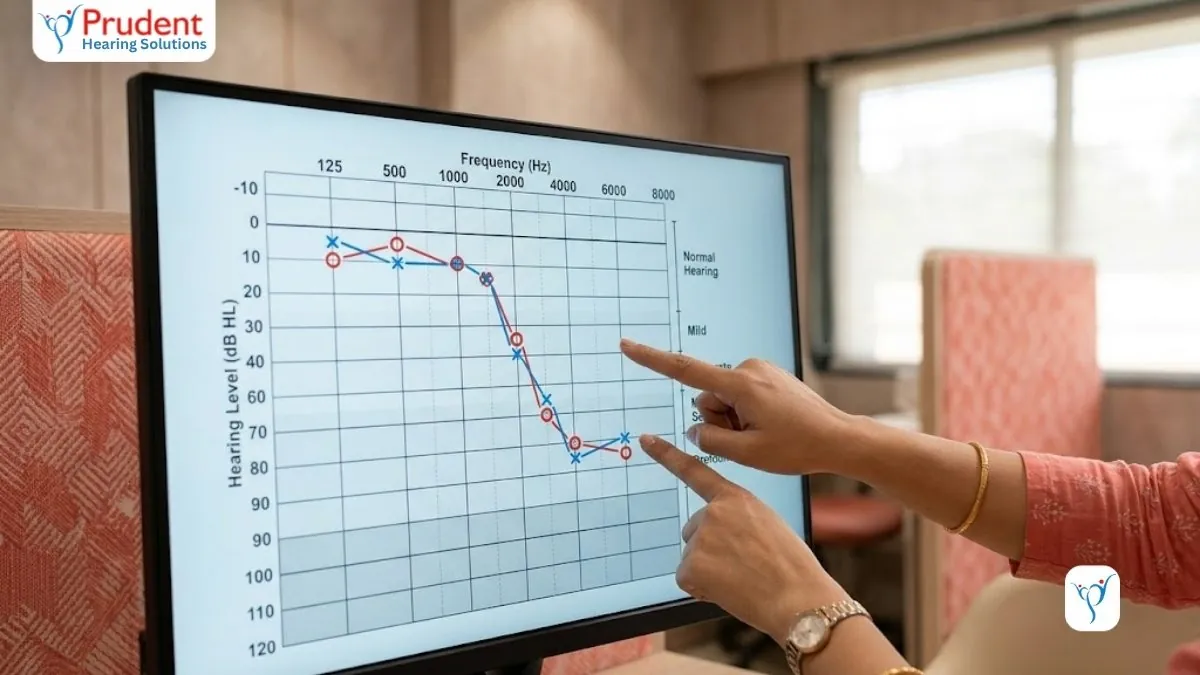
The cochlea (hearing) and the vestibular system (balance) share the same fluid, the same nerve, and the same blood supply, so a problem in one often shows up in the other. A hearing test gives a clinician clues that spinning alone cannot: whether one ear is affected or both, whether the loss is in the low pitches (a Meniere's pattern) or spread across the range, and whether it is fluctuating or stable.
The results are plotted on a chart, and our guide to understanding your audiogram walks through how to read it. If the drop was sudden, read our note on sudden and noise-induced hearing loss and act quickly. Even without dizziness, the everyday signs you need a hearing test are worth knowing.
Getting checked in India: what to expect
At Prudent Hearing Solutions every clinic functions as a full-scale clinical diagnostic centre, so a dizziness work-up does not stop at a basic hearing test. Our free 45-minute hearing test is painless and non-invasive, and it maps exactly which ear and which pitches are involved.
For complex inner-ear and balance cases we run the specialised tests these problems need under one roof: VEMP (which checks the balance organs of the inner ear), ECochG (electrocochleography, which records the inner ear's electrical response to sound and can reveal the raised inner-ear fluid pressure of Meniere's disease) and BERA/ABR (an objective test of the hearing nerve and brainstem pathway, useful when responses cannot be given reliably).
This makes us a strong choice when hearing loss comes with dizziness or severe ringing. Where the problem needs medical treatment, such as the repositioning manoeuvres for BPPV, we tell you plainly and help you get to the right ENT or vestibular specialist.
When hearing loss or tinnitus is part of your Meniere's, we can fit and program hearing aids, with an in-clinic trial, 0% EMI options and free lifetime programming so the fit keeps up as your hearing changes. You can book at any of our clinics in Pune, Delhi and Bengaluru: call +91 9429690093, find your nearest branch on our locations page, or reach us through contact.
"If your world spins for a few seconds when you roll over in bed, it is most likely BPPV, and it is very treatable. If the spinning lasts an hour while your hearing dips and your ear feels full, think Meniere's and see an ENT. Either way, get your hearing checked first, because it tells us which ear, and how much, is really involved."
Continue reading
Frequently asked questions
Is vertigo the same as just feeling dizzy?
No. "Dizzy" is a broad word people use for several different feelings. Vertigo is specifically the sensation that you or the room is spinning or tilting when nothing is moving, and it usually comes from the inner ear or its nerve. Feeling faint, light-headed or simply unsteady on your feet are separate problems with different causes. Describing exactly what you feel helps your clinician find the right one.
Can a hearing aid cure my vertigo or Meniere's disease?
No. Hearing aids manage hearing loss and can ease the tinnitus that often comes with Meniere's, but they do not stop vertigo and they do not cure Meniere's, which has no cure. Vertigo from BPPV is treated with repositioning manoeuvres, and Meniere's is managed by an ENT with diet changes and sometimes medication. Hearing aids handle the hearing loss these conditions leave behind.
How do I tell if it is BPPV or Meniere's?
The two big clues are how long an attack lasts and whether your hearing is involved. BPPV causes brief spinning of seconds to about a minute, triggered by head movements, with normal hearing. Meniere's causes longer attacks of 20 minutes to a few hours, with fluctuating hearing loss, ringing and a full feeling in one ear. Only a proper assessment, including a hearing test, can confirm which it is.
Should I see an audiologist or an ENT for dizziness?
Both have a role. An audiologist tests your hearing, which gives important clues about which ear is affected and points toward causes like Meniere's. An ENT or vestibular specialist handles the medical diagnosis and treatment, including positional testing and repositioning for BPPV. If your dizziness comes with any red-flag sign such as sudden hearing loss, weakness or a severe headache, go straight to a hospital instead.
Will a hearing test hurt, and is it expensive?
A hearing test is completely painless and non-invasive. You wear headphones in a quiet room and respond to sounds; nothing goes deep into the ear. At Prudent Hearing Solutions the standard hearing test is free and takes about 45 minutes, at our clinics in Pune, Delhi and Bengaluru. It is one of the simplest and lowest-risk steps in working out why you feel dizzy.
Can BPPV come back after it is treated?
Yes. BPPV can recur weeks, months or years later, because the same tiny crystals can dislodge again. The reassuring part is that the repositioning manoeuvre works just as well the second time, so a return of symptoms usually means another quick session rather than a bigger problem. If attacks become frequent, or the pattern changes, it is worth being reassessed to rule out other causes.
Free consultation
Ready to hear the difference?
Book a free 45-minute hearing test at any Prudent Hearing clinic: no obligation, honest advice, expert audiologists.