Educational information, not medical advice. This article is written to help you understand common ear and hearing issues. It is not a substitute for professional diagnosis or treatment. If your symptoms are severe, sudden, or persistent, please consult a qualified doctor or audiologist. For urgent symptoms (sudden hearing loss, bleeding from the ear, severe pain with dizziness, or a head injury), seek medical care the same day.
A normal hearing test result means thresholds of 25 dB or better in both ears, with a flat audiogram, matched air and bone lines, and a type A tympanogram — here is how to read yours and spot when it isn't normal.
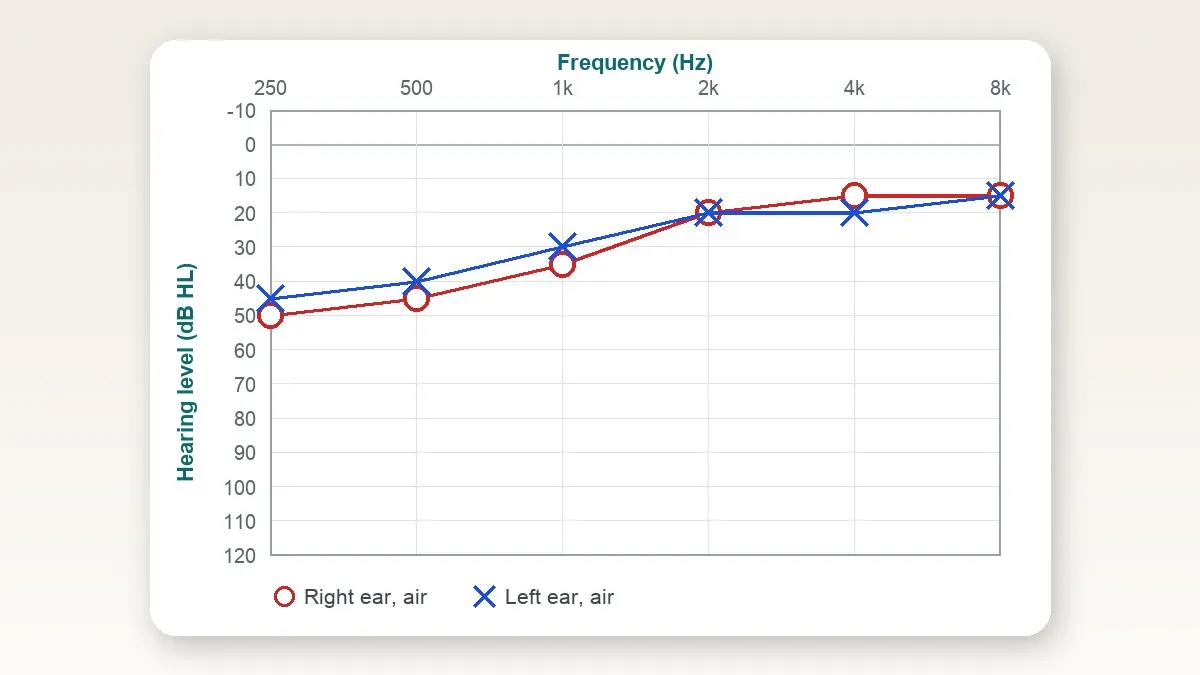
A normal hearing test result means you can detect sounds at 25 dB HL or softer across every pitch tested (250 Hz to 8000 Hz) in both ears, with your air-conduction and bone-conduction lines matching and a healthy, type A tympanogram. On the audiogram this shows up as your O (right ear) and X (left ear) symbols sitting near the top of the graph, inside the 0–25 dB band.
See an ENT urgently (within 24–72 hours) if your hearing dropped suddenly in one ear, or comes with spinning dizziness, severe ear pain, discharge or blood, or facial weakness — sudden hearing loss is a medical emergency even when a later test reads "normal."
What counts as a normal hearing test result?
Audiologists summarise your hearing in a single number called the pure-tone average, or PTA. It averages your softest audible level (threshold) at the speech frequencies — usually 500, 1000 and 2000 Hz. If that average is 25 dB HL or better in each ear, your hearing is graded normal for an adult.
Lower decibels are better, not worse. 0 dB HL is not silence — it is the softest sound a healthy young adult can just detect. Plenty of people hear better than that, into negative numbers. So a threshold of 5 or 10 dB is excellent hearing, not a mild loss.
What does a normal audiogram look like?
Picture the graph: frequency (pitch) runs left to right, loudness runs top to bottom with the softest sounds at the top. A normal result is a near-flat line hugging the top of the chart, with the right-ear O's and left-ear X's both parked in the 0–25 dB band and close to each other. There should be no gap between the air-conduction symbols and the bone-conduction markers. For a full walk-through of the lines and symbols, see how to read your audiogram.
Is the audiogram the whole hearing test?
No — a proper diagnostic test is more than the beep test. Tympanometry pushes a tiny change in air pressure to check your eardrum and middle ear. Speech audiometry checks how clearly you understand words, not just whether you detect tones. A genuinely "normal" report should clear all three — tones, eardrum and speech — not just the beeps.
| Test component | A normal result | What warrants follow-up |
|---|---|---|
| Pure-tone audiogram | Thresholds 0–25 dB HL in both ears | Any point worse than 25 dB; a dip (notch) around 4000–6000 Hz |
| Ear-to-ear symmetry | Both ears within ~10 dB of each other | One ear 15 dB or more worse than the other |
| Air vs bone conduction | Air and bone lines overlap, no gap | An air–bone gap over 10 dB (points to a middle-ear issue) |
| Tympanogram (eardrum) | Type A — normal middle-ear pressure | Type B (flat) or Type C (negative pressure) |
| Speech audiometry | Word score 90–100%, matches the PTA | Poor word scores despite near-normal tones |
What do the decibel numbers mean?
Beyond the normal band, hearing loss is graded by how loud a sound must be before you hear it: mild (26–40 dB), moderate (41–55 dB), moderately severe (56–70 dB), severe (71–90 dB) and profound (91 dB+). A deeper breakdown is in degrees of hearing loss, mild to profound.
One honest caveat: the cut-off for "normal" is not universal. The classic clinical line is 25 dB. The WHO's 2021 grading set the normal ceiling lower, at under 20 dB, and counts 20 dB and above as the start of mild difficulty. So a borderline 22 dB result can read as normal on the classic scale but as mild on the WHO scale — context and symptoms decide.
Can your hearing test be normal but you still struggle to hear?
Yes — and it is more common than people expect. A standard audiogram is done in a silent booth with pure tones. Real life is a noisy restaurant with three people talking at once. Some people with a perfectly normal audiogram still cannot follow conversation in background noise. If that is you, ask for a speech-in-noise test (such as QuickSIN); it measures the thing the beep test misses.
Tinnitus — ringing or buzzing — can also sit alongside a completely normal audiogram. A normal result does not mean the ringing is imagined; it means the cause is elsewhere. More on that in tinnitus causes, myths and help.
Is a normal result the same for children and seniors?
No. For children the bar is stricter — thresholds of 15 dB or better are treated as normal, because even a mild loss can hold back speech and language learning in school years. For older adults, a gentle slope that dips only at the high frequencies (4000–8000 Hz) is very common after 60; the PTA may still land in the normal range, but it is worth monitoring year on year.
When should you still see a doctor despite a normal test?
- Hearing that dropped suddenly in one ear — treat as an emergency, see an ENT within 24–72 hours
- One ear clearly worse than the other, even if both look "normal-ish" on the chart
- Ringing or buzzing in only one ear that does not settle
- Dizziness or vertigo, especially with vomiting
- Discharge, blood, or severe pain from the ear
- Facial weakness or drooping on one side
- A blocked, full feeling that will not clear
One-sided tinnitus or a one-sided hearing difference, even with an otherwise good test, occasionally signals something that needs imaging (rarely, a benign growth called an acoustic neuroma). It is not a reason to panic — it is a reason to get it checked rather than wait.
How often should you repeat a hearing test if it is normal?
Adults with no symptoms: every 3–5 years is reasonable, and a baseline test in your 50s is smart — see how often to get a hearing test for the schedule by risk group. Test yearly if you work around loud machinery, use firearms, or spend hours in high-volume headphones. And retest sooner the moment you notice a change, a new ringing, or that you keep turning the TV up.
How do you get a hearing result you can trust?
A "pass" scribbled on a slip is not a result you can use. You want the full report — audiogram, tympanogram and speech scores — explained to you in plain language. Prudent Hearing Solutions runs a free 45-minute diagnostic hearing test with RCI-registered audiologists at our clinics in Pune (Viman Nagar), Mumbai (Malabar Hill), Navi Mumbai (Seawoods), Delhi (Rohini and Green Park) and Bengaluru (Jayanagar), plus home visits in other cities.
A full diagnostic test elsewhere often costs ₹500–₹2000; ours is free, includes the eardrum and speech checks, and comes with no pressure to buy anything. You can book a hearing test online.
If your result comes back normal, that is genuinely good news — keep it that way by protecting your ears from loud, prolonged noise. If it does not, early mild loss is the easiest kind to manage, and knowing is always better than guessing.
Continue reading
Frequently asked questions
What is a normal hearing test score?
For adults, a pure-tone average (PTA) of 25 dB HL or better in each ear is graded as normal hearing. On the WHO's 2021 scale the normal ceiling is lower — under 20 dB — so 20 dB and above is counted as the start of mild difficulty. For children the bar is stricter — 15 dB or better.
Is 20 dB hearing loss normal?
It is borderline. On the classic clinical scale, anything up to 25 dB is normal, so 20 dB is within normal. On the WHO 2021 scale, 20 dB is where mild difficulty begins rather than true normal. Your symptoms and whether you struggle in background noise matter more than the exact number.
Can I have a normal audiogram and still have tinnitus?
Yes. Tinnitus — ringing or buzzing — can occur with a completely normal audiogram. A normal result does not mean the ringing is imagined; it means the cause is elsewhere, such as noise exposure, stress or hidden cochlear changes. One-sided tinnitus should be checked by an ENT.
What does a normal audiogram look like?
A near-flat line hugging the top of the graph, with the right-ear O symbols and left-ear X symbols both sitting in the 0–25 dB band and close to each other. There is no gap between the air-conduction and bone-conduction markers.
How much does a hearing test cost in India?
A full diagnostic hearing test at many centres costs roughly ₹500 to ₹2000. At Prudent Hearing Solutions the 45-minute diagnostic test is free, includes tympanometry and speech testing, and comes with no obligation to buy.
Free consultation
Ready to hear the difference?
Book a free 45-minute hearing test at any Prudent Hearing clinic: no obligation, honest advice, expert audiologists.