Educational information, not medical advice. This article is written to help you understand common ear and hearing issues. It is not a substitute for professional diagnosis or treatment. If your symptoms are severe, sudden, or persistent, please consult a qualified doctor or audiologist. For urgent symptoms (sudden hearing loss, bleeding from the ear, severe pain with dizziness, or a head injury), seek medical care the same day.
Hearing loss is graded from mild to profound by how loud a sound must be before you can just hear it, in decibels on an audiogram. Here is the full dB chart, what each degree means for everyday listening, and what help usually suits it.
The short answer: hearing loss is graded by how loud a sound must be before you can hear it
Hearing loss is sorted into degrees (mild, moderate, moderately severe, severe and profound) based on how loud a sound has to become before you can just detect it, measured in decibels hearing level (dB HL) on a test called an audiogram.
As a commonly used clinical guide: normal hearing sits up to about 25 dB HL, mild is 26–40, moderate 41–55, moderately severe 56–70, severe 71–90, and profound is 91 dB HL and above. The higher the number, the more sound your ear needs before it registers, and the more everyday listening is affected.
If you are reading this for a parent who keeps turning the TV up or asking people to repeat themselves, that is exactly the kind of thing these degrees describe. But the degree is only one part of the picture, and it is not something you can judge by ear at home: it comes from a proper test read by an audiologist.
This guide walks through each degree in plain language: what it means, which sounds and speech get missed, how it shows up in daily life, and what help usually suits it. One honest thing to hold onto throughout: a hearing aid manages hearing loss, it does not cure it. The point of finding your degree is to match the right help, not to promise the old hearing back.
How the degree is measured: the audiogram and your Pure Tone Average
The degree of hearing loss comes from a pure tone audiometry test. You sit in a quiet room, wear headphones, and press a button (or raise a hand) each time you just hear a soft beep.
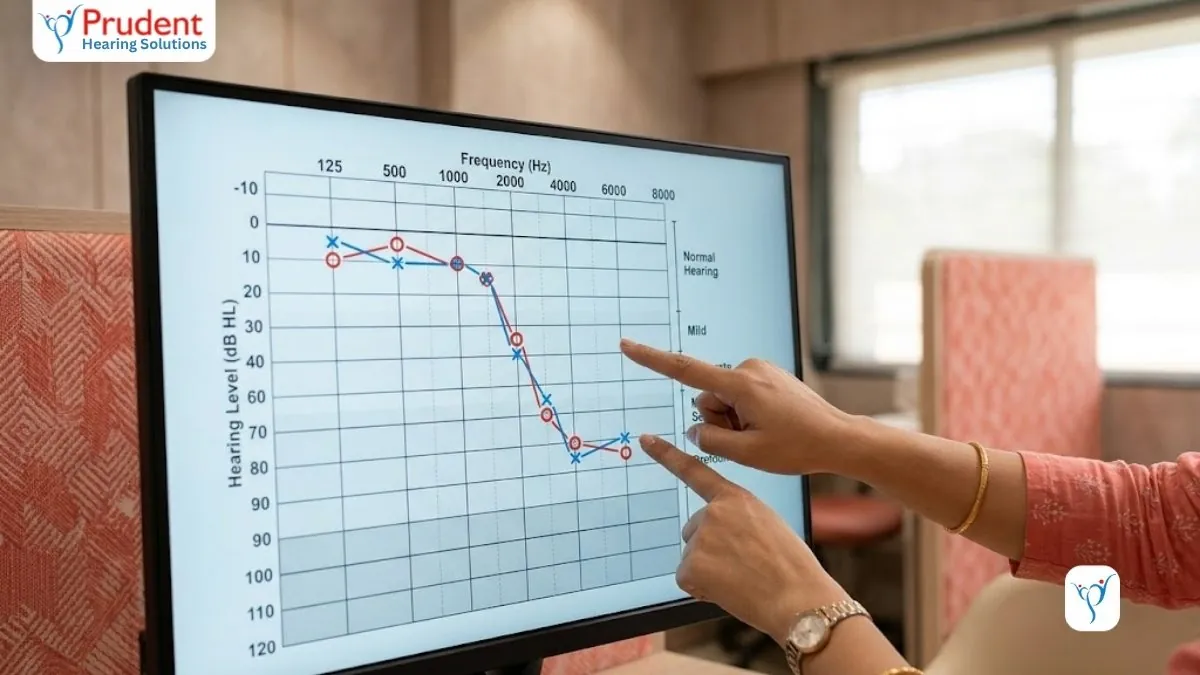
The audiologist plays tones at different pitches (frequencies) and slowly softens each one to find the quietest level you can detect: that quietest level is your threshold for that pitch. Those thresholds are plotted on a chart called an audiogram, with pitch running low to high across the top and loudness running soft at the top to loud at the bottom.
To put a single number on the degree, the audiologist works out your Pure Tone Average (PTA): the average of your thresholds at the main speech frequencies, most commonly 500, 1000 and 2000 Hz (some clinics also include 4000 Hz). That average is then matched to the dB bands above to name the degree. Each ear is tested and graded separately, so it is normal to be, say, mild in one ear and moderate in the other.
If you want to understand the chart itself before an appointment, our guide to reading audiogram symbols and the chart breaks down every mark, and what actually happens in a pure tone audiometry test explains the test step by step. One quick note on the units: the audiogram uses dB HL (hearing level), which is calibrated to human hearing, so it is not the same scale as the decibel numbers you might see for traffic or music. Do not compare them directly.
The hearing loss dB chart at a glance
Here is the full classification most audiologists in India use, based on your Pure Tone Average in dB HL. Keep this as your quick reference; the sections after it explain what each band feels like in real life.
- Normal hearing: up to about 25 dB HL. Soft sounds and speech come through comfortably.
- Mild hearing loss: 26–40 dB HL. Soft speech and speech in noise start to slip.
- Moderate hearing loss: 41–55 dB HL. Normal conversation becomes hard to follow.
- Moderately severe hearing loss: 56–70 dB HL, even normal conversation is difficult without help.
- Severe hearing loss: 71–90 dB HL. Ordinary speech is inaudible; only loud sounds get through.
- Profound hearing loss: 91 dB HL and above, even very loud sounds may not be heard.
A note on why the numbers vary slightly
You may see slightly different cut-offs elsewhere, and that is normal. Different classification systems (for example those used by ASHA, the WHO and BIAP) draw the lines in marginally different places: one might start mild at 20 or 26 dB HL, or group severe and profound differently. The ranges in this guide are a widely used clinical version, and the small differences at the boundaries rarely change what help suits you.
What matters far more than which system labels you is your own audiogram read alongside how you actually cope day to day. Someone right at the edge of two bands is not a different person on Monday than on Tuesday; the label is a guide for the audiologist, not a verdict. Treat the degree as a useful shorthand, and let a qualified audiologist interpret the full result.
Normal hearing (up to about 25 dB HL)
With hearing in the normal range, you can pick up soft sounds (a whisper, rustling leaves, a ticking clock, a tap dripping in another room) and follow speech comfortably in most everyday settings, including reasonably noisy ones. There is no degree of loss to classify here.
One honest caveat: a normal audiogram does not always mean effortless hearing. Some people hear pure tones well but still struggle to follow speech in a busy restaurant or on a crackly phone line. If that sounds familiar despite a 'normal' result, it is still worth discussing with an audiologist: the standard tone test is only the starting point, and there are further tests that look specifically at understanding speech.
Mild hearing loss (26–40 dB HL)
With mild hearing loss you can usually follow one-to-one conversation in a quiet room, so it is easy to dismiss. What slips is the soft and the subtle: whispers, someone speaking from another room or with their back turned, and the high, quiet consonants (like s, f, th and k) that carry a lot of a word's meaning. Speech in background noise (a busy kitchen, a family gathering, a restaurant) becomes noticeably harder, and following it all day can be tiring.
This is often the stage where families first notice something, even if the person themselves has not. The classic signs are a creeping-up TV volume, frequent 'what?' or 'you're mumbling', and missing the doorbell or a soft-spoken grandchild.
What help suits it depends on how much it affects daily life. Very mild loss is sometimes monitored rather than treated straight away, with simple communication strategies (facing the speaker, reducing background noise). But many people with mild loss benefit clearly from hearing aids, especially if work, phone calls or an active social life are involved. Whether to fit at this stage is a shared decision with your audiologist, and what level of hearing loss actually needs a hearing aid goes into this in detail.
- Usually fine: one-to-one chat in a quiet room.
- Often missed: whispers, soft or high-pitched consonants, speech from a distance or in noise.
- Everyday signs: TV up louder, 'everyone mumbles', tiring group conversations.
- Typical help: monitoring for very mild; hearing aids often help if it affects daily life.
Moderate hearing loss (41–55 dB HL)
At a moderate degree, normal conversational speech itself becomes difficult to follow, not just the soft edges of it. In a quiet room you may manage, but add any background noise or a second person talking and you are working hard to keep up, filling in gaps and asking for repetition. Phone calls get trickier because you lose the lip movements and facial cues you had been leaning on without realising.
Around the home, the TV or radio is now clearly too loud for everyone else, and you may miss the phone ringing or someone calling from another room. It becomes harder to hide, and the effort of constant concentration often leaves people withdrawing a little from noisy gatherings.
For a moderate degree, hearing aids are usually recommended and typically make a clear, welcome difference: they are one of the situations where the benefit is most obvious. The right style and power come from your audiogram and your daily needs, decided together with your audiologist rather than off a shelf.
- Hard even in quiet: normal-volume conversation without concentration.
- Much harder: groups, background noise, phone calls.
- Everyday signs: TV very loud for others, frequent repetition, pulling back from gatherings.
- Typical help: hearing aids usually recommended and often very effective.
Moderately severe hearing loss (56–70 dB HL)
At a moderately severe degree, even normal conversation is difficult to follow without help. Someone speaking loudly and clearly, close to you, in a quiet room, you may still catch, but ordinary talk across a table, in a group, or anywhere with background noise becomes very hard. You are likely relying heavily on watching faces and guessing from context.
This is a stage where hearing loss clearly affects relationships and daily independence, and where people often feel cut off in exactly the situations they most want to join: family meals, functions, conversations with grandchildren.
Hearing aids are strongly indicated here, usually somewhat more powerful fittings than for milder loss, and combined with lip-reading and good communication habits they can restore a great deal of everyday conversation. The aim, honestly stated, is to make listening manageable and less exhausting again, not to return hearing to exactly what it once was.
- Sometimes catchable: loud, clear speech close by in quiet.
- Very hard: normal conversation, groups, any background noise.
- Everyday impact: feeling left out of family and social talk.
- Typical help: more powerful hearing aids, plus visual and communication strategies.
Severe hearing loss (71–90 dB HL)
With severe hearing loss, ordinary conversation is not audible without hearing aids. Without help, you may still notice loud sounds (a door slamming, a dog barking, heavy traffic, a raised voice right beside you) but the everyday speech that carries daily life does not get through on its own.
People with severe loss depend heavily on well-fitted, powerful hearing aids together with visual cues such as lip-reading, and often on thoughtful communication habits from those around them. Fitting at this level is precise work: too little power leaves you straining, too much is uncomfortable, which is exactly why a careful audiogram and professional fitting matter so much.
High-power hearing aids are the usual route and can help many people considerably. In some cases, where hearing aids give only limited understanding of speech, a cochlear implant may be discussed: that is a decision made with an audiologist and ENT team, never a first assumption. Our guide to hearing aids for severe and profound loss covers the options in more depth.
- May still notice: loud sounds like door slams, barking, heavy traffic.
- Not audible unaided: normal and even fairly loud conversation.
- Relies on: powerful hearing aids plus lip-reading and visual cues.
- Typical help: high-power hearing aids; a cochlear implant is occasionally considered if aids give limited speech understanding.
Profound hearing loss (91 dB HL and above)
Profound is the most significant degree. At this level, even very loud sounds may not be heard, and some people perceive loud environmental sounds more as vibration than as clear sound. Spoken conversation is not accessible through hearing alone without substantial help.
Powerful hearing aids may still offer some benefit (awareness of sounds, some access to speech for some people) but the benefit varies a great deal from person to person, and it would be dishonest to promise a fixed result. For profound loss, cochlear implants are frequently considered, particularly when hearing aids do not give enough understanding of speech. Whether an implant is suitable is assessed by an audiologist and ENT specialist together, based on the individual.
The honest framing here is the same as everywhere else, only more so: the goal is to open up communication as much as possible with the right combination of technology and support (hearing aids, implants where appropriate, lip-reading, and sometimes sign language) not to reverse the loss. A good team will be candid about realistic expectations for that particular person.
- May not hear: even very loud sounds; some are felt as vibration.
- Not accessible unaided: spoken conversation.
- Typical help: powerful hearing aids may help some; cochlear implants often considered.
- Decided by: an audiologist and ENT team, based on the individual, not by degree alone.
Why the degree is only half the story
The degree tells you how much, but not the whole picture, and two people with the same Pure Tone Average can have very different day-to-day experiences. What else the audiologist reads includes the configuration of your loss (which pitches are affected: many people hear low sounds far better than high ones), the type of loss (conductive, sensorineural or mixed, which points to different causes and treatments), and how well you understand words as opposed to just detecting tones (measured by a separate speech test).
The difference between your two ears matters too, as does whether the loss is stable or changing. All of this is why a number off a chart is a starting point, not a plan. Someone with a 'moderate' PTA but a sharp high-frequency drop and poor speech scores may need more support than the label alone suggests, and vice versa.
This is simply the case for having it done properly and interpreted by a qualified professional, rather than self-diagnosing from an online chart or a phone app. The chart in this article helps you understand the conversation; it does not replace the test.
How to find out your degree, and what to do next
The only reliable way to know your degree of hearing loss is a proper hearing test with an audiologist. At Prudent Hearing Solutions the hearing test is free and takes about 45 minutes, and it is carried out by RCI-registered audiologists (MASLP or BASLP qualified). You will be shown your own audiogram, told plainly which degree it falls into, and given an honest view of whether you would benefit from help, with no obligation to buy anything.
If it turns out you would benefit, the degree guides the sensible options, from communication strategies and monitoring at the milder end to hearing aids, and, for severe or profound loss, a discussion of implants where appropriate. Whatever the result, you will leave understanding it, which is the whole point of getting tested in the first place.
Prudent is an RCI-registered audiology group with clinics in Pune, Delhi and Bengaluru, and expanding. To book a free test or simply talk through a result you already have, even a second opinion on someone else's report, call +91 9429690093 or WhatsApp +91 8485096505. And to set expectations honestly from the start: whatever your degree, a hearing aid manages hearing loss, it does not cure it, and a good fitting is what turns that management into a real, everyday difference.
Continue reading
Frequently asked questions
What are the degrees of hearing loss?
Hearing loss is commonly graded into five degrees by your Pure Tone Average in decibels hearing level (dB HL): mild (26–40 dB HL), moderate (41–55), moderately severe (56–70), severe (71–90) and profound (91 and above). Anything up to about 25 dB HL is considered normal hearing. The higher the number, the louder a sound must be before you can hear it, and the more everyday listening is affected.
What is considered normal hearing in decibels?
Normal hearing is generally taken as thresholds up to about 25 dB HL, meaning you can detect soft sounds and follow speech comfortably in most settings. Minor variations exist between classification systems (some use 20 dB HL), so treat it as a guide. A normal audiogram does not always rule out difficulty understanding speech in noise, which is worth raising with an audiologist if you experience it.
How is the degree of hearing loss measured?
It is measured with pure tone audiometry, where an audiologist finds the quietest level at which you can hear tones at different pitches, plots them on an audiogram, and calculates your Pure Tone Average, usually the average of your thresholds at 500, 1000 and 2000 Hz. That average is matched to the dB bands to name the degree. Each ear is measured and graded separately.
Which degree of hearing loss needs a hearing aid?
There is no single cut-off. Moderate loss and above usually benefits clearly from hearing aids, and severe or profound loss almost always needs them (with cochlear implants sometimes considered for profound loss). Mild loss may be monitored or fitted depending on how much it affects your daily life, work and social needs. It is a shared decision with your audiologist rather than a number alone.
Is profound hearing loss the same as being deaf, and can anything help?
Profound loss (91 dB HL and above) means even very loud sounds may not be heard, and some people perceive loud sounds mainly as vibration. Powerful hearing aids may offer some benefit for some people, and cochlear implants are frequently considered, especially when aids give limited speech understanding. Suitability is assessed by an audiologist and ENT team together. Any option manages the loss and opens up communication; it does not cure it.
Can my degree of hearing loss change over time?
Yes. Hearing can change gradually with age or noise exposure, and sometimes suddenly (a sudden drop should be checked urgently). Your two ears can also sit at different degrees. Because of this, periodic re-testing is sensible, especially if you notice new difficulty, so that any change is picked up and your help can be adjusted. A free 45-minute test with an RCI-registered audiologist is the way to track it accurately.
Free consultation
Ready to hear the difference?
Book a free 45-minute hearing test at any Prudent Hearing clinic: no obligation, honest advice, expert audiologists.