Educational information, not medical advice. This article is written to help you understand common ear and hearing issues. It is not a substitute for professional diagnosis or treatment. If your symptoms are severe, sudden, or persistent, please consult a qualified doctor or audiologist. For urgent symptoms (sudden hearing loss, bleeding from the ear, severe pain with dizziness, or a head injury), seek medical care the same day.
What Type A, B and C tympanogram results mean, what each suggests about your middle ear, and the next steps to take. Explained by audiologists.
Quick answer
A tympanogram measures how well your eardrum moves when air pressure changes in the ear canal. A Type A result means the eardrum and middle ear are moving normally. Type B suggests fluid, wax, or a possible perforation limiting movement. Type C points to negative middle-ear pressure, often from Eustachian tube trouble. It is a middle-ear check, not a hearing test on its own.
Key takeaways
- A tympanogram tests eardrum and middle-ear movement, not how well you actually hear.
- Type A is broadly normal; Type B and Type C flag possible middle-ear problems.
- Variants As (stiff) and Ad (very mobile) refine a Type A picture.
- Results are read alongside your history and a hearing test, never in isolation.
- Many findings, especially in children, settle on their own or with simple treatment.
A tympanogram measures how well your eardrum moves when air pressure changes in the ear canal. A Type A result means the eardrum and middle ear are moving normally. Type B suggests fluid, wax, or a possible perforation limiting movement. Type C points to negative middle-ear pressure, often from Eustachian tube trouble. It is a middle-ear check, not a hearing test on its own.
What does a tympanogram actually measure?
During the test, a soft probe seals the ear canal and gently varies the air pressure while a low tone plays. The device records how much sound energy the eardrum reflects at each pressure point. The eardrum moves most freely when the pressure in the canal matches the pressure behind it, in the middle ear.
The result is plotted as a curve. The height of the peak shows how mobile the eardrum is, and the position of the peak (along the pressure axis) shows the pressure in the middle ear. The overall shape of that curve is what your audiologist sorts into a "type".
Importantly, a tympanogram does not tell you your hearing thresholds. It is one part of a fuller assessment. For how it fits with the rest of the workup, see our pillar guide, Tympanometry (Impedance) Test. If you also want to know your actual hearing levels, that needs a separate hearing test.
What does a Type A tympanogram mean?
A Type A curve shows a clear peak at or near normal pressure, meaning the eardrum moves well and middle-ear pressure is in the expected range. This is usually a reassuring, normal result.
There are two useful sub-types:
- Type As ("s" for shallow or stiff): the peak sits at normal pressure but is low. The eardrum is more rigid than expected. This can be seen with conditions that stiffen the middle-ear system.
- Type Ad ("d" for deep): the peak is very tall. The eardrum is unusually floppy, which can occur with a very loose eardrum or a break in the tiny middle-ear bones.
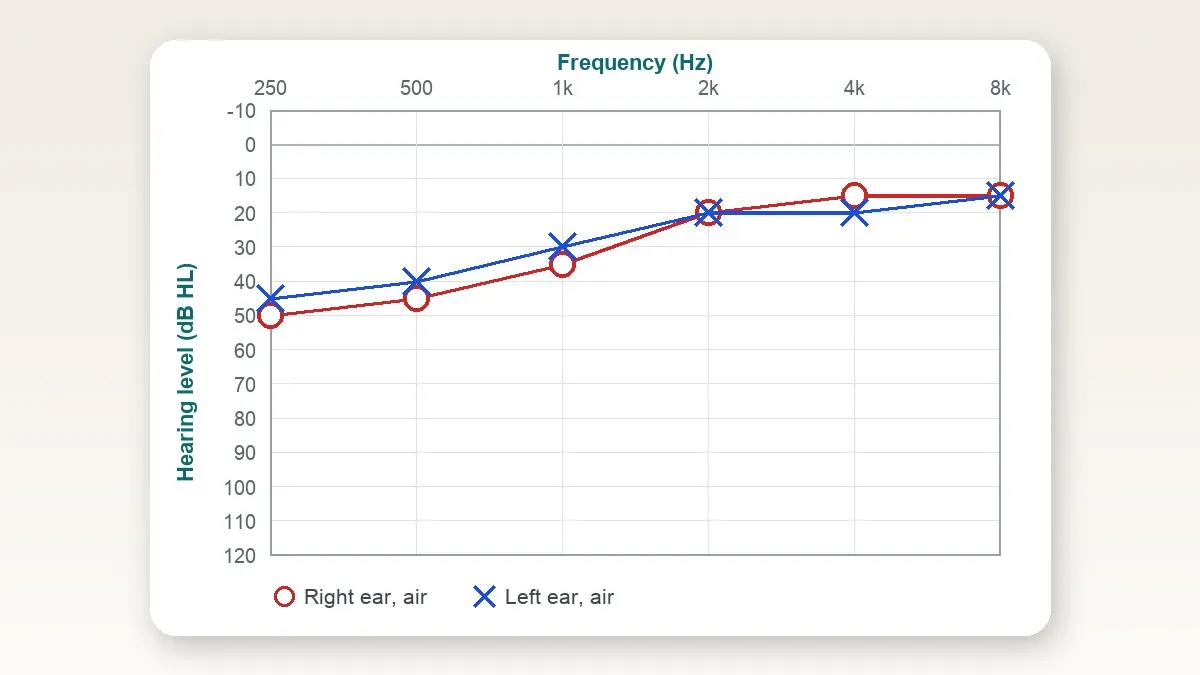
A Type A result does not, by itself, rule out every hearing problem, since some causes of hearing loss sit in the inner ear or hearing nerve and would not change eardrum movement. This is why a tympanogram is paired with an audiogram, which maps the softest sounds you can hear across different pitches.
What does a Type B tympanogram mean?
A Type B curve is flat, with no clear peak. It suggests the eardrum is not moving normally. Common reasons include:
- Fluid in the middle ear (as in otitis media with effusion), which is very common in children.
- A blocked ear canal, for example from wax, which the equipment can often flag by also measuring canal volume.
- A perforation (hole) in the eardrum or an open grommet/ventilation tube, which typically shows a flat trace with a large canal volume.
Middle-ear fluid behind the eardrum is one of the most frequent findings. Ear infections and the fluid that follows them are extremely common in early childhood; most children have at least one ear infection by their third birthday, according to the NIDCD. Fluid can dull hearing temporarily while it is present.
A Type B result is a prompt for further evaluation, not a diagnosis on its own. Your clinician interprets it with what they see on ear examination and your symptoms.
What does a Type C tympanogram mean?
A Type C curve has a peak, but it is shifted towards negative pressure. This means the pressure inside the middle ear is lower than the pressure outside. It commonly reflects a Eustachian tube that is not equalising pressure well, for instance during or after a cold, an allergy flare, or a blocked nose.
Type C is often a transient state. In many people the Eustachian tube recovers and pressure normalises. Sometimes negative pressure precedes or accompanies fluid building up, so your audiologist may recommend a repeat test after a few weeks to see how things are trending.
Do these results diagnose hearing loss?
No. A tympanogram describes the mechanical behaviour of the eardrum and middle ear. It can strongly suggest a middle-ear cause behind a hearing difficulty, and it helps separate middle-ear (conductive) issues from inner-ear ones. But the actual hearing measurement comes from an audiogram.
Read together, the two tests give a much clearer picture. For example, a Type B result alongside a mild conductive loss on the audiogram points towards fluid or a blockage, which is often treatable.
When should I see a doctor urgently?
Book a prompt review, rather than waiting, if you have sudden hearing loss in one or both ears, severe ear pain, high fever, dizziness or spinning, discharge from the ear, or facial weakness. Sudden hearing loss is treated as an emergency and needs same-day medical attention. Otherwise, you can contact our clinic to arrange a full assessment, or ask about a home visit if travelling is difficult.
Continue reading
Frequently asked questions
Is a Type C tympanogram serious?
Usually not. It reflects negative pressure in the middle ear, often linked to a temporary Eustachian tube problem after a cold or allergy. It frequently improves on its own, though a repeat test may be advised to confirm it is settling and no fluid is developing.
Can a Type B result mean I have a hole in my eardrum?
It can. A flat (Type B) trace with a large ear-canal volume may indicate a perforation or an open ventilation tube, while a flat trace with normal volume more often suggests fluid or a blockage. Your clinician distinguishes these with an ear examination.
Does a Type A tympanogram mean my hearing is normal?
Not necessarily. Type A means the eardrum and middle ear are moving normally, but some hearing loss comes from the inner ear or hearing nerve, which a tympanogram does not measure. A separate hearing test is needed to confirm your hearing levels.
How often are these tests repeated in children?
It depends on the finding. Fluid and negative-pressure results are often rechecked after a few weeks, because many resolve without treatment. Your audiologist will advise a timeline based on your child's ears and symptoms.
Where can I get a tympanometry test done?
Most audiology clinics offer it as a quick, painless part of a hearing test. You can explore your options and, if needed, hearing aids after diagnosis. Speak to a qualified audiologist to interpret results in context.
Sources & further reading
We cross-checked this article against the following authoritative sources. Guidance and figures reflect the most recent public guidance available at the time of last review (September 2026). Clinical review by the Prudent Hearing clinical team.
- NIDCD (NIH): Ear Infections in Children (nidcd.nih.gov)
- ASHA: Understanding your audiogram (asha.org)
Free consultation
Ready to hear the difference?
Book a free 45-minute hearing test at any Prudent Hearing clinic: no obligation, honest advice, expert audiologists.