Educational information, not medical advice. This article is written to help you understand common ear and hearing issues. It is not a substitute for professional diagnosis or treatment. If your symptoms are severe, sudden, or persistent, please consult a qualified doctor or audiologist. For urgent symptoms (sudden hearing loss, bleeding from the ear, severe pain with dizziness, or a head injury), seek medical care the same day.
PTA is the hearing test; the audiogram is the graph it produces. A quick, clear guide to the difference, plus what "pure-tone average" means.
Quick answer
No, they are not the same thing, though they are closely linked. PTA (pure-tone audiometry) is the hearing test itself, the procedure done in a soundproof room. The audiogram is the graph that the test produces. So one is the test, the other is the result you take home.
Key takeaways
- PTA = the test. Pure-tone audiometry is the procedure where you listen to beeps at different pitches and volumes.
- Audiogram = the graph. It is the chart of your results, plotting softest sounds you can hear across frequencies.
- PTA has a second meaning too: "pure-tone average," a single number averaged from a few key frequencies.
- People mix them up because the same three letters and the same test feed all three ideas.
- A hospital audiogram shows each ear's thresholds by pitch, not a diagnosis on its own.
No, they are not the same thing, though they are closely linked. PTA (pure-tone audiometry) is the hearing test itself, the procedure done in a soundproof room. The audiogram is the graph that the test produces. So one is the test, the other is the result you take home.
What does PTA actually mean?
PTA most often stands for pure-tone audiometry: the standard hearing test where an audiologist plays pure tones (single-pitch beeps) through headphones. You raise a hand or press a button each time you hear one, even faintly. The audiologist finds the softest level you can detect at each pitch, called your threshold.
This is the routine test that maps how well each ear hears across the range of speech and everyday sound. If you want the full walk-through of the graph and its markings, see our pillar guide, How to Read Your Audiogram: PTA Symbols.
So what is the audiogram, then?
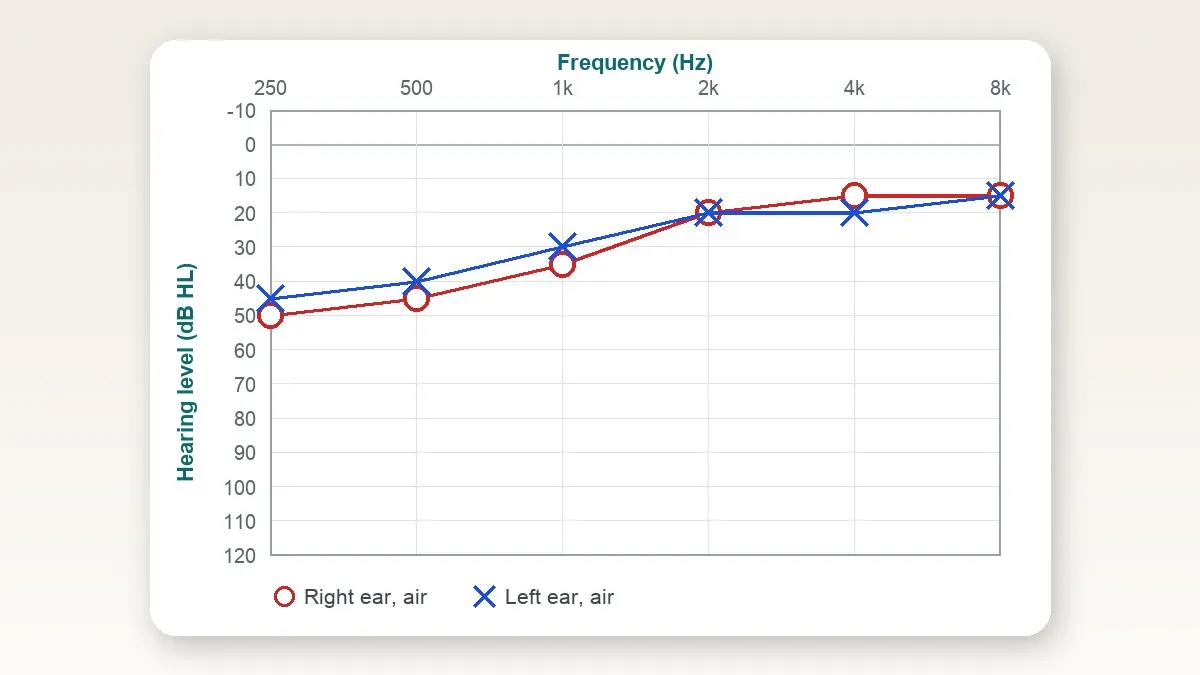
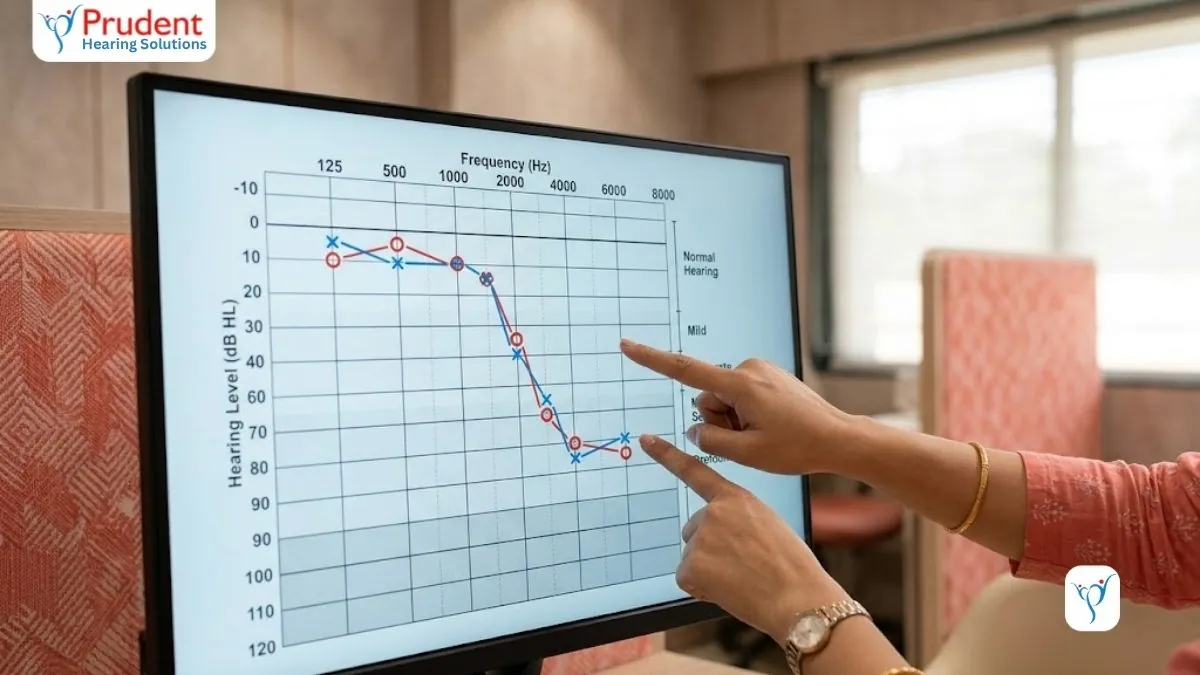
The audiogram is the picture of your results. It is a grid with pitch (frequency, in Hertz) running left to right, from low pitches to high, and loudness (in decibels) running top to bottom, from soft at the top to loud at the bottom.
Your audiologist marks the softest sound you heard at each pitch. Join those marks and you have a line for each ear. A line sitting near the top means good hearing; a line dropping toward the bottom means sounds had to be louder before you heard them.
According to ASHA, the audiogram shows the type, degree and configuration of hearing loss. In short: the audiogram is what the PTA test creates.
Then why do people call the average "PTA" too?
Here is where the confusion deepens. PTA also stands for "pure-tone average." This is a single number worked out by averaging your thresholds at a few important speech frequencies, commonly 500, 1000 and 2000 Hz.
So the same letters cover two things:
- Pure-tone audiometry: the test.
- Pure-tone average: a summary number pulled from that test's results.
Both come from the same session, which is exactly why the terms blur together. When a report says "PTA: 45 dB," it means the average, not the test name.
Why do so many people confuse PTA and the audiogram?
A few reasons pile up:
- The test and the graph happen in one appointment, so they feel like one thing.
- The abbreviation PTA does double duty (test and average).
- Hospital paperwork often just hands you the graph and a number, without labelling which is which.
- Everyday speech treats "getting a PTA" and "getting an audiogram" as the same errand.
None of this is wrong, exactly. It just helps to know the underlying difference when you are reading a report or talking to a specialist.
What does a hospital audiogram actually show?
A typical audiogram from a hospital or clinic shows:
- Separate results for each ear (right and left, usually marked O and X for air conduction).
- Thresholds across frequencies, from low to high pitch.
- The degree of any loss (mild, moderate, severe or profound) read from how far down the marks sit.
- Often a pure-tone average figure and sometimes bone-conduction marks too.
What it does not do by itself is diagnose the cause. Age-related hearing loss, for example, often shows up first in the higher pitches on the audiogram, but confirming the reason and the plan is a clinical judgement, not something the graph decides alone (NIDCD). The graph is evidence; the audiologist reads it in context.
Does this change what you should do next?
Not really, and that is the reassuring part. Whether you call it a PTA or an audiogram, the sensible step is the same: have the test done properly and have the results explained to you.
If you have noticed turning the TV up, asking people to repeat themselves, or struggling in noisy rooms, a straightforward hearing test will give you the audiogram and the numbers to work from. You can book a hearing test with our RCI-registered audiologists, and they will talk you through your own graph line by line.
Note one safety point: if hearing loss comes on suddenly in one ear, or arrives with pain, discharge or dizziness, treat it as urgent and see an ENT doctor or audiologist quickly rather than waiting for a routine appointment.
Continue reading
Frequently asked questions
Is a PTA test the same as an audiogram?
Not exactly. The PTA (pure-tone audiometry) is the test you sit for; the audiogram is the graph of your results. You need the test to get the audiogram, so they always come together, but they are two different things.
What is a normal PTA number?
"Normal" thresholds are generally in the range where you hear soft sounds without difficulty. Because clinics vary in how they band results, ask your audiologist to explain your own figure against your audiogram rather than comparing to a fixed cut-off online.
Is the audiogram a diagnosis?
No. The audiogram shows how well you hear across pitches, but the cause and the plan are decided by a qualified audiologist or ENT who reads it alongside your history and other tests.
Do I get both an audiogram and a PTA number after my test?
Usually yes. A standard pure-tone audiometry session produces the audiogram graph and, on most reports, a pure-tone average number for each ear.
Which one should I ask my audiologist for?
Ask for both: a copy of the audiogram and an explanation of your pure-tone average. Together they give you the clearest picture, and you can contact us if you would like your existing report reviewed.
Sources & further reading
We cross-checked this article against the following authoritative sources. Guidance and figures reflect the most recent public guidance available at the time of last review (September 2026). Clinical review by the Prudent Hearing clinical team.
- ASHA (Understanding your audiogram)
- NIDCD (NIH) (Age-Related Hearing Loss)
Free consultation
Ready to hear the difference?
Book a free 45-minute hearing test at any Prudent Hearing clinic: no obligation, honest advice, expert audiologists.