Educational information, not medical advice. This article is written to help you understand common ear and hearing issues. It is not a substitute for professional diagnosis or treatment. If your symptoms are severe, sudden, or persistent, please consult a qualified doctor or audiologist. For urgent symptoms (sudden hearing loss, bleeding from the ear, severe pain with dizziness, or a head injury), seek medical care the same day.
What air conduction (AC) and bone conduction (BC) mean on your audiogram, what the air-bone gap tells you, and how to read the O, X and bracket symbols.
Quick answer
On your audiogram, air conduction (AC) tests your whole hearing pathway through earphones, while bone conduction (BC) tests the inner ear directly through a small vibrator on the skull. Comparing the two shows where a problem sits: a gap between them usually points to a conductive (outer or middle-ear) cause, while both lines dropping together suggests a sensorineural (inner-ear) cause.
Key takeaways
- AC goes through the ear canal, eardrum and middle ear before reaching the cochlea; BC skips those and stimulates the inner ear straight through the skull bone.
- The space between the two lines is the air-bone gap and it is the single most useful clue on the graph.
- No gap (AC and BC together, both reduced) points to a sensorineural loss; a gap points to a conductive or mixed loss.
- Symbols matter: O and X mark air conduction (right and left), while bracket-style marks (< > or [ ]) mark bone conduction.
- The audiogram shows where and how much, not why. Only an audiologist and, where needed, a doctor can confirm the cause.
On your audiogram, air conduction (AC) tests your whole hearing pathway through earphones, while bone conduction (BC) tests the inner ear directly through a small vibrator on the skull. Comparing the two shows where a problem sits: a gap between them usually points to a conductive (outer or middle-ear) cause, while both lines dropping together suggests a sensorineural (inner-ear) cause.
What does air conduction (AC) actually measure?
Air conduction is the "normal" way you hear. Sound travels down the ear canal, vibrates the eardrum, moves the three middle-ear bones, and finally reaches the cochlea (inner ear) and hearing nerve. During testing, an audiologist plays tones through headphones or insert earphones, so the sound uses this entire pathway.
Because AC covers the whole route, a poor AC result tells you something is wrong, but not where. The blockage could be earwax, fluid, a stiff eardrum, an inner-ear problem, or a mix. That is exactly why bone conduction is added.
What does bone conduction (BC) measure?
For bone conduction, a small vibrating device (a bone oscillator) is placed on the mastoid bone behind the ear or on the forehead. The vibration travels through the skull directly to the cochlea, bypassing the ear canal, eardrum and middle-ear bones.
So BC is a cleaner test of the inner ear and hearing nerve on their own. If your inner ear works well, BC will look near-normal even when AC is reduced.
Why are both tested together?
Because comparing them is what locates the problem. Age-related and noise-related hearing loss usually sit in the inner ear, so both AC and BC are affected together (NIDCD). A middle-ear issue such as fluid or wax mostly blocks the air route, so AC drops while BC stays better. One test alone cannot separate these; two tests can.
What is the air-bone gap and what does it mean?
The air-bone gap is the difference (in decibels) between your AC and BC thresholds at the same frequency.
- No meaningful gap (roughly within 10 dB, both lines low): the inner ear itself is affected. A sensorineural hearing loss.
- A clear gap (AC noticeably worse than BC, with BC near normal): sound is being blocked before the inner ear. A conductive hearing loss (for example wax, fluid or a middle-ear problem).
- Both reduced and a gap present: a mixed hearing loss, with inner-ear and conductive parts together.
This "where does it sit" question is central to reading the whole chart, which we cover step by step in How to Read Your Audiogram: PTA Symbols.
How do the O, X and bracket symbols work?
Audiologists plot each ear with its own symbol so the graph can be read at a glance (ASHA). The common convention is:
- O: air conduction, right ear (often printed in red)
- X: air conduction, left ear (often printed in blue)
- < or [: bone conduction, right ear
- > or ]: bone conduction, left ear
So round and cross symbols are air conduction; the angled or square bracket marks are bone conduction. Colours and exact bracket shapes vary slightly between clinics, but the O/X vs bracket split stays the same. A key or legend usually appears on the sheet.
A worked example
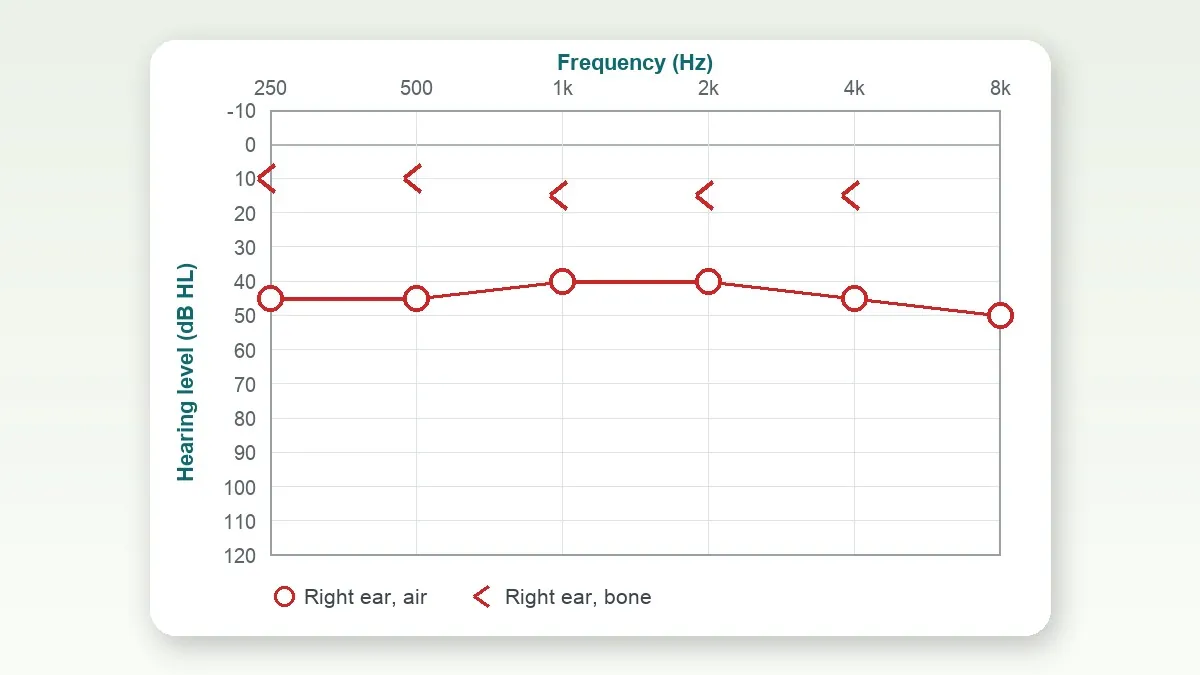
Imagine a right ear where, across the speech frequencies, the O (air conduction) marks sit around 45 dB, but the bracket (bone conduction) marks sit around 10 dB.
- AC is clearly reduced, so this ear does not hear soft sounds normally.
- BC is near normal, so the inner ear is working fine.
- The 35 dB air-bone gap points to a conductive cause: something in the outer or middle ear is blocking sound, such as wax or middle-ear fluid.
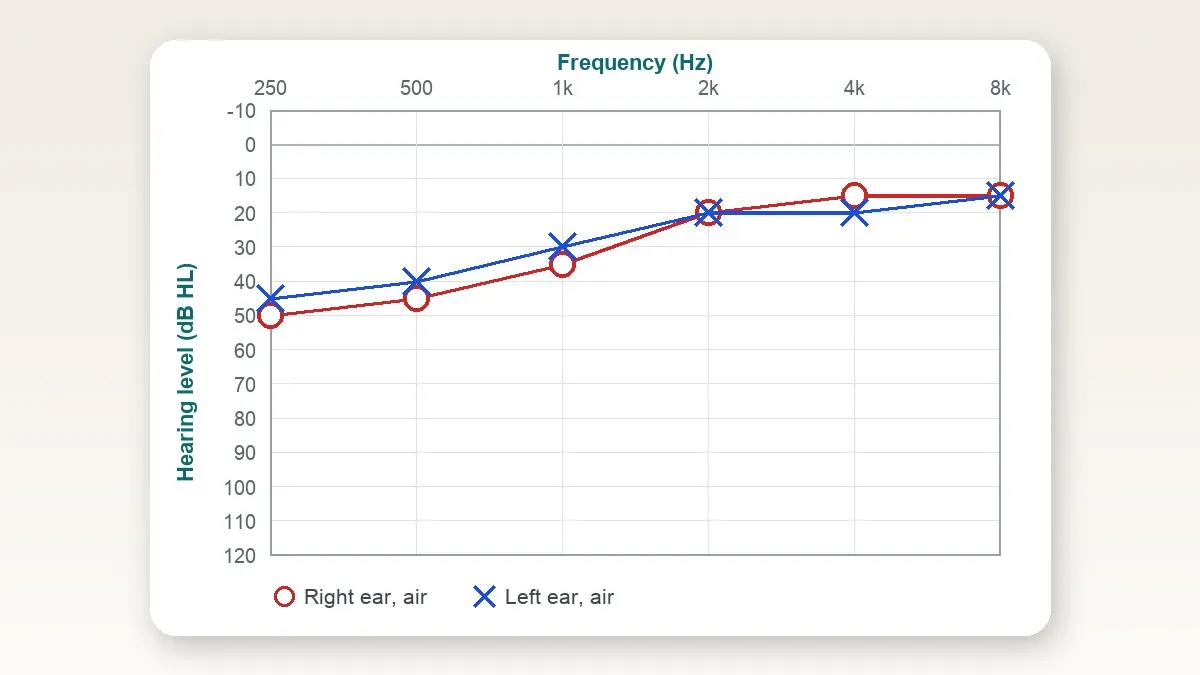
Now imagine both the O and bracket marks sitting together around 50 dB, with almost no gap. That pattern points to a sensorineural loss in the inner ear, which is the usual picture in age-related and noise-related hearing loss.
Remember: these patterns suggest a category. Confirming the exact cause needs a clinical exam, and sometimes further tests.
When should you see an audiologist?
Book a proper assessment if speech sounds muffled, you turn the volume up more than others, you struggle in noisy places, or a screening app flags a problem. A full hearing test records both AC and BC so the pattern can be read correctly, and our team can explain your own graph with you at the clinic or through a home visit if travelling is hard.
Urgent: sudden hearing loss in one ear, especially with dizziness, ringing or a feeling of fullness, should be treated as a medical emergency. See an ENT doctor or audiologist within 24 to 72 hours, as early care can matter.
Continue reading
Frequently asked questions
Is bone conduction better than air conduction?
Neither is "better": they test different things. AC checks your whole hearing pathway; BC isolates the inner ear. The value comes from comparing them, not from one replacing the other.
Can bone conduction be worse than air conduction?
Genuinely, no: the inner ear cannot perform worse than the full pathway that includes it. If BC looks worse than AC on a sheet, it usually reflects testing factors (like masking or equipment), and the audiologist will re-check it.
Does a large air-bone gap mean I need surgery?
Not necessarily. A gap only shows a conductive component. The cause could be simple wax or fluid that clears with treatment, or a middle-ear condition that a doctor evaluates. The audiogram guides the next step; it does not decide treatment on its own.
Will hearing aids fix a conductive loss shown by the gap?
Sometimes the underlying cause is treatable medically first. Where a loss is permanent, hearing aids can help, but the right plan depends on your full result and an ENT opinion where needed.
Why did the tester put a buzzing device behind my ear?
That is the bone oscillator used for the bone-conduction test. The gentle buzzing you feel through the bone is how sound is sent straight to your inner ear, bypassing the ear canal and middle ear.
Sources & further reading
We cross-checked this article against the following authoritative sources. Guidance and figures reflect the most recent public guidance available at the time of last review (September 2026). Clinical review by the Prudent Hearing clinical team.
- NIDCD (NIH) (Age-Related Hearing Loss)
- ASHA (Understanding your audiogram)
Free consultation
Ready to hear the difference?
Book a free 45-minute hearing test at any Prudent Hearing clinic: no obligation, honest advice, expert audiologists.