Educational information, not medical advice. This article is written to help you understand common ear and hearing issues. It is not a substitute for professional diagnosis or treatment. If your symptoms are severe, sudden, or persistent, please consult a qualified doctor or audiologist. For urgent symptoms (sudden hearing loss, bleeding from the ear, severe pain with dizziness, or a head injury), seek medical care the same day.
How to prepare for a hearing test: rest your ears from loud noise, leave wax alone, bring your medicines list. The PTA itself takes about 20 to 30 minutes.
The short answer: very little preparation, but a few things matter
Preparing for a hearing test takes almost no effort, and that is the honest headline. A standard pure tone audiometry (PTA) test needs no fasting, no medicines stopped and no special clothing. What it does need is ears that are as close to their normal state as possible on the day, so the result reflects your real hearing rather than a temporary blip.
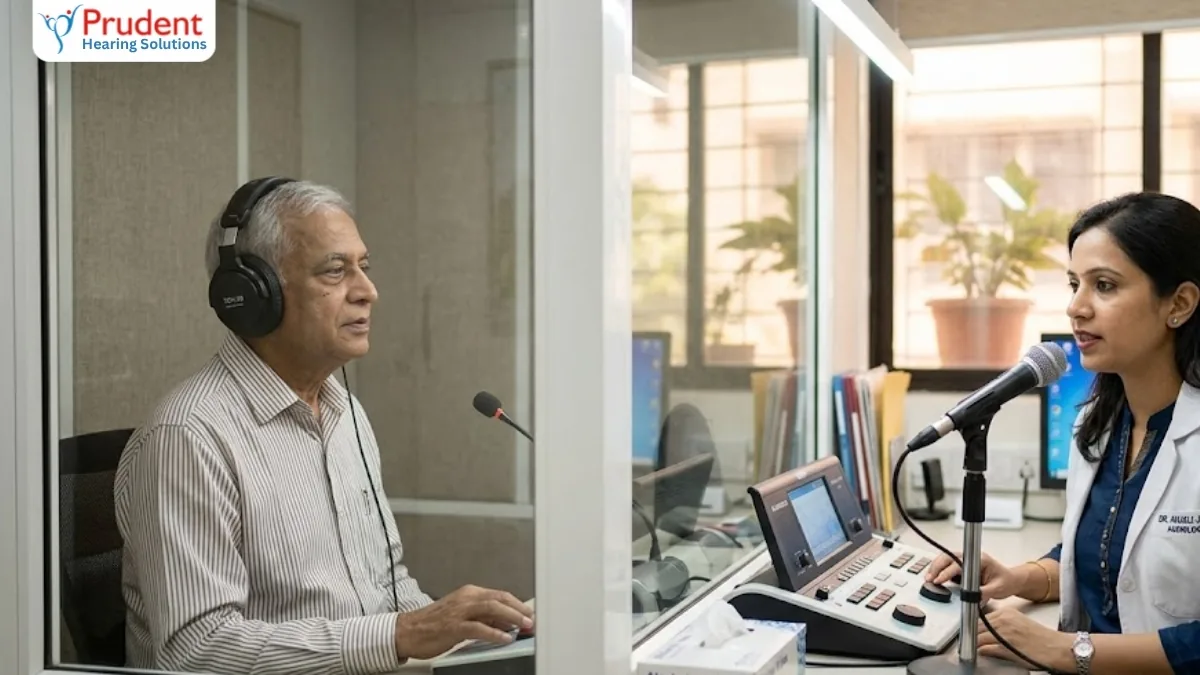
The pure tone part itself usually takes about 20 to 30 minutes; a full assessment at Prudent is a free 45-minute appointment, which leaves time to check your ears, test carefully and explain what the numbers mean.
Below is what to do the day before, what to bring, what happens in the room, and the few situations where it is better to move the appointment. If you want the test itself explained in depth, read our guide to the PTA test (pure tone audiometry).
The day before: rest your ears from loud noise
The single most useful thing you can do is avoid loud noise for at least the day before. A loud wedding DJ, a cinema, firecrackers, a drill at work, or a long commute with earphones turned up can all cause a temporary dip in hearing, sometimes with ringing afterwards. That dip usually recovers, but if it is still there when you are tested, your audiogram can look worse than your true hearing.
This matters most for people who work in noise. If your job involves machinery, construction or loud music, try to book the test after a quiet day off, or first thing in the morning before a shift. If you cannot avoid noise, tell the audiologist, so the result is read in that light.
- Skip concerts, weddings with loud DJs and firecrackers the night before if you can.
- Keep earphone volume low, or leave them out, on the way to the appointment.
- If you work somewhere noisy, mention how recently you were exposed.
Leave your ear wax alone, and tell us if an ear feels blocked
Please do not clean your ears with cotton buds, hairpins or oil before the test. Cotton buds tend to push wax deeper, and a freshly irritated ear canal helps nobody. The audiologist looks into both ears before testing; if wax is blocking the canal, it can make you sound deafer than you are, so it may need to be removed first and the test done after that. Our guide to ear wax removal, microsuction versus syringing explains the options, and what happens during otoscopy shows what that first look involves.
What to bring to your hearing test
A few things make the appointment far more useful. None is compulsory, but each one saves a second visit or a guess.
| What to bring | Why it helps |
|---|---|
| A list of your medicines | Some medicines can affect hearing or cause ringing, so the audiologist will want to know. |
| Earlier audiograms or ENT reports | Comparing old and new results shows whether your hearing has changed, and how fast. |
| Your hearing aids, if you wear them | They can be checked, and we can see how they are set for your current hearing. |
| A family member | A second person notices things you may not, and helps you remember what was explained. |
| Your questions, written down | It is easy to forget them once the test starts. |
| Your phone | Useful if hearing aids come up, because Bluetooth streaming depends on the handset. |
It also helps to think, before you arrive, about where you struggle most: phone calls, the television, family meals, meetings, or one particular voice. Note any ringing (tinnitus), dizziness, ear pain or discharge, and whether one ear seems worse than the other. These details guide which tests are done and how the results are read.
When to move the appointment, and when not to wait
A heavy cold, a blocked nose or an ear infection can block the middle ear for a while and make hearing temporarily worse. If you are unwell in that way, call us. Often it is better to test once the blockage has settled, so you do not end up with a result that reflects the cold rather than your ears.
There is one important exception. If your hearing dropped suddenly in one or both ears, over hours or a day or two, do not wait for a cold to clear or for a convenient slot. Sudden hearing loss needs to be seen urgently, ideally the same day; read why in sudden hearing loss is a medical emergency.
"Rule of thumb: a gradual change can wait for a good day to test. A sudden change should not wait at all."
How long a hearing test takes, step by step
How long a hearing test takes depends on what is included. The pure tone part, where you press a button for soft beeps, usually takes about 20 to 30 minutes. A complete assessment takes longer, because there is more to it than beeps. At Prudent we set aside about 45 minutes for the free hearing test, roughly in this order:
- A short conversation about your hearing, your health, any noise exposure and what you want help with.
- Otoscopy: a quick, painless look into each ear canal and at the eardrum.
- Pure tone audiometry: headphones first (air conduction), then a small vibrator behind the ear (bone conduction).
- Speech testing: how clearly you follow words, not just whether you hear sound.
- Explaining the result: your audiogram, what it means, and sensible next steps.
Further tests, such as tympanometry to check how the eardrum moves, are added when your history or the first results suggest they are needed.
During the test: tips for an accurate result
The beeps are meant to be faint. The audiologist is looking for the quietest sound you can just detect, so many tones will feel uncertain. That is normal and expected. Press the button as soon as you think you hear a tone, even a very soft one, but try not to press in rhythm or just because you expect one is coming. Sit still, breathe normally and say if the headphones are uncomfortable.
If you have tinnitus, mention it beforehand. The ringing can sometimes be confused with the test tones, and there are ways to work around that. And if you are anxious, say so: there is no pass or fail, and nobody minds repeating a tone.
Hearing tests for children and older parents
Very young children cannot press a button, so they are tested differently, with play-based methods or objective tests such as OAE and BERA; see BERA, ABR and OAE hearing tests. For older parents, the main preparation is practical: book a time of day when they are alert, bring their glasses and any hearing aids, and go with them.
Many families find the conversation after the test as useful as the test itself. Our guide to what to expect at a parent's first hearing test covers how to raise it gently and what happens on the day.
After the test, and booking yours
You leave with your audiogram and a plain explanation of it. What happens next depends on the result, from 'no action needed' to a referral to an ENT or a hearing aid trial; we walk through every scenario in after your hearing test: what happens next. If you are not sure whether you need a test at all, our list of signs you need a hearing test is a good place to start.
Book a free hearing test at any Prudent clinic: Pune (Viman Nagar), Mumbai (Malabar Hill and Kandivali), Navi Mumbai (Seawoods), Delhi (Rohini and Green Park) or Bengaluru (Jayanagar), or ask about a home visit in other cities. Our RCI-registered audiologists (MASLP or BASLP qualified) will do the test and explain it properly. Call +91 94296 90093. Prudent Hearing Solutions.
Free consultation
Ready to hear the difference?
Book a free 45-minute hearing test at any Prudent Hearing clinic: no obligation, honest advice, expert audiologists.