BTE vs CIC hearing aids compared: pros, cons, cost in India, and how to match the style to your degree of hearing loss, dexterity and daily life.
Walk into any hearing clinic and the first real decision is not the brand on the box. It is the shape of the aid. Behind-the-ear (BTE) and completely-in-canal (CIC) aids sit at two ends of the same shelf: one rests over the top of your ear, the other hides deep inside the canal.
Both run the same kind of digital technology, yet they suit very different ears, hands and lives. This guide puts them head to head, then gives you a simple way to match the style to your degree of hearing loss, your finger dexterity and your daily routine. Treat it as preparation for a proper hearing test, not a replacement for one. The final call always comes from your audiogram.
The short answer, in one line
BTE aids are larger, sit behind the ear, and handle every degree of loss from mild to profound. They are the most flexible and by far the easiest to handle. CIC aids are tiny custom pieces that sit inside the ear canal, are nearly invisible, and suit mild to moderate loss in people with steady fingers. If you want power and easy handling, lean BTE. If you want discretion and have a milder loss, lean CIC. Everything below is the detail behind that one sentence.
What is the difference between BTE and CIC hearing aids?
The core difference is where the electronics sit and, because of that, how much sound the aid can safely deliver. That single fact drives almost everything else: visibility, battery life, comfort, Bluetooth and the range of hearing loss each style can cover.
Behind-the-ear (BTE): the workhorse
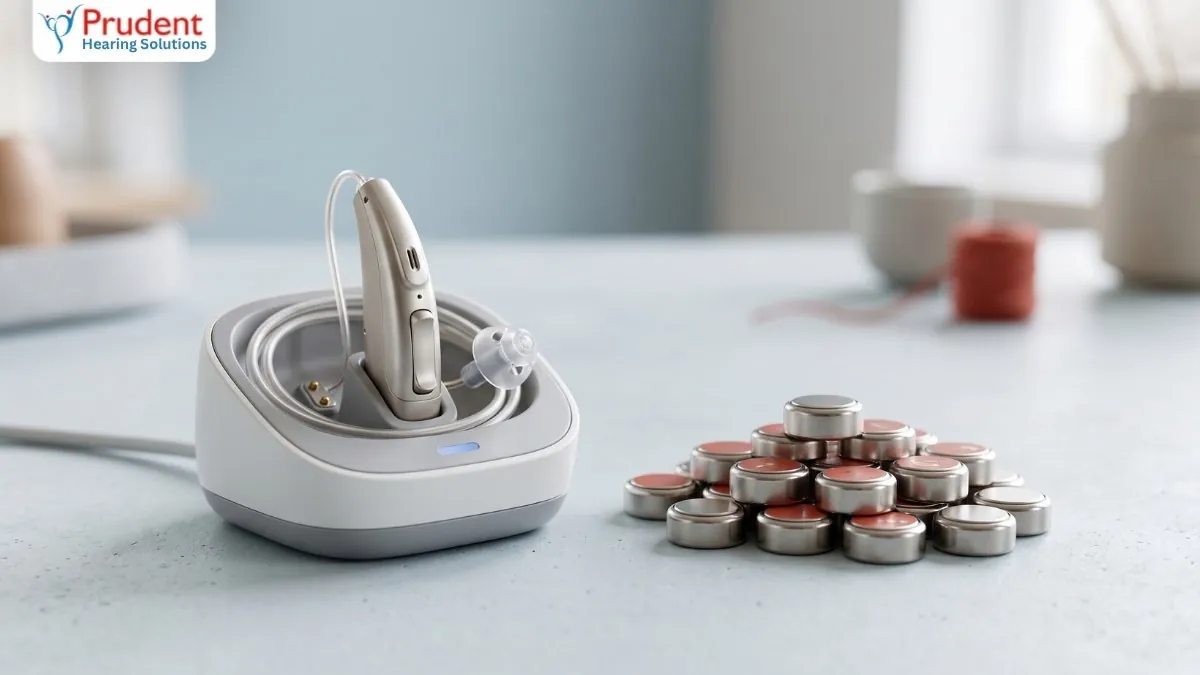
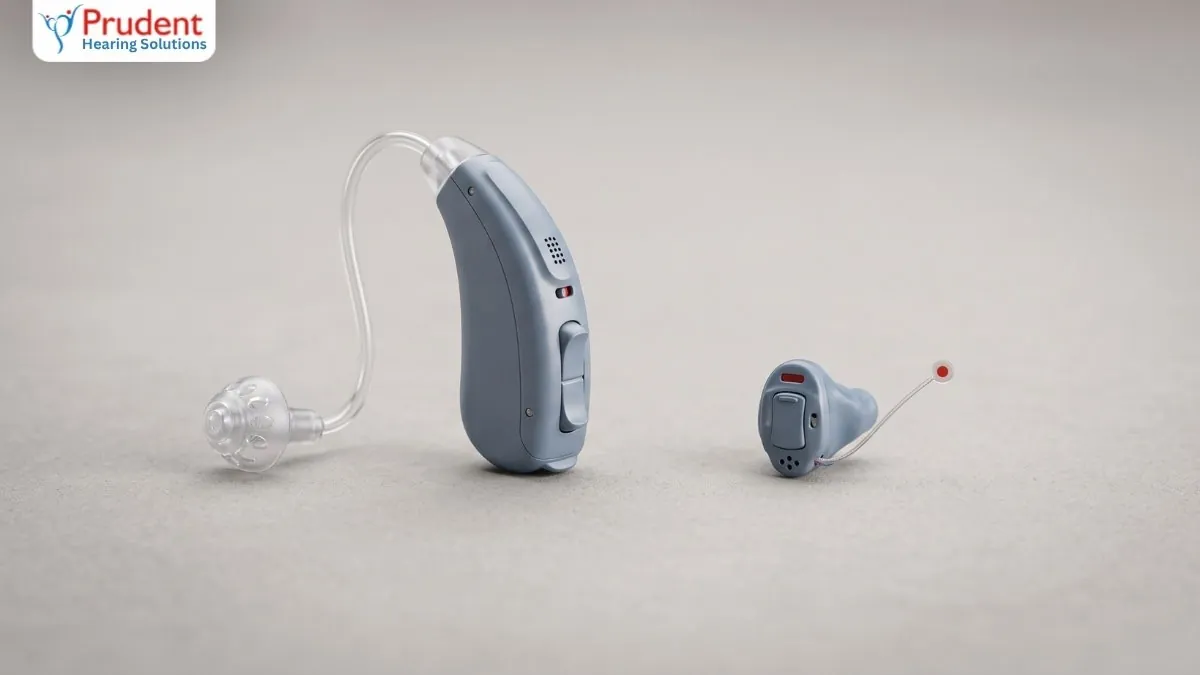
A BTE aid has a small curved case that rests behind your outer ear. It holds the microphone, chip, amplifier and battery. Sound travels down a thin tube or wire into the ear, either through a soft dome or a custom earmould. Because the case sits outside the ear, engineers can fit a larger receiver and battery, which is exactly why BTEs cover the widest range of hearing loss of any style.
- Sits behind the ear; nothing fills the whole canal, so ears feel less blocked
- Larger body and controls, so easier to insert, clean and adjust
- Available with rechargeable batteries and Bluetooth streaming on most models
- Powerful enough for severe and profound loss when fitted with a custom mould
- More visible than in-canal styles, though modern slim-tube versions are quite discreet
Completely-in-canal (CIC): the discreet one
A CIC aid is a single custom-moulded piece, built from an impression of your ear. It sits fully inside the canal with only a tiny removal cord showing. Everything (microphone, chip, receiver, battery) is squeezed into that little shell. Because it sits close to the eardrum and uses your natural outer ear to gather sound, many users find phone calls and wind easier to manage.
- Sits deep in the canal; barely visible to others
- Uses the ear's natural shape to catch sound, which can help on the telephone
- No tubes or wires over the ear, so nothing to catch on glasses or masks
- Uses very small batteries and tiny controls; needs steady fingers and good eyesight
- Best for mild to moderate loss; limited power for severe loss
BTE vs CIC: a side-by-side comparison
Here is how the two stack up on the points people ask about most in the clinic:
- Visibility: CIC wins, nearly invisible. BTE is seen more, though slim tubes are subtle.
- Range of loss: BTE covers mild to profound. CIC handles mild to moderate, occasionally moderately-severe.
- Handling: BTE is far kinder to small or unsteady fingers. CIC is fiddly.
- Battery and charging: BTE offers bigger, longer-lasting and rechargeable options. CIC mostly uses small size-10 disposable cells.
- Bluetooth and streaming: common and reliable on BTE. Limited on most CICs because the antenna barely fits, though a few newer models add it.
- Wax and feedback: a CIC sits in a warm, waxy canal, so it needs more cleaning and can whistle if wax builds up. A BTE keeps its electronics outside the canal.
- Comfort: a BTE with an open dome feels airy; a CIC fills the canal and can feel plugged for the first weeks.
- Servicing: a CIC's tight build and canal moisture mean slightly more repairs over the years.
"The best hearing aid is not the smallest or the most powerful. It is the one you will wear all day, handle without frustration, and actually hear well with."
Pros and cons at a glance
BTE: pros and cons
- Pros: fits every degree of loss; easy to handle and clean; the best battery and rechargeable options; reliable Bluetooth; sturdy and long-lasting
- Cons: more visible than in-canal aids; can catch on spectacles or masks; open fittings let in some ambient sound
CIC: pros and cons
- Pros: discreet and cosmetic; natural sound pickup that helps on the phone and in wind; nothing sitting over the ear
- Cons: limited power; small, fiddly batteries and controls; more wax-related cleaning; often no or limited Bluetooth; costs a little more to make for the same technology tier
How do I know which type of hearing aid is right for my level of hearing loss?
Start with your audiogram, the graph from your hearing test that shows how soft a sound you can hear at each pitch. Your degree of loss (mild, moderate, severe or profound) sets the outer limit of which styles can physically give you enough sound. Style is a choice; adequate power is not. If you are not sure how to read yours, our guide on <a href="/blog/understanding-your-audiogram">understanding your audiogram</a> walks through it in plain language.
Mild to moderate loss
Almost every style is on the table, including CIC. If discretion matters and your fingers are steady, a CIC can work beautifully here. Open-fit BTE and RIC aids are also excellent at this level and keep the ear feeling natural and un-plugged.
Moderate to moderately-severe loss
BTE and RIC become the safer bet. A CIC can sometimes be pushed into this range, but feedback (whistling) and limited output start to work against it. A BTE with a custom mould gives cleaner, louder sound with fewer day-to-day problems.
Severe to profound loss
This is BTE territory, full stop. Only a power BTE with a snug custom earmould can deliver the amplification you need without whistling. A CIC simply cannot hold a big enough receiver. Trying to force a tiny aid onto a severe loss usually ends in disappointment and a return trip to the clinic.
- Mild loss: BTE, RIC, ITE, CIC, IIC (genuinely your choice)
- Moderate loss: BTE, RIC, ITE, often CIC
- Moderately-severe loss: BTE, RIC, sometimes a power ITE
- Severe to profound loss: power BTE with a custom earmould
Beyond hearing loss: dexterity, lifestyle and your ears
Two people with the same audiogram often walk out with different styles, because the audiogram is only the first filter. Three everyday factors decide the rest.
Manual dexterity and eyesight
CIC aids use size-10 batteries (about the size of a lentil) and have almost no external controls. If arthritis, tremor, neuropathy or weak eyesight make small objects hard to grip, a CIC becomes a daily struggle. A BTE with a larger body, a drop-in rechargeable dock and a phone app is far kinder to unsteady hands. This is why we often steer older users toward BTE or RIC.
Your daily listening life
Think about where you actually need to hear. Lots of phone calls, noisy restaurants, meetings, music and television push you toward a BTE or RIC with Bluetooth streaming and stronger noise handling. If your life is quieter and you mostly want easy one-to-one conversation without anyone noticing the aid, a CIC's discretion is a real advantage. Our guide to <a href="/blog/bte-hearing-aids-guide-india">behind-the-ear and Bluetooth hearing aids</a> covers streaming in more detail.
The shape of your ear canal and wax
Very narrow or sharply curved canals may not take a CIC comfortably, and heavy earwax or frequent ear infections make deep in-canal aids harder to maintain. India's damp monsoon months add to that. A quick look inside your ear during the test tells the audiologist a great deal about what will last for you.
What about RIC and ITE, the middle ground?
BTE and CIC are the two ends of the range; most people actually land somewhere in between. A receiver-in-canal (RIC) aid looks like a slim BTE but places the receiver inside the ear on a thin wire: discreet, comfortable, and now the single most popular style we fit. In-the-ear (ITE) and in-the-canal (ITC) aids are custom pieces larger than a CIC: easier to handle, and roomy enough to hold Bluetooth and a bigger battery while staying fairly discreet.
If a CIC feels too fiddly but a BTE feels too visible, one of these is usually the answer. Our full guide on <a href="/blog/how-to-choose-the-right-hearing-aid">how to choose the right hearing aid</a> compares all of them, and for the tiniest custom options see our guide to <a href="/blog/invisible-cic-iic-hearing-aids">invisible CIC and IIC hearing aids</a>.
Prices in India: what BTE and CIC cost
Style affects price far less than the technology tier inside. The same chip can go into a BTE or a CIC, so you are mostly paying for the processor, not the shape. As a rough guide per device:
- Entry level: around ₹11,000–₹30,000
- Mid-range: around ₹35,000–₹80,000
- Premium: around ₹1,20,000–₹2,00,000
CIC and other custom aids can cost a little more than a comparable BTE at the same tier, because each shell is made to order from an impression of your ear. Your final price depends on your audiogram and the features you actually need. See our <a href="/blog/hearing-aid-price-in-india-2026">hearing aid price guide for India</a> for the full breakdown. At Prudent Hearing Solutions we also offer 0% EMI, so cost need not push you into the wrong style.
Our honest clinic take
Neither style is simply 'better'. They solve different problems. If you have a milder loss, steady hands and discretion is your priority, a CIC is a lovely, near-invisible choice. If you have more than a moderate loss, or you want easy handling, long battery life and reliable Bluetooth, a BTE or RIC will serve you better and for longer.
Remember that hearing aids manage hearing loss; they do not cure sensorineural loss, and the fitting and follow-up matter as much as the device itself. The right decision comes from your audiogram, a look inside your ears and an honest conversation about your day, not from a picture on a website.
Still not sure which way to lean? Book a free 45-minute digital hearing test at any Prudent Hearing Solutions office: Pune (Viman Nagar), Delhi (Rohini or Green Park) or Bengaluru (Jayanagar). Our RCI-registered audiologists will read your audiogram, examine your ears and let you try BTE and custom in-canal styles from Phonak, Signia, Oticon, Widex, ReSound, Starkey and Unitron before you decide, with 0% EMI available. Call +91 9429690093 or WhatsApp +91 8485096505 to fix a time.
Continue reading
Frequently asked questions
What is the difference between BTE and CIC hearing aids?
A behind-the-ear (BTE) aid has a small case that rests behind your outer ear and sends sound down a thin tube or wire into the canal, while a completely-in-canal (CIC) aid is a tiny custom piece that sits fully inside the ear canal.
Because a BTE holds a larger receiver and battery, it covers every degree of loss from mild to profound and is much easier to handle, whereas a CIC is nearly invisible but suits mild to moderate loss and needs steady fingers. BTE models also offer better battery life, rechargeable options and reliable Bluetooth; most CICs are too small for consistent streaming. In short: BTE trades a little visibility for power and easy handling, and CIC trades power for discretion.
How do I know which type of hearing aid is right for my level of hearing loss?
Start with your audiogram, which shows your degree of loss (mild, moderate, severe or profound), because that sets the outer limit of which styles can give you enough sound. Mild to moderate loss can use almost any style, including CIC; moderately-severe loss is safer with a BTE or RIC; and severe to profound loss really needs a power BTE with a custom earmould.
After that, your finger dexterity, eyesight, daily listening needs and the shape of your ear canal narrow the choice further. The most reliable way to decide is a professional hearing test where an audiologist reads your audiogram, looks inside your ears and lets you trial the options.
Are CIC hearing aids good for severe or profound hearing loss?
Generally no. A CIC is too small to hold a powerful enough receiver, so pushing one onto a severe or profound loss usually causes whistling (feedback) and not enough volume. For those levels a power behind-the-ear aid with a snug custom earmould is the dependable choice. CIC aids are best kept to mild and moderate losses.
Which hearing aid style is better for elderly users, BTE or CIC?
For most elderly users a BTE or RIC is the kinder choice, mainly because of handling rather than sound. BTE aids have a larger body, simple rechargeable docks and a phone app, which matter when arthritis, tremor or weaker eyesight make tiny CIC batteries and controls hard to manage. A CIC can still suit an active, dexterous person with a milder loss who wants discretion, so the decision is best made individually at a fitting.
Do CIC hearing aids have Bluetooth for phone calls and streaming?
Most CIC aids do not, because the shell is usually too small to fit a reliable Bluetooth antenna. A few newer premium CIC models are starting to add limited streaming, but if hands-free calls, music and TV streaming are important to you, a BTE or RIC is the safer bet. Your audiologist can tell you which current models offer streaming in a size that fits your ear.
Free consultation
Ready to hear the difference?
Book a free 45-minute hearing test at any Prudent Hearing clinic: no obligation, honest advice, expert audiologists.