Most adults should have a baseline hearing test by age 50 and then one every three years. Every year is better if you already wear hearing aids, work around loud noise, or have diabetes. Here is the schedule by age and situation.
The short answer
Adults with no hearing complaints should have a baseline hearing test around age 50, then repeat it every three years. If you already have hearing loss, wear hearing aids, work in a noisy job, or have a condition such as diabetes, test once a year. Children are tested at birth, again before school, and whenever a parent or teacher notices a problem.
Hearing loss usually creeps in over years, and the brain quietly adapts. Most people only notice once a meaningful amount has already been lost. A regular test catches that early, when treatment is simplest.
Recommended schedule by age
- Newborns: Screening in the first month of life. If a baby does not pass, a diagnostic test (BERA/ABR) follows within three months. See our guide to newborn hearing screening in India.
- Children, 3 to 17: A check before starting school and then whenever there are signs: frequent ear infections, asking for the TV louder, slow speech, or inattention in class. Children with repeated ear infections or glue ear need closer follow-up.
- Adults, 18 to 49: A baseline test once, ideally in your 30s or 40s, especially if you use earphones for hours or work near noise. Test sooner if you notice ringing, muffled sound or trouble following speech.
- Adults, 50 to 64: Every three years. Age-related loss (presbycusis) typically begins in this decade, most often in the high pitches where consonants sit.
- Adults, 65 and above: Every one to two years. Loss is common by this age, and untreated loss is linked to social withdrawal and faster cognitive decline.
When you should test every year
- You already wear hearing aids. Your needs change and the aids should be re-tuned against a fresh audiogram.
- You work in a loud setting such as a factory, construction site, call centre with headsets, or live music.
- You have diabetes, high blood pressure, kidney disease or a family history of hearing loss.
- You take medicines that can affect the ear (ototoxic drugs), for example some chemotherapy and certain antibiotics. See our guide to medicines that affect hearing.
- You have tinnitus that is constant or getting worse.
When you should not wait for the next scheduled test
Book a test straight away if you notice any of the following, whatever your age:
- Hearing that drops suddenly in one or both ears. This is a medical emergency; see an ENT the same day.
- Ringing, fullness or muffled sound in one ear only.
- Asking people to repeat themselves several times a day.
- Turning the TV up while others in the room say it is too loud.
- Dizziness or balance problems together with any change in hearing.
What a routine test actually involves
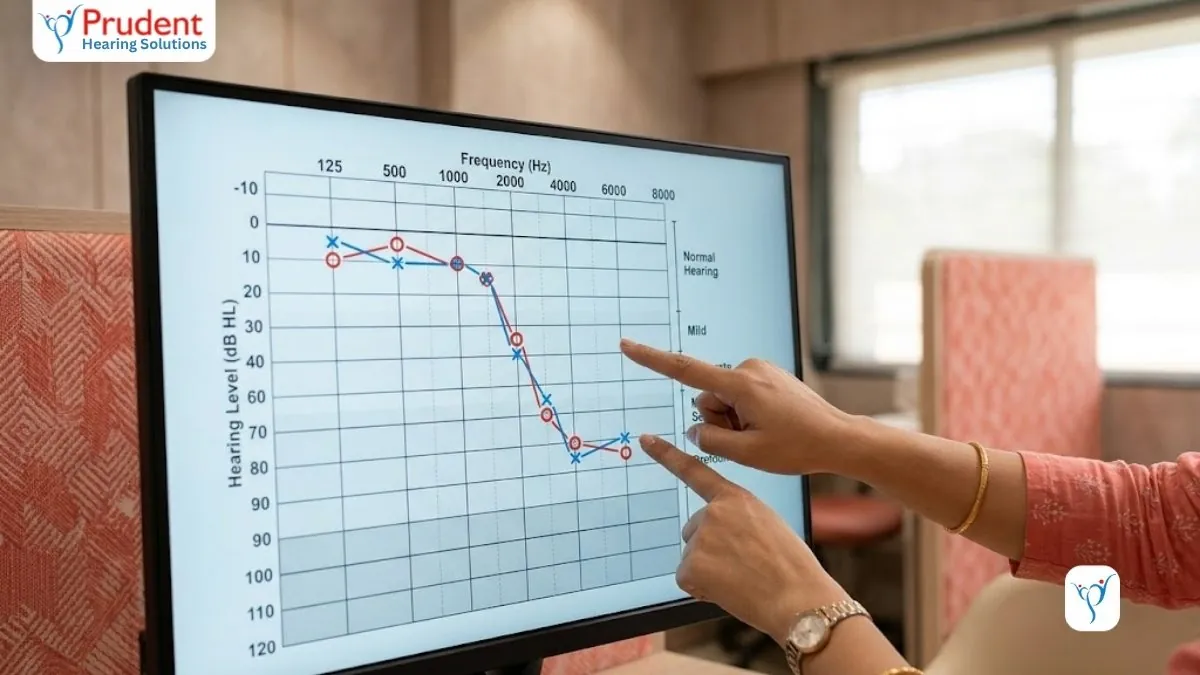
A routine test at Prudent is painless and takes about 45 minutes. It includes a look in the ear canal, a pure-tone test in a sound-treated booth, a speech test to see how clearly you understand words, and, where needed, a middle-ear test. You leave with an audiogram, a chart of what you hear at each pitch, and a plain explanation of what it means. To know what the results look like, read understanding your audiogram.
What a normal result does and does not mean
A normal result today does not guarantee it will stay normal. It gives you a baseline, and that baseline is the real value. Next time, the audiologist compares against it and can spot a small change long before you would notice it yourself.
Book yours
Our free hearing test is available at our clinics in Pune, Delhi and Bengaluru, and we also offer a home visit for people who cannot travel. Call +91 9429690093, Monday to Saturday, 10am to 7pm.
Frequently asked questions
How often should adults get a hearing test?
Have a baseline test around age 50, then repeat it every three years. From 65 onwards, every one to two years is sensible, because age-related loss is common by then.
Who should have a hearing test every year?
People who already wear hearing aids, work in a loud setting, have diabetes, high blood pressure, kidney disease or a family history of hearing loss, take ear-damaging (ototoxic) medicines, or have tinnitus that is constant or worsening.
When should I get a hearing test straight away?
Do not wait for the next scheduled test if your hearing drops suddenly, which is a medical emergency, or if you notice ringing, fullness or muffled sound in one ear, keep asking people to repeat themselves, or have dizziness with any change in hearing.
How often should children have a hearing test?
At birth through newborn screening, again before starting school, and whenever a parent or teacher notices signs such as poor response to sound or delayed speech.
What does a routine hearing test involve?
At Prudent it takes about 45 minutes and is painless: a look in the ear canal, a pure-tone test in a sound-treated booth, a speech test and, where needed, a middle-ear test. You leave with an audiogram and a plain explanation.
Free consultation
Ready to hear the difference?
Book a free 45-minute hearing test at any Prudent Hearing clinic: no obligation, honest advice, expert audiologists.