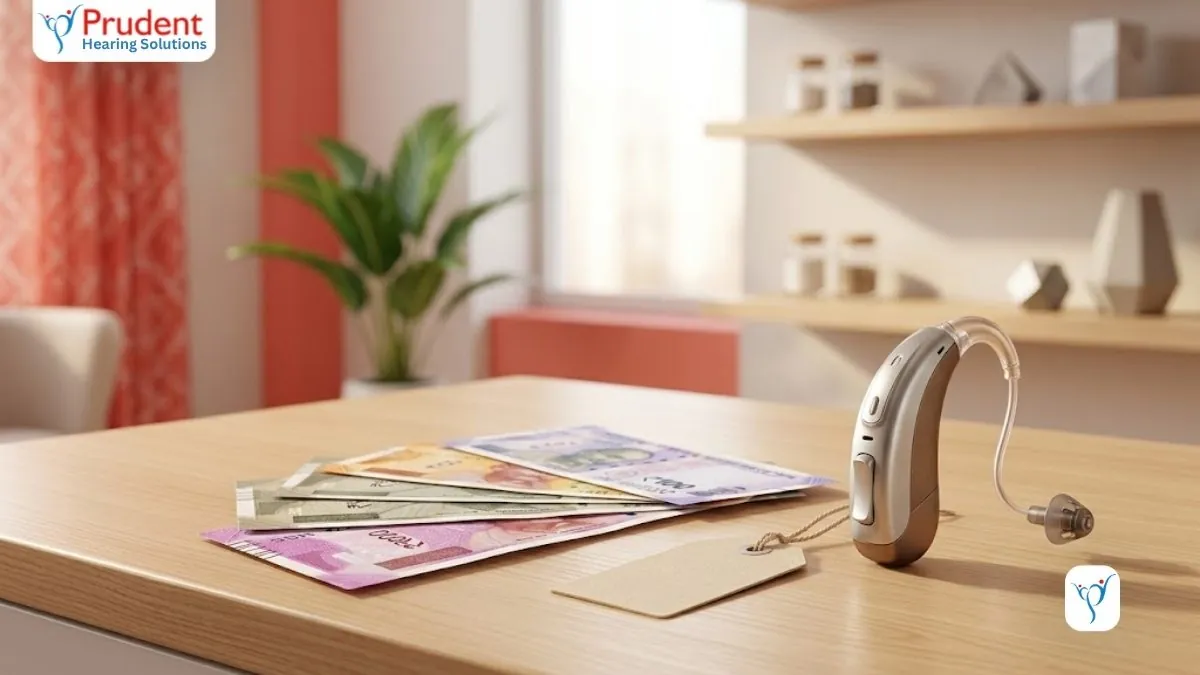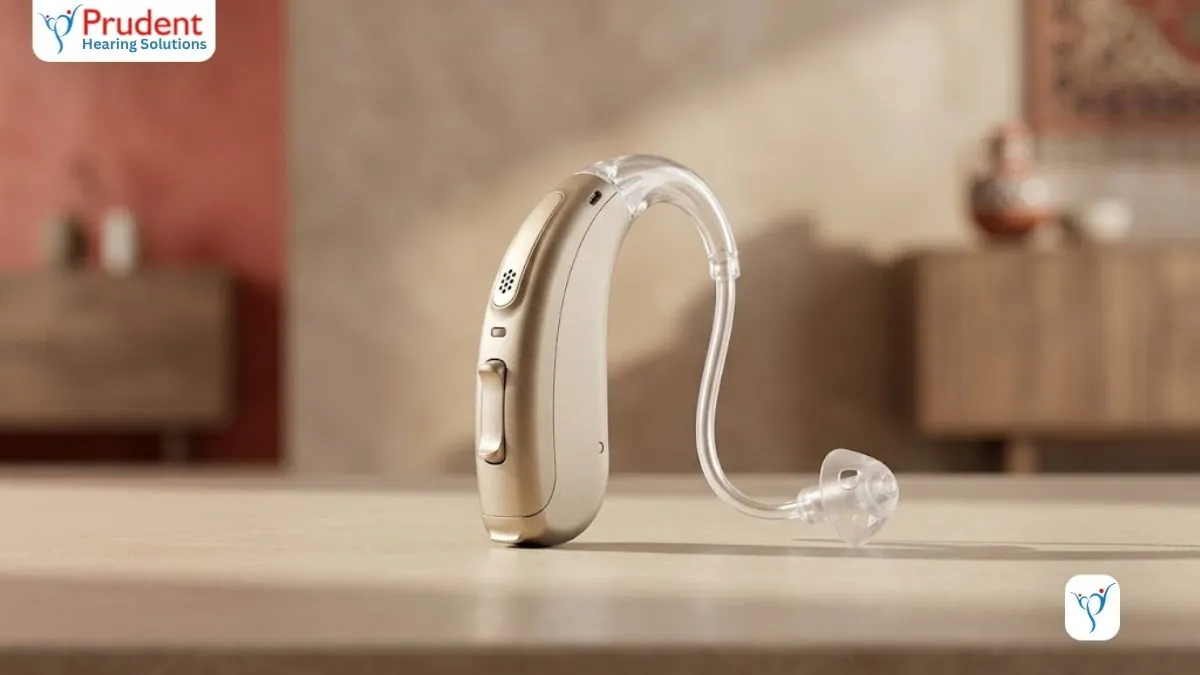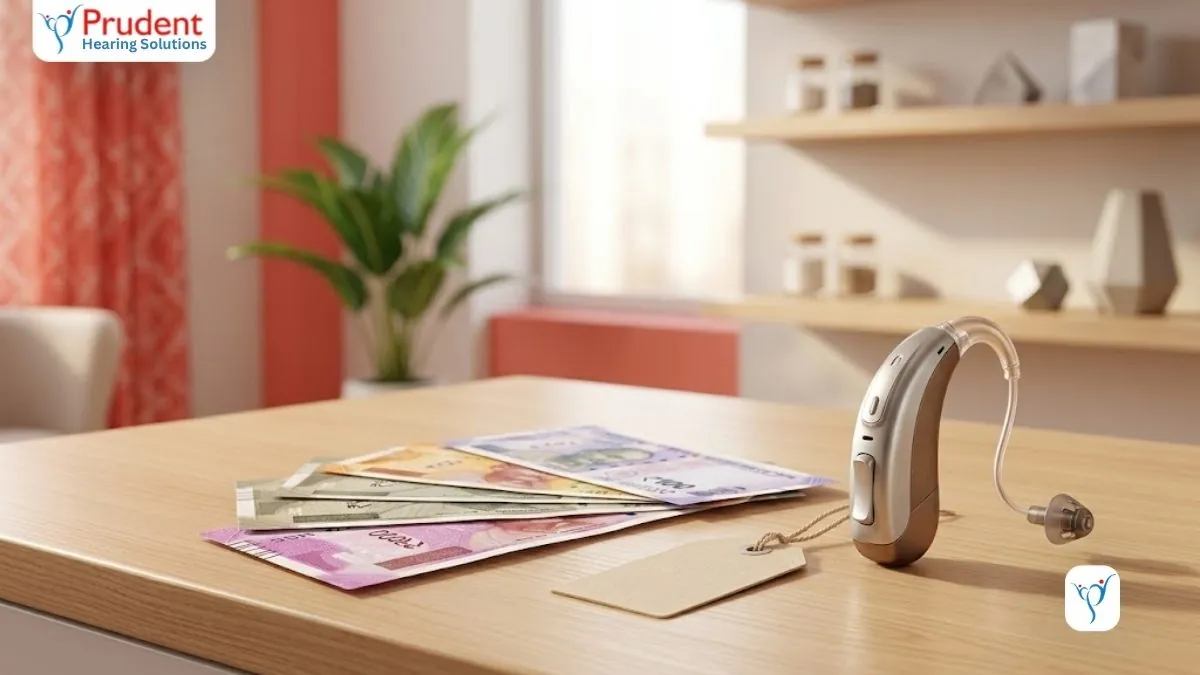
The cheapest genuine hearing aid in India starts at Rs 10,990 MRP per ear (Signia Fast P, a basic 4-channel BTE), and MRP is the list price, with up to 30-50% off at Prudent. The cheap ear machines sold online are amplifiers, not fitted hearing aids, and can make your hearing worse.
Quick answer
The cheapest genuine hearing aid in India starts around ₹10,990 MRP per ear (the Signia Fast P, a basic 4-channel BTE), and Prudent typically sells 30 to 50% below MRP. That buys a real, fitted digital aid, not the ₹1,000 to ₹3,000 'ear machines' sold online, which are unfitted amplifiers that can worsen hearing. Entry-level aids suit mild-to-moderate loss, with fewer automatic and noise features than premium tiers.
Key takeaways
- Genuine entry-level digital aids start about ₹10,990 MRP per ear (Signia Fast P); Prudent sells below MRP.
- Cheap online 'ear machines' are unfitted amplifiers, not prescription hearing aids.
- Entry aids suit mild-to-moderate loss; you give up advanced noise and automatic features.
- 0% EMI, ADIP and tax relief can lower the real cost further.
- A proper hearing test and fitting matter even at the entry level.
The cheapest genuine hearing aid on the 2026 Indian price lists is the Signia Fast P at Rs 10,990 MRP per ear, a basic 4-channel BTE that a qualified audiologist programmes to your audiogram. One step up, the Signia Run (8 channels, Rs 18,990) and Prompt (8 channels, Rs 20,990) give the audiologist more channels to follow the shape of your loss.
MRP is the manufacturer's list price, not what you pay. Prudent gives up to 30-50% off it, and your real figure is confirmed in writing at your appointment. The much cheaper devices advertised on marketplaces and at roadside counters are not hearing aids at all. They are sound amplifiers, and the difference matters more than the price gap suggests.
Cheap versus cheap-and-good
Cheap means the number on the tag is small. Cheap-and-good means the number is small and the device actually improves your ability to follow a conversation without damaging what hearing you have left. Those two things separate at roughly the Rs 10,000 line. Below it you are almost always buying volume. Above it, from a fitted aid, you are buying volume that has been shaped to the exact frequencies you have lost, with the frequencies you still hear normally left alone. That shaping is the product you are paying for.
What the cheap "ear machine" actually is
A cheap "ear machine" is almost always a personal sound amplifier, not a hearing aid. Walk through any medical market in Pune or Karol Bagh, or open any large Indian marketplace app, and you will find devices called "ear machine", "hearing amplifier" or "sound enhancer", usually with a photo of a smiling grandfather. Inside is a microphone, a small analogue or crude digital amplifier, a speaker, and a volume wheel. Some are assembled perfectly well.
The problem is what they do: a personal sound amplifier raises everything by the same amount, so the fan, the traffic, the pressure cooker and the one voice you were trying to hear all come up together. Most adult hearing loss is sloping, meaning you have lost the high frequencies that carry consonants like s, f, th and k while the low frequencies are close to normal.
An amplifier makes the noise you already heard fine much louder and barely helps the sounds that carry meaning. People wear one for a week, say everything is just loud and they still cannot understand, and put it in a drawer.
There is a further problem that sellers rarely mention: an unfitted amplifier can make your hearing worse. A fitted hearing aid is programmed with an MPO, or maximum power output, set below the level at which sound becomes uncomfortable or harmful for you specifically, calculated from your audiogram. An amplifier has no such ceiling.
Turn the wheel up because you still cannot follow the conversation, and a door slam or a horn can push well past safe levels straight into an ear that already has damage. We have seen patients arrive with a measurably worse audiogram after months with a cheap amplifier at maximum volume. Hearing aids manage hearing loss rather than cure it, and an amplifier does not even manage it.
The real 2026 entry-level price list
These are MRP figures from the 2026 manufacturer price lists, per ear (a single unit). MRP is the manufacturer's list price, not what you pay. Prudent gives up to 30-50% off it, and your real figure is confirmed at the appointment once we know which model suits your loss. Where a listing says "Kit", that means a pair, so two units. Hearing aids are GST-exempt in India; accessories are not.
- Signia Fast P: BTE, 4 channels, Rs 10,990 MRP per ear. The genuine floor for a fitted digital aid from a major brand.
- Signia Fun P / SP: BTE, 6 channels, Rs 13,990 MRP per ear.
- Signia Run P / SP / Click: BTE or ITC/CIC, 8 channels, Rs 18,990 MRP per ear.
- Signia Prompt: BTE or ITC/CIC, 8 channels, Rs 20,990 MRP per ear.
- Signia Intuis 3: RIC or BTE, 12 channels, Rs 26,990 MRP per ear. More channels means finer shaping across frequencies.
- Phonak Terra: RIC 312 or BTE, 8 fine-tuning channels, Rs 33,000 MRP per ear.
- Phonak Terra+: RIC 312 or BTE, 10 fine-tuning channels, Rs 42,000 MRP per ear.
See full specs and India pricing for the Phonak Terra and Signia Intuis 3, compare the budget end across every brand we fit, or shortlist by need in our best hearing aids in India guide.
Every model and current price sits on our live price list, with brand-specific pages for Signia and Phonak. For the full picture across brands and levels, see our hearing aid price guide for 2026, or browse the range we fit.
What you get at the entry level
- Real digital signal processing, programmed to your audiogram. The aid amplifies 4kHz by a different amount than 500Hz, because that is what your ears need. This alone is the reason to buy it.
- 4 to 12 independent channels. Each channel is a frequency band the audiologist can adjust on its own, so the more channels, the more precisely the prescription can follow the shape of your loss.
- Basic noise reduction. It will not perform miracles in a wedding hall, but it takes the edge off steady noise like a fan or an air conditioner.
- Feedback cancellation, so you do not get the whistling that plagued old aids.
- Compression, which makes soft sounds audible without making loud sounds painful, plus the MPO ceiling that protects your ears.
- A real fitting appointment, real-ear verification where indicated, a follow-up tuning after you have lived with it for a few weeks, and a manufacturer warranty.
- A shell that fits your ear, in a style suited to your loss and dexterity: BTE, RIC, or a custom ITC/CIC.
What you give up
- Rechargeability. Entry aids typically run on button batteries (size 312 or 13), which you change every 5-10 days. Manageable, but it needs fingers that can handle a small cell. See rechargeable vs battery for the trade-off.
- Bluetooth streaming. Limited or none at this level: no direct calls to your ear, no music streaming, usually no smartphone app. If that matters to you, read our Bluetooth hearing aids guide before deciding it is essential.
- Advanced directional microphones that automatically narrow onto the voice in front of you in a crowded room. Entry aids handle quiet rooms well and noisy rooms adequately.
- Automatic programme switching. You may need to press a button when moving from the living room to the market.
- Motion sensors, AI scene classification, tinnitus masking on some models, and the other premium refinements covered in our features guide.
The discount, EMI and government routes
The sticker frightens people away from a device they can afford. Take the Signia Prompt at Rs 20,990 MRP per ear. Apply our discount of up to 30-50% off that list price and the real figure drops substantially; the exact number depends on the model and is confirmed at your appointment rather than guessed at online. Split it across 0% EMI over 6 or 12 months and the monthly outgo becomes modest.
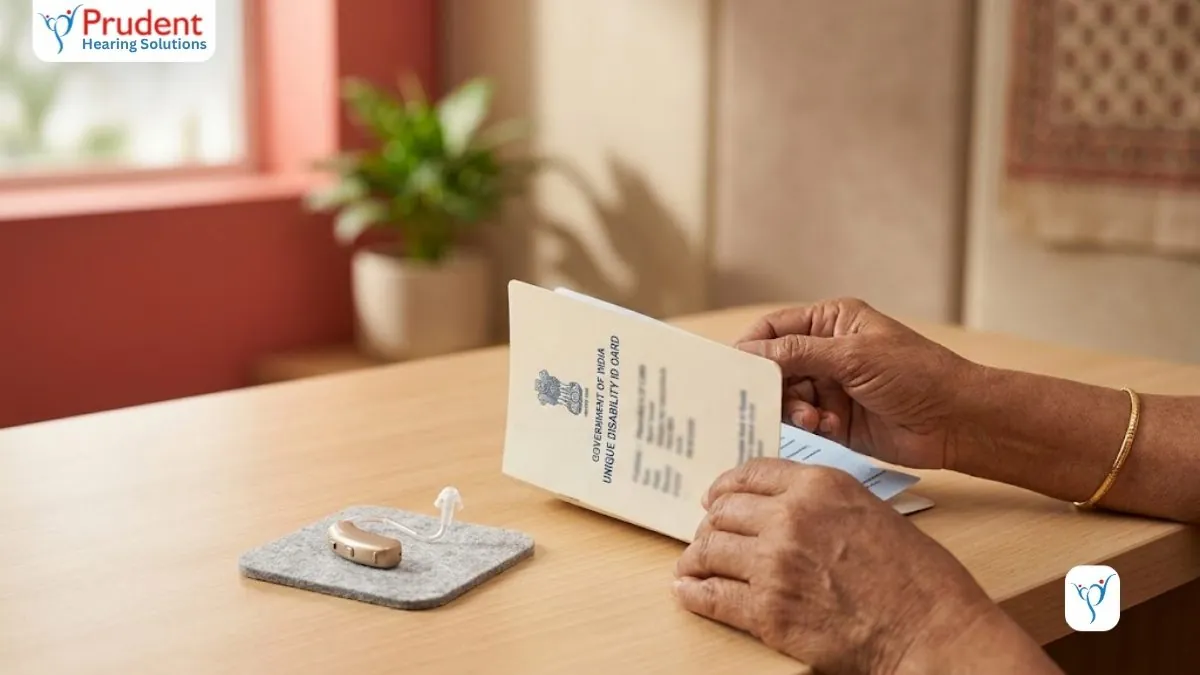
Our EMI and finance guide covers how it works, which cards qualify and what documents you need. There is also the government route: the ADIP scheme and various state programmes provide free or heavily subsidised aids for those who qualify on income and disability-certificate criteria. The devices are basic and the waiting can be long, but for genuinely low-income families it is the right first stop. Our government schemes guide explains eligibility and paperwork. Some employer and health policies contribute too; see hearing aids and insurance in India.
Which entry model, and how to choose between the brands
Neither Signia nor Phonak is the better brand. Both make capable entry aids, and the right one depends on four things. Your audiogram comes first: the shape and depth of your loss decides whether 8 channels can follow it or whether you need the finer tuning of 12, and whether a standard receiver has the power you need.
Then your phone and how you use it, since streaming behaviour differs between platforms and matters more to some people than others. Then power needs, because a BTE with a stronger receiver suits a severe or sloping-to-profound loss that a small RIC cannot serve. Then budget, including whether two aids at one level beat one aid at a higher level.
Within those constraints the Signia Fast P at Rs 10,990 MRP is the lowest-priced genuine option (a 4-channel BTE), the Fun and Run (6 and 8 channels, Rs 13,990 and Rs 18,990) sit between it and the Prompt, and the Signia Prompt at Rs 20,990 MRP comes as a BTE or a custom ITC/CIC if discretion matters (see our invisible CIC and IIC guide).
The Signia Intuis 3 at Rs 26,990 MRP adds 12 channels and RIC or BTE styling, worth the step up if your loss has an awkward shape.
The Phonak Terra at Rs 33,000 MRP offers 8 fine-tuning channels as RIC 312 or BTE, and the Terra+ at Rs 42,000 MRP has 10. Our RIC guide and BTE guide explain the styles, and Signia vs other brands plus the 10 brands overview lay out the differences without the marketing. What none of these tiers take away is the core ability to hear speech clearly in a quiet or moderately noisy room.
Buying at the bottom of the market without getting burned
- Get an audiogram first. A proper hearing test is quick and inexpensive, and our audiometry cost guide has the figures. Without it nobody can programme anything, and anyone selling you a device without one is selling you an amplifier with a better name.
- Ask directly whether the device is programmed to your audiogram. If the seller cannot show you the fitting software with your thresholds loaded, walk out.
- Insist on a trial. You should hear the device in your own ear, in a real room, before paying.
- Check whether the price quoted is per ear or per pair. Cheap online listings blur this deliberately.
- Confirm warranty and follow-up. An aid needs at least one tuning visit after the first few weeks. A device sold with no follow-up is not being fitted, it is being shipped.
- Buy from an RCI-registered clinic. That is the baseline, not a bonus.
If you are new to all this, our first-time buyer guide and how to choose the right hearing aid cover the ground in order. If you are buying for a parent, best hearing aids for senior citizens is the better starting point.
If what brought you here was searching "kaan ki machine price", that page is the same conversation in the words most families actually use. And if you are not yet sure you need any of this, start with signs you need a hearing test and types and causes of hearing loss.
"The cheapest hearing aid that you actually wear every day beats the most expensive one sitting in a drawer. But an unfitted amplifier is not a bargain. It takes your money, fails to help you understand speech, and can quietly cost you more hearing on the way."
What to do next
Book a hearing test, get your audiogram, and let an audiologist tell you the honest floor for your specific loss. Sometimes that floor is the Signia Prompt. Sometimes your loss needs more than 8 channels can deliver, or more power than a small receiver can give, and we will tell you that rather than sell you something that will disappoint you. Every model and MRP is published on our price list, and you can get in touch on +91 9429690093 to book at our clinics in Pune, Delhi or Bengaluru.
Continue reading
Frequently asked questions
What is the cheapest good hearing aid in India in 2026?
The Signia Fast P at Rs 10,990 MRP per ear (a single unit): a basic 4-channel BTE programmed to your audiogram by an audiologist. That is the lowest-priced genuine fitted digital hearing aid from a major brand on the 2026 lists; the 8-channel Signia Run (Rs 18,990) and Prompt (Rs 20,990) give finer tuning.
MRP is the manufacturer's list price; Prudent gives up to 30-50% off it, so what you pay is lower and is confirmed at your appointment. The next steps up are the Signia Intuis 3 at Rs 26,990 MRP (12 channels) and the Phonak Terra at Rs 33,000 MRP (8 fine-tuning channels).
Why can I find hearing aids for a few hundred rupees online? Are they real?
Those are personal sound amplifiers, not hearing aids. They have a microphone, an amplifier, a speaker and a volume wheel, but no programming, no matching to your audiogram, no output ceiling. They raise every sound equally, so the fan and the traffic get as loud as the voice you were trying to hear. Most hearing loss is high-frequency, so an amplifier boosts the noise you already heard fine and barely helps the consonants that carry meaning. They are legal to sell, but they are not the same product.
Can a cheap ear machine damage my hearing?
Yes, it can. A fitted hearing aid has a maximum power output set below your own discomfort and safety threshold, calculated from your audiogram. An unfitted amplifier has no such limit. If you turn the volume up because you still cannot follow speech, a sudden loud sound such as a horn or a door slam can push past safe levels into an ear that is already damaged. We have seen patients whose audiogram worsened after months of using a cheap amplifier at high volume.
What do I lose by buying an entry-level hearing aid instead of a premium one?
Usually rechargeability (entry aids use button batteries), Bluetooth streaming and app control, advanced directional microphones for noisy rooms, and automatic programme switching. What you keep is the important part: real digital processing tuned to your audiogram, 4-12 channels, basic noise reduction, feedback cancellation, and a safe output ceiling. For quiet homes and one-to-one conversation, an entry aid does the job. For restaurants and large gatherings, the premium tier earns its money.
Is Signia or Phonak better at the entry level?
Neither brand is better across the board. The choice rests on your audiogram (whether 8 channels can follow the shape of your loss or you need 12), your phone and how much streaming matters to you, your power needs (a stronger BTE receiver for a severe loss versus a small RIC), and your budget.
The Signia Fast P at Rs 10,990 MRP per ear (4 channels) is the lowest-priced genuine option and the 8-channel Signia Prompt is Rs 20,990; the Signia Intuis 3 is Rs 26,990 MRP with 12 channels; the Phonak Terra is Rs 33,000 MRP with 8 fine-tuning channels and the Terra+ Rs 42,000 MRP with 10. All are list prices, with up to 30-50% off at Prudent.
Should I get one hearing aid instead of two to save money?
Only if your hearing loss is genuinely in one ear. If both ears have lost hearing and you fit only one, you cannot locate where sounds come from, you struggle more in noise, and the unaided ear tends to get worse at understanding speech over time even though its audiogram does not change.
If budget forces a choice, two entry-level aids are often a better outcome than one mid-range aid. Remember that MRP figures are per ear unless the listing says Kit, which means a pair. That decision belongs in the fitting appointment, not in a price comparison.
Which hearing aid is the best value for money for mild to moderate hearing loss in India?
For mild to moderate loss, the best value is usually an entry to mid-range digital aid from a major brand, roughly Rs 11,000 to 40,000 per ear, fitted and programmed to your audiogram. Signia's entry range starts at Rs 10,990 MRP per ear (Fast P) and ReSound at Rs 20,995, before discounts of up to 30-50% off MRP. Spending more mainly buys better performance in noise, so a quieter lifestyle rarely needs a premium model. The fitting matters more than the badge.
Sources & further reading
We cross-checked this article against the following authoritative sources. Guidance and figures reflect the most recent public guidance available at the time of last review (July 2026). Clinical review by the Prudent Hearing clinical team.
- Hearing Aids (National Institute on Deafness and Other Communication Disorders (NIDCD, NIH))
- Registered audiologists in India (Rehabilitation Council of India (RCI))
Free consultation
Ready to hear the difference?
Book a free 45-minute hearing test at any Prudent Hearing clinic: no obligation, honest advice, expert audiologists.