A complete India guide to BTE hearing aids: types (mini, RIC/RITE, power), who they suit, honest pros and cons, brands, and realistic price bands per ear.
If you have started looking at hearing aids in India, the behind-the-ear style, usually shortened to BTE, is almost certainly one your audiologist will show you. It is the shape most people picture when they think of a hearing aid: a small curved case that rests behind the ear, connected to the ear canal by a slim tube or a fine wire.
BTE is also the most versatile family of hearing aids, powering everything from a child's first device to the strongest aids made for profound loss. This guide explains, in plain language, what a BTE hearing aid is, the different types, who it suits, its honest pros and cons, and how to choose the right one in India.
What is a BTE hearing aid?
A behind-the-ear hearing aid keeps all the working parts, the microphones, amplifier, battery and controls, inside a small case that sits behind your ear, tucked against the head where hair and the ear itself hide most of it. From that case, the sound has to travel into your ear canal, and this is where BTE splits into two designs that often confuse first-time buyers.
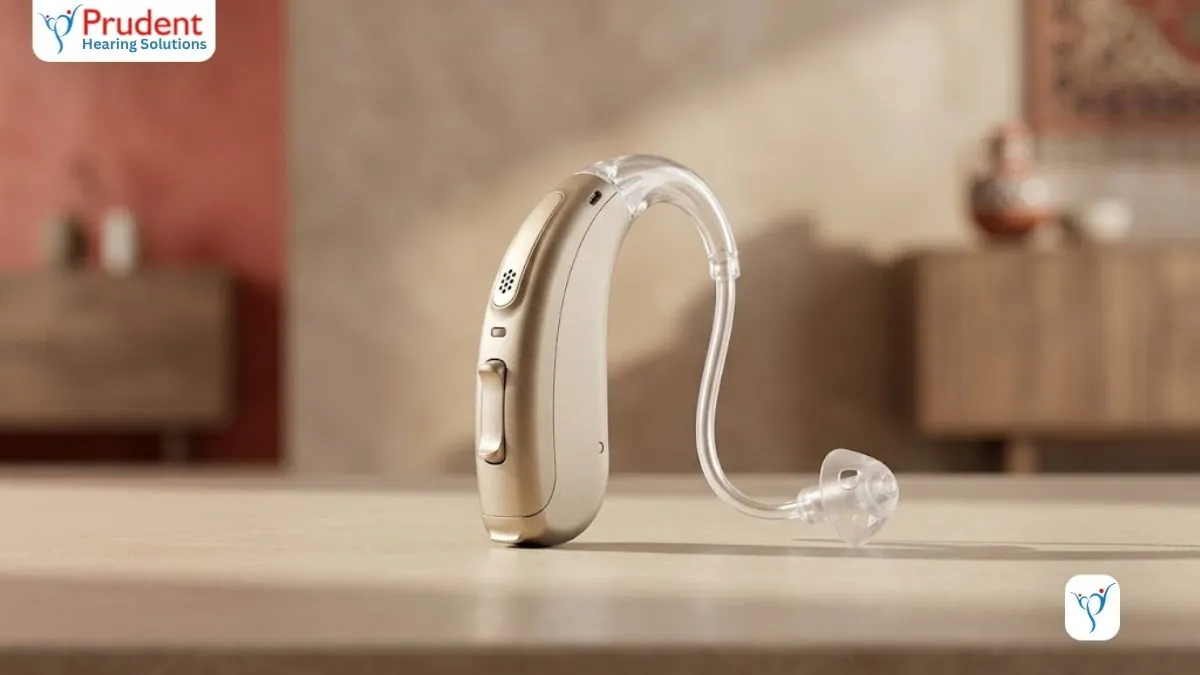
In the classic BTE, a clear plastic tube carries the amplified sound from the case, over the top of the ear, down to a custom earmould that sits snugly in your ear. The loudspeaker (called the receiver) lives inside the case. This is the sturdy, high-power arrangement that has been trusted for decades.
In the newer variation, the receiver is not in the case at all; instead a thin wire runs down to a tiny speaker that sits directly inside your ear canal, held by a soft dome or a small custom tip. This design is called RIC (receiver-in-canal) or RITE (receiver-in-the-ear), two names for essentially the same idea.
How RIC and RITE relate to classic BTE
It helps to think of RIC/RITE as a slimmer, modern member of the BTE family rather than a completely different animal. The case still sits behind the ear, so it is still a behind-the-ear device. The key difference is where the speaker lives. In a classic BTE the speaker is in the case and pushes sound down a tube to an earmould; in a RIC the speaker is moved out of the case and placed in the ear itself, connected by a discreet wire.
Moving the speaker into the ear lets the behind-the-ear case shrink dramatically, so a RIC looks far less noticeable than a traditional BTE. The trade-off is that the receiver sits in a warm, waxy environment and can need more frequent cleaning or replacement. Both are BTE at heart; your audiologist chooses between them based on your hearing level and ear health.
Anatomy and how it works day to day
Whatever the sub-type, a BTE works the same way. The microphones on the top of the case pick up sound from around you. A small computer chip inside analyses that sound, decides which parts to boost (usually speech) and which to soften (usually background noise), and shapes everything to match the exact pattern of your hearing loss. The amplified signal then reaches your ear, either through the tube and earmould or through the wire and receiver. All of this happens many times a second, quietly and automatically.
In daily life a BTE is genuinely easy to live with. You pop it on in the morning, hooking the case over your ear, and it settles into place. There is usually a rocker switch or button for volume and programmes, a battery door or a charging contact, and, on modern models, a smartphone app for finer control. Because the case sits outside the ear, the parts that do the electronics are protected from earwax and moisture, which is one reason BTEs tend to be so reliable.
Types of BTE hearing aids
BTE is really an umbrella term. Under it sit three practical styles, and knowing the difference helps you follow what your audiologist recommends.
Standard and mini BTE with earmould
This is the traditional design: a behind-the-ear case connected by a tube to a custom earmould. Standard BTEs are a little larger, which allows bigger batteries, stronger amplification and larger, easier-to-use controls. Mini BTEs are a scaled-down version for milder losses, often using a thin tube and a soft dome instead of a full earmould for a lighter, more open feel. The custom earmould can be remade whenever needed, which matters a lot for growing children and for anyone who wants a very secure, sealed fit for maximum power.
RIC and RITE
As explained above, RIC/RITE moves the speaker into the ear canal on a thin wire, letting the behind-the-ear case become small and discreet. This has become the most popular everyday style for mild to moderately-severe loss because it is comfortable, natural-sounding and barely visible. It is also the style most often paired with rechargeable batteries and Bluetooth streaming, so it tends to be the modern default when high power is not the main concern.
Power and super-power BTE
For severe-to-profound hearing loss, there is no substitute for a dedicated power or super-power BTE. These are purpose-built to deliver very high amplification without whistling or feedback, using a strong receiver housed in a sturdy case and a tightly sealed custom earmould to hold all that sound in. If your loss is significant, this category is often the only style that can give you genuinely usable hearing, which is exactly why BTE remains irreplaceable at the high-power end of the market.
Who is a BTE hearing aid best for?
BTE suits an unusually wide range of people, which is why it is the most-fitted style worldwide. It tends to be the right choice for:
- People with severe-to-profound hearing loss, where a power BTE with a custom earmould delivers the amplification smaller in-the-ear styles simply cannot.
- Children, because a durable behind-the-ear case survives active play, and the earmould can be remade cheaply and quickly as their ears grow, without replacing the whole device.
- Older users and anyone with dexterity or eyesight challenges, since larger BTEs have bigger buttons, easier battery doors or simple drop-in charging, and are easier to handle than a tiny in-canal aid.
- People who want the longest battery life and the most features, as the larger case leaves room for bigger batteries and fuller technology.
- Anyone whose ear canals are prone to wax or moisture, since keeping the electronics outside the ear improves reliability.
If you are weighing this style against the tiniest in-ear options, our detailed BTE versus CIC comparison walks through the fit, visibility and power differences side by side so you can see which suits your ears and lifestyle.
Pros and cons of BTE hearing aids, honestly
No style is perfect for everyone, and BTE is no exception. Here is the balanced view.
The advantages
- Power: BTEs, especially power and super-power models, cover the widest range of hearing loss, right up to profound.
- Durability: the tough case handles knocks, sweat and daily wear well, which is ideal for children and active users.
- Easier handling: larger controls, batteries and charging contacts suit anyone with limited dexterity or eyesight.
- Longer battery life and fuller features: the roomier case allows bigger batteries and more technology.
- Flexible and re-fittable: tubes, domes and earmoulds can be changed or remade as your ears or hearing change.
The trade-offs
- Visibility: classic and power BTEs are more noticeable than in-the-ear or invisible styles, though modern RIC models are very discreet.
- Size behind the ear: some people find the case bulky at first, particularly if they wear glasses or a mask.
- Wind noise: the case sits exposed, so outdoors it can pick up more wind noise than a deeply seated in-ear aid.
- Earmould upkeep: custom earmoulds and tubes need occasional cleaning and remaking.
If discretion is your single biggest priority and your loss is mild to moderate, it is worth also reading about invisible CIC and IIC hearing aids so you can compare honestly, but remember those tiny styles cannot match a BTE for power or battery life.
Rechargeable BTE and connectivity
Modern BTEs, particularly RIC models, are increasingly rechargeable. Instead of changing disposable batteries, you drop the aids into a small charging case overnight and get roughly a full day of hearing on a charge. For older users and anyone who dislikes fiddling with tiny batteries, this alone can be reason enough to choose a BTE. If you are unsure which way to go, our guide comparing rechargeable versus battery hearing aids lays out the real pros and cons of each.
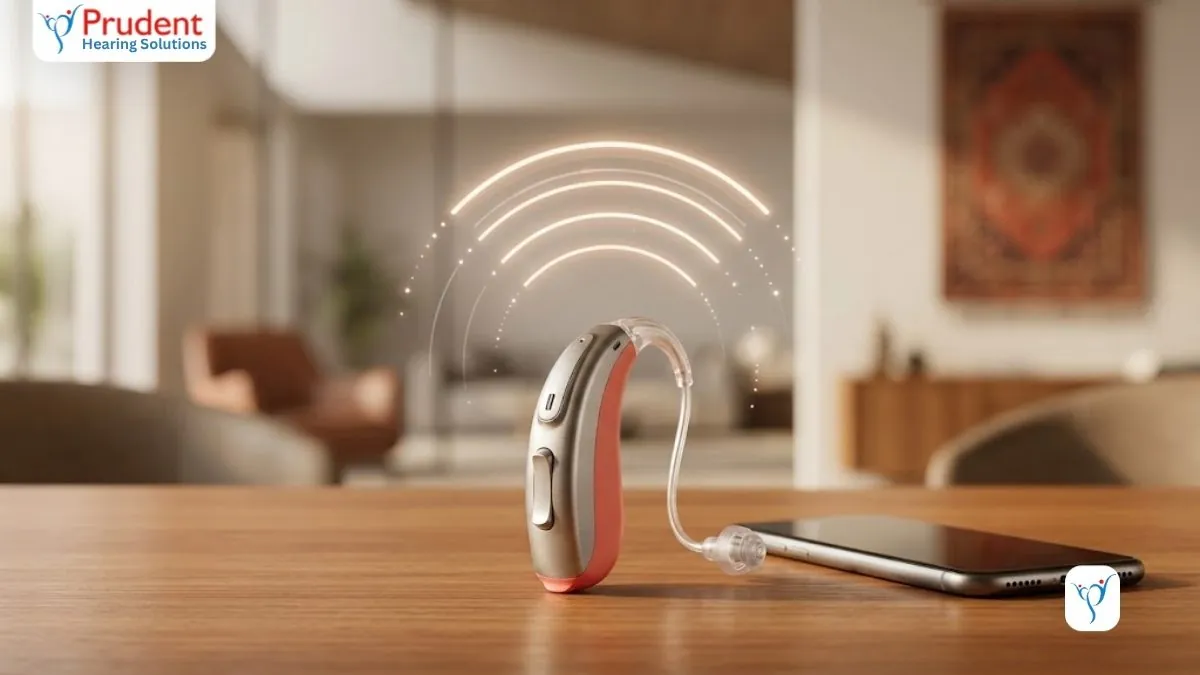
On connectivity, most current BTEs offer Bluetooth streaming, so calls, music, videos and turn-by-turn directions can play straight into your ears, effectively turning the hearing aids into wireless earphones. A free smartphone app lets you adjust volume, switch programmes and sometimes locate a misplaced aid. Streaming is usually smoothest on recent iPhones, while some Android phones may need a small clip-on accessory. For a fuller picture of what streaming can and cannot do, see our overview of behind-the-ear and Bluetooth hearing aids.
Which brands offer BTE hearing aids in India?
Every major global manufacturer sells BTE, mini BTE, RIC and power BTE models in India, so you are not short of choice. The well-known names include Signia, Phonak, Oticon, Widex, ReSound, Starkey and Unitron. Each has its own strengths in sound processing, app design and rechargeable options, but honestly, no single brand is best for everyone.
The right brand depends on your hearing loss, your budget and how a given device actually sounds to you on trial. If you want a neutral, side-by-side sense of the field, our full guide to hearing aid brands in India is a good starting point before you visit a clinic.
BTE hearing aid price in India
Honest answer first: there is no single fixed rupee figure for a BTE, and you should be wary of any page that quotes one. The price depends on the technology level, the sub-type (a basic mini BTE costs far less than a premium rechargeable RIC), the brand and the clinic. As a rough guide to the wider market, entry-level hearing aids in India sit around Rs 11,000 to Rs 30,000 per aid, mid-range devices around Rs 35,000 to Rs 80,000, and premium flagships Rs 1,20,000 and above.
Two things matter here. First, these figures are per ear, so if both ears need help, budget accordingly. Second, the band you actually need is decided by your hearing loss and lifestyle, not by picking the cheapest sticker or the flashiest flagship. A quiet, home-based routine has very different needs from a busy, meeting-heavy one. For the bigger picture and current market bands, see our detailed look at hearing aid prices in India, and always confirm the present price with the clinic.
How to choose the right BTE
The single most important step is a proper hearing test and an audiogram, because that measurement, not a brochure, decides which BTE sub-type and power level you need. Someone with a mild high-frequency loss and someone with a profound loss may both end up in a behind-the-ear aid, but they need completely different devices. Only a qualified audiologist, reading your audiogram alongside your ear health, lifestyle and dexterity, can match you correctly.
After that, a proper in-clinic trial matters just as much. A spec sheet tells you little about how a BTE actually sounds on speech, in background noise, or on a phone call. Trialling the device in the clinic, on the sounds that matter to you, is the only reliable way to know it fits. Our guide on how to choose the right hearing aid walks through the questions worth asking before you commit.
"Our honest take: BTE is the most versatile and dependable style there is, but a hearing aid only performs as well as its fitting. Get the audiogram right, trial it in the clinic, and the device almost chooses itself."
One expectation to set early: a hearing aid manages hearing loss, it does not cure it. A BTE amplifies and clarifies sound so you can follow conversations again; it does not repair the underlying loss. Understanding that from the start makes for a far happier long-term experience.
Book a free BTE trial with Prudent Hearing
At Prudent Hearing Solutions we are an RCI-registered audiology clinic established in 2004, and we fit, trial and service BTE, mini BTE, RIC and power BTE models across all major brands. We offer a free 45-minute hearing test where we check your hearing, explain your audiogram in plain language and, if a hearing aid makes sense, let you actually hear the difference before you decide. If cost is a concern, we also offer 0% EMI so you can spread the payment comfortably.
You can visit us in Pune (Viman Nagar), Delhi (Rohini and Green Park) or Bengaluru (Jayanagar), the only three cities where we currently have clinics. To book your free 45-minute test or a no-pressure BTE trial, call us on +91 9429690093. Come in, listen for yourself, and choose with clear information rather than marketing promises.
Continue reading
Frequently asked questions
What is a BTE hearing aid?
A behind-the-ear (BTE) hearing aid keeps its microphones, amplifier and battery in a small case that rests behind your ear. Sound then travels into the ear canal either through a slim tube to a custom earmould, or through a thin wire to a tiny speaker inside the ear (the RIC or RITE design). It is the most versatile and durable hearing aid style.
Who should use a BTE hearing aid?
BTE suits a very wide range of people: those with severe-to-profound loss who need a power model, children (durable and re-mouldable as ears grow), older users or anyone with dexterity issues who benefit from bigger controls and easy charging, and people who want the longest battery life and fullest features. An audiogram confirms the right sub-type for you.
Are BTE hearing aids better than in-the-ear ones?
Neither is universally better; they suit different needs. BTEs offer more power, longer battery life, easier handling and greater durability, which matters for stronger losses, children and older users. In-the-ear and invisible styles are more discreet but cannot match a BTE for power. The right choice depends on your hearing loss, dexterity and priorities, decided at a fitting.
How much does a BTE hearing aid cost in India?
There is no single fixed price. As a market guide, entry-level hearing aids run about Rs 11,000 to Rs 30,000 per aid, mid-range about Rs 35,000 to Rs 80,000, and premium flagships Rs 1,20,000 and above. These are per ear, and the exact price depends on the technology level, sub-type, brand and clinic, so confirm the current figure with the clinic.
Are BTE hearing aids good for severe hearing loss?
Yes, they are usually the best choice for it. Power and super-power BTEs are purpose-built to deliver very high amplification without feedback, using a strong receiver and a tightly sealed custom earmould. For severe-to-profound loss, a BTE is often the only style that can provide genuinely usable hearing, which is why it remains essential at the high-power end.
Do BTE hearing aids come rechargeable and with Bluetooth?
Many do, especially the RIC models. Rechargeable BTEs sit in a charging case overnight and give roughly a full day of hearing, with no fiddly batteries. Most current BTEs also offer Bluetooth streaming for calls, music and video, plus a smartphone app for volume and programme control. Streaming is smoothest on recent iPhones; some Android phones may need a clip-on accessory.
Free consultation
Ready to hear the difference?
Book a free 45-minute hearing test at any Prudent Hearing clinic: no obligation, honest advice, expert audiologists.