
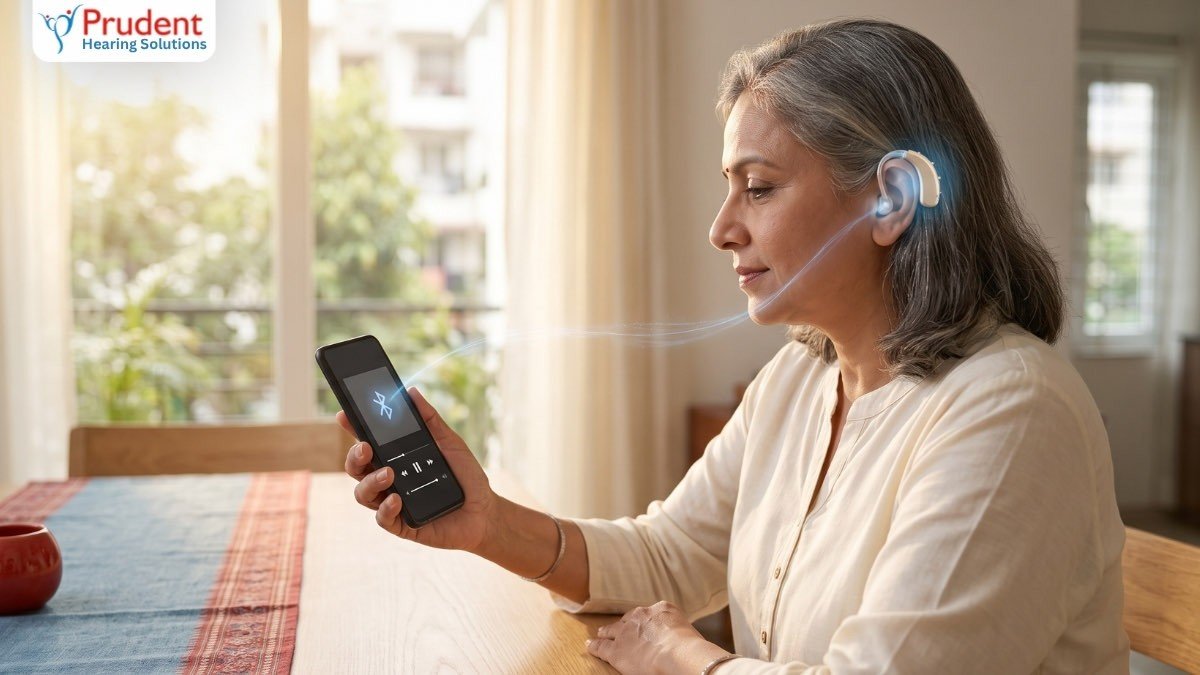
A practical guide to Bluetooth hearing aids in India: benefits, connecting to Android phones, iPhones and TVs, if the cost is worth it, and affordable brands.
Ten years ago, a hearing aid was something you wore and largely forgot about. Today, most new hearing aids sold in India can talk to your phone, stream a call straight into your ears, and be fine-tuned from an app while you sit at the dinner table. That is what people mean by a Bluetooth hearing aid. But the word Bluetooth hides a lot of detail: which phones actually connect, whether your TV will work, and whether the extra money is genuinely worth it. This guide walks through all of it, in plain terms, for Indian users. One honest note first: a Bluetooth hearing aid still manages hearing loss, it does not cure it. The wireless features are a real convenience, but the hearing correction underneath has to be set up correctly by an audiologist for any of it to matter.
What a Bluetooth hearing aid actually is
A Bluetooth hearing aid is a normal, prescription hearing aid that also has a tiny wireless radio inside. That radio lets the aid connect to your smartphone, and through your phone to almost anything else: music, videos, WhatsApp calls, map directions and streaming apps. Nearly every mid-range and premium aid sold in India now includes it as standard. It is no longer a rare, top-shelf feature.
Streaming versus control: two different jobs
It helps to separate the two things Bluetooth does, because they behave very differently:
- Streaming: sound from your phone or TV plays directly inside the hearing aids, like a pair of hidden earphones. Clear phone calls and video audio are the big wins here.
- Control: a free app on your phone becomes a discreet remote. You raise or lower volume, switch between a restaurant and a quiet setting, and on some models even nudge the tuning yourself, without touching the aid.
Almost all Bluetooth aids do control well. Direct streaming quality, on the other hand, depends heavily on which phone you own, which is exactly where India's device mix makes things interesting.
What are the benefits of Bluetooth hearing aids for users in India?
The benefits are practical rather than magical. Here is what regular users actually notice, day to day:
- Clearer phone calls: the caller's voice goes into both ears at once instead of being held against one, a real help on India's often noisy mobile networks.
- Hands-free convenience: answer a call with a tap while cooking, riding to work, or holding a grandchild.
- Discreet control in public: turn things down at a wedding or a loud restaurant from your phone, without fiddling at your ear.
- Better TV and video: stream serials, news, YouTube and video calls at your own volume, so the rest of the family is not forced to sit through a loud TV.
- Remote fine-tuning: many audiologists in India can now adjust your settings over the internet, saving a trip across a crowded city for a small change.
- One device, less clutter: the same aids handle hearing, calls and music, so there is no separate Bluetooth earpiece to lose.
None of these fix hearing loss. What they do is remove the small daily frictions that make people give up on hearing aids in the first place. If you want a first-hand account rather than a feature list, it is worth reading how Bluetooth hearing aids changed one user's daily life.
"The biggest benefit of Bluetooth is not the technology. It is that people actually keep wearing the aid, because it fits into a phone-centred life instead of fighting it."
Can Bluetooth hearing aids connect directly to Indian smartphones and televisions?
Short answer: yes, but the word directly means different things on Android, on iPhone, and on a TV. This is the part most buyers get wrong, so it is worth understanding before you spend a single rupee.
Connecting to Android phones (the ASHA question)
India runs largely on Android, so this matters most. Modern hearing aids connect to Android using a standard called ASHA (Audio Streaming for Hearing Aids), built into Android 10 and later. If your phone is reasonably recent and the hearing aid supports ASHA, calls and audio stream directly into your ears. Older or very budget Android phones, and a few regional brands with heavily customised software, may not support ASHA cleanly, so streaming can be patchy or limited to newer premium aids.
Practical advice: tell your audiologist exactly which phone you use, brand and model, before buying. A quick pairing test in the clinic settles the question in a few minutes and saves a lot of disappointment later.
Connecting to iPhones (Made for iPhone)
iPhones have supported hearing aids for years through Apple's Made for iPhone (MFi) system, and the connection is usually rock-solid. If you use an iPhone, most premium Bluetooth aids from the major brands will stream calls and audio smoothly and reliably. For iPhone users, connectivity is rarely the deciding factor; you are freer to choose on sound quality alone.
The Auracast shift (Bluetooth LE Audio)
The newest standard, Bluetooth LE Audio with a feature called Auracast, is starting to appear. It promises the same easy streaming across both Android and iPhone, plus the ability to tune into public broadcasts: think an airport announcement, a temple discourse, or a cinema audio feed sent straight to your aids. It is early days in India, and both your aids and the venue need to support it, but it is clearly the direction things are heading. If you are buying a premium aid you expect to keep for five or more years, ask whether it is LE Audio or Auracast ready.
Connecting to your television
A television is not a phone, so it usually will not pair with hearing aids on its own. For clean TV sound you add a small TV streamer, a matchbox-sized box that plugs into the TV and beams audio to your aids. Each brand sells its own, for example the Phonak TV Connector, Signia StreamLine TV or Oticon TV Adapter. It is an extra accessory, often around 8,000 to 18,000 rupees, but for households where the TV volume is a daily battleground, it is money well spent.
Are Bluetooth hearing aids worth the extra cost compared to regular hearing aids in India?
Here is the honest surprise: in 2026, Bluetooth is often not a paid extra at all. On most mid-range and premium aids it comes built in as standard, so you are not paying a separate Bluetooth surcharge. The real cost difference is the level of the aid itself.
Rough India price bands, per device, give a sense of scale:
- Entry level: around 15,000 to 30,000 rupees. Some have basic Bluetooth for control, though direct streaming may be limited.
- Mid-range: around 35,000 to 80,000 rupees. This is where reliable Bluetooth streaming becomes normal, and where most working adults land.
- Premium: around 1,20,000 to 2,00,000 rupees. Best-in-class streaming, noise handling and app features.
- Flagship pairs: the top pairs can cross 4,00,000 rupees, aimed at the most demanding listening lives.
So the real question is less is Bluetooth worth it and more which level of aid suits my hearing and my life. If you are on the phone a lot for work, watch a lot of TV, or want remote adjustments because you live far from the clinic, streaming earns its place easily. If you barely use a smartphone and mostly want to hear family at home, a simpler aid may serve you just as well; do not pay for features you will never switch on. Whatever you are quoted, remember the final price depends on your audiogram and a proper hearing test, not on a brochure. Our detailed hearing aid price guide for India breaks the numbers down further, and 0% EMI can spread the cost if needed.
How do Bluetooth hearing aids improve the quality of life for people with hearing loss in India?
Beyond the feature list, the day-to-day difference is about staying connected, both to people and to your own independence.
- Staying in conversations: clearer phone calls mean older parents can talk to children abroad without a family member relaying every sentence.
- Independence: booking an Ola, hearing a UPI payment confirmation, or following Google Maps directions all become easier when audio comes straight into the ears.
- Less social withdrawal: people who can follow the chatter at a function are far less likely to quietly stop attending, which protects mental well-being.
- Safety: hearing the doorbell, the pressure cooker whistle, or a phone alarm clearly matters, especially for elderly users living alone.
- Family harmony: no more shouting matches over TV volume when the sound streams privately to the aids.
There is also a growing body of research linking untreated hearing loss to faster cognitive decline, which is one reason treating it early is worth doing. Hearing aids do not reverse the loss, but keeping the brain engaged with clear, effortless sound is one of the kinder things you can do for it as you age.
Which Bluetooth hearing aid brands are available and affordable in India?
At our clinics we fit seven established brands, all of which now offer Bluetooth models across their ranges: Phonak, Signia, Oticon, Widex, ReSound, Starkey and Unitron. There is no single best one. The right choice depends on your hearing test, your ears, your budget and your phone.
A few honest pointers on affordability:
- Affordable does not mean the cheapest sticker price. It means the right aid at a fair price for your loss. An overpowered premium aid you never fully use is not affordable, however impressive it looks.
- Bluetooth now reaches down into mid-range models from every one of these brands, so you no longer have to buy the flagship just to get streaming.
- Rechargeable and Bluetooth usually arrive together on newer models, a trade-off we weigh up in our guide on rechargeable versus battery hearing aids.
- Buy on how it sounds for your ears, not on the logo. Two people with the same phone can prefer different brands after a trial.
This is exactly why a trial and a professional fitting matter more than any brand ranking. The same model can feel excellent for one person and wrong for another. Most Bluetooth models in India are behind-the-ear styles, and our guide to behind-the-ear Bluetooth hearing aids explains why that form factor pairs so naturally with wireless features.
A few honest cautions before you buy
To keep your expectations realistic:
- Streaming uses more power, so expect shorter battery life on heavy streaming days; a rechargeable aid usually still lasts through a normal day.
- Phone compatibility is real. Always test streaming with your own phone before you pay, not a demo handset in ideal conditions.
- It is still a medical device. Bluetooth is the convenience layer; the hearing correction underneath must be set correctly, or none of the rest helps.
- It does not cure loss. Sensorineural hearing loss is managed, not reversed, and anyone promising a cure is not being straight with you.
The only reliable way to know which Bluetooth hearing aid fits your ears, your phone and your budget is a proper hearing test. At Prudent Hearing Solutions, RCI-registered audiologists since 2004, we offer a free 45-minute digital hearing test at every office in Pune (Viman Nagar), Delhi (Rohini and Green Park) and Bengaluru (Jayanagar). You can try streaming with your own phone, compare brands side by side, and ask about 0% EMI, with no pressure to buy. Call or WhatsApp us on +91 9429690093 to book a slot.
Continue reading
Frequently asked questions
What are the benefits of Bluetooth hearing aids for users in India?
The main benefits are clearer, hands-free phone calls streamed straight into both ears, private TV and video listening at your own volume, and discreet control of your aids from a phone app instead of fiddling at your ear. Many audiologists in India can also fine-tune Bluetooth aids remotely over the internet, saving a trip across the city. None of these features cure hearing loss, but they remove the daily frictions that make people abandon hearing aids, so users tend to wear them far more consistently.
Can Bluetooth hearing aids connect directly to Indian smartphones and televisions?
Yes, though the word directly works differently across devices. iPhones connect very reliably through Apple's Made for iPhone system, while Android phones use the ASHA standard built into Android 10 and later, so a recent Android phone streams well but very old or budget handsets may not. Televisions usually cannot pair on their own; you add a small brand-specific TV streamer box, roughly 8,000 to 18,000 rupees, that sends the sound to your aids. Always test streaming with your own phone model in the clinic before buying.
Are Bluetooth hearing aids worth the extra cost compared to regular hearing aids in India?
In 2026 Bluetooth is usually not a separate paid extra; it comes built into most mid-range and premium aids as standard, so the real cost difference is the level of aid you choose, not the Bluetooth itself. Bands run roughly 15,000 to 30,000 rupees at entry level, 35,000 to 80,000 for mid-range and 1,20,000 to 2,00,000 for premium, per device. If you use the phone or TV a lot, or want remote adjustments, streaming earns its place easily; if you barely use a smartphone, a simpler aid may serve you just as well. The final price always depends on your audiogram and a hearing test, so get one before deciding.
How do Bluetooth hearing aids improve the quality of life for people with hearing loss in India?
They help people stay connected and independent, with clearer calls to children abroad, easier UPI and ride-booking confirmations, following group conversations at functions, and hearing doorbells or alarms safely at home. Private TV streaming also ends the daily volume battles that strain families. Because the aids fit naturally into a phone-centred life, users are less likely to withdraw socially, which protects mental well-being and keeps the brain engaged. They manage hearing loss rather than curing it, but that steady engagement matters for long-term brain health.
Which Bluetooth hearing aid brands are available and affordable in India?
At Prudent Hearing Solutions we fit seven established brands that all offer Bluetooth models across their ranges: Phonak, Signia, Oticon, Widex, ReSound, Starkey and Unitron. Bluetooth now reaches down into their mid-range models, so you no longer have to buy a flagship just to get streaming. Affordable means the right aid for your hearing loss at a fair price, not simply the cheapest sticker; an overpowered aid you never fully use is not a bargain. The best choice depends on your hearing test, your ears and your phone, which is why a trial and professional fitting matter more than any brand ranking.
Free consultation
Ready to hear the difference?
Book a free 45-minute hearing test at any Prudent Hearing clinic: no obligation, honest advice, expert audiologists.