Educational information, not medical advice. This article is written to help you understand common ear and hearing issues. It is not a substitute for professional diagnosis or treatment. If your symptoms are severe, sudden, or persistent, please consult a qualified doctor or audiologist. For urgent symptoms (sudden hearing loss, bleeding from the ear, severe pain with dizziness, or a head injury), seek medical care the same day.
A clinical guide to Tinnitus Retraining Therapy in India: the psychoacoustic tests done first, what directive counselling and sound enrichment actually involve, how long habituation takes, what the trial evidence really shows, and the red flags that need urgent care.
Tinnitus Retraining Therapy (TRT) is a 12-24 month programme combining structured directive counselling with low-level sound enrichment, aimed at habituation rather than silence. In India it is delivered at RCI-registered audiology clinics after full audiometry and ENT clearance. The evidence is mixed: structured care clearly helps, but TRT has not outperformed good standard care in the one large randomised trial.
What does a tinnitus treatment pathway actually look like?
TRT sits inside a wider pathway, and treatment is a sequence rather than a single product. Skipping straight to a device or a supplement is the commonest reason people spend money and get nowhere. The best-practice pathway used by Indian audiology clinics in 2026, adapted from NICE guideline NG155 (UK) and the American Academy of Otolaryngology guideline, runs in this order:
- Step 1: Rule out the dangerous causes. ENT examination, audiometry and a medication review. Pulsatile, one-sided or sudden tinnitus, and tinnitus starting on a known ototoxic drug, are investigated before any therapy begins.
- Step 2: Measure the hearing. Roughly 80-90% of people with chronic tinnitus have some measurable hearing loss, often only in the high frequencies they never noticed losing.
- Step 3: Treat the hearing loss. Where loss exists, amplification comes first: it treats the hearing loss in its own right and lifts the level of ordinary background sound.
- Step 4: Treat the reaction. This is where TRT or cognitive behavioural therapy (CBT) sits: reducing the distress, attention and fear attached to the sound.
- Step 5: Review on a schedule. Questionnaire scores are repeated at 3, 6, 12 and 18 months so progress is measured rather than assumed.
Broader options beyond TRT, including counselling, sound therapy and device choices, are covered in tinnitus treatment options that work.
How is tinnitus measured before TRT starts?
TRT is never prescribed on a description alone. A tinnitus assessment takes 60-90 minutes and begins with pure-tone audiometry from 250 Hz to 8 kHz, often extended above 8 kHz (into the 9-16 kHz range where equipment allows) because early damage frequently hides there. Then comes tinnitus-specific psychoacoustic testing:
- Pitch matching: you match a presented tone to your own tinnitus, usually somewhere in the 3-8 kHz region and typically in the same region as the hearing loss.
- Loudness matching: most tinnitus is matched at 10 dB or less above threshold at that pitch, far quieter than it feels, though a minority need considerably more.
- Minimum masking level: the softest broadband noise that just covers the tinnitus. This guides sound-therapy settings.
- Residual inhibition: whether the tinnitus quietens briefly after masking noise stops. It is a useful counselling demonstration, showing the brain can turn the sound down, but it has not been shown to predict how well sound therapy will work for you.
- Loudness discomfort levels: screens for hyperacusis. Because it uses progressively louder sound, it is done cautiously and stopped early if you are sound-sensitive; tell the audiologist beforehand, and expect that a short-lived flare afterwards is possible.
- THI or TFI questionnaire: the Tinnitus Handicap Inventory or Tinnitus Functional Index, both scored 0-100. This baseline is what treatment is judged against.
What is Tinnitus Retraining Therapy (TRT)?
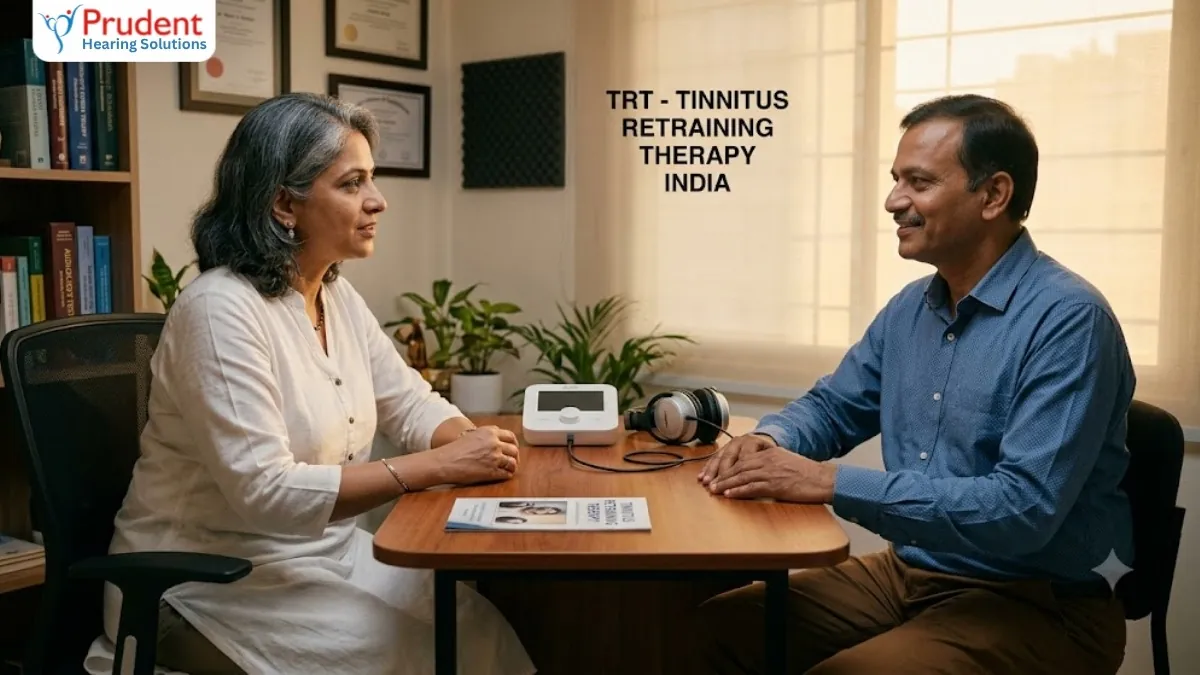
Tinnitus Retraining Therapy (TRT) is a programme of counselling and low-level sound that teaches the brain to stop treating tinnitus as a threat, so it fades into the background.
It was developed by Pawel Jastreboff in the 1990s and rests on a neurophysiological model: tinnitus becomes a problem not because the signal is loud, but because the limbic and autonomic systems have tagged it as threatening. Remove the threat value and the brain filters it out the way it filters a ceiling fan. TRT has exactly two components, and both are compulsory.
- Directive counselling. Structured, repeated sessions in which the audiologist demystifies the mechanism, using your own audiogram and pitch-match data, until the sound stops being interpreted as danger. This is teaching, not reassurance.
- Sound enrichment. Low-level broadband sound worn or played for most of the waking day, set deliberately *below* the masking level at the mixing point, so the tinnitus and the background blend. TRT does not mask the tinnitus; covering it up prevents the habituation you are trying to build.
What is habituation, and how long does it take?
Habituation is the goal of TRT: the tinnitus stops mattering rather than stops existing. It arrives in two stages. Habituation of reaction (the sound no longer triggers alarm, and sleep, concentration and mood recover) usually comes first, and many people notice it over the first three to six months.
Habituation of perception (long stretches of genuinely not noticing the sound) takes considerably longer where it happens at all, and it is not guaranteed for everyone. No honest clinic can put a date on it, and any programme that promises habituation on a fixed timetable is overselling. Progress is tracked with repeat THI or TFI scores rather than with how loud the sound feels on a given day.
"TRT does not make tinnitus quieter. It makes tinnitus irrelevant. Patients who understand that distinction on day one do far better than those expecting silence."
How long does TRT take, and what happens along the way?
TRT is a 12-24 month programme. Anyone offering a six-week TRT "course" is not delivering TRT. A typical Indian clinic schedule looks like this:
- Weeks 0-2: full assessment, categorisation (TRT sorts patients into categories 0-4 based on hearing loss, hyperacusis and sound-induced worsening), and a first counselling session of 60-90 minutes.
- Months 1-3: sound generators, combination hearing aids or environmental sound in place for 6-8 hours daily; two to three follow-up counselling sessions; settings adjusted at each visit.
- Months 4-12: review every 6-8 weeks. THI or TFI repeated. Sleep, concentration and avoidance behaviour tracked, since these change before the tinnitus does.
- Months 12-24: sessions spaced further apart, sound enrichment gradually reduced as habituation holds.
- What counts as success: a drop of roughly 9-13 points on the TFI, or about 11-20 points on the THI, is treated as a clinically meaningful change, depending on baseline severity and how long treatment has run, not a report of silence.
Does TRT actually work? What the evidence really says
Honest answer: clinical experience runs ahead of the trial evidence, and you deserve to know both. The Tinnitus Retraining Therapy Trial (Scherer et al., *JAMA Otolaryngology–Head & Neck Surgery*, 2019) randomised 151 serving and retired US military personnel and their dependents, all with functionally adequate hearing, to full TRT, partial TRT or standard care. All three groups improved over 18 months and full TRT was not statistically better than standard care, though the trial deliberately excluded people with significant hearing loss, the group most likely to benefit from amplification-led care.
The 2020 Cochrane review (Fuller et al.) found CBT probably reduces the impact of tinnitus on quality of life compared with audiological care (moderate certainty), and may reduce it compared with no treatment or TRT (low certainty); whether it changes tinnitus loudness is uncertain. Cochrane reviews of sound therapy alone report low-certainty evidence, and NICE NG155 (2020) recommends CBT for tinnitus-related distress while positioning sound therapy as an option, not a cure.
The practical reading: the counselling half of TRT, which overlaps heavily with CBT, appears to do most of the work, and structured care of any kind beats being told to live with it.
TRT, CBT or sound therapy: which one do you need?
The choice is decided by two findings: whether audiometry shows hearing loss, and how much distress the tinnitus is causing. Hearing loss points to amplification plus TRT. High distress, insomnia or low mood points to CBT first. Sound therapy on its own is rarely the whole answer.
- Constant tinnitus plus measurable hearing loss: amplification first, then TRT. This is the largest group in clinic.
- Severe distress, insomnia, low mood or panic on hearing it: CBT led by a clinical psychologist, ideally alongside sound enrichment. Distress-first cases do not respond well to devices alone.
- Tinnitus with normal standard thresholds: sound enrichment plus counselling; extended high-frequency audiometry often finds loss that standard testing missed.
- Tinnitus with sound sensitivity: treat the hyperacusis first with graded sound desensitisation, otherwise sound therapy will be intolerable.
- Tinnitus after noise exposure: if it clears within a day, hearing protection and monitoring are enough. If it is still there 24-48 hours later, or hearing is muffled, it is treated as sudden hearing loss. Get audiometry and ENT review the same week, ideally the same day.
- Tinnitus with vertigo or a blocked-ear feeling: investigate for Meniere's disease and other vestibular causes before starting therapy.
Where do hearing aids fit into TRT?
Where hearing loss is present, a well-fitted hearing aid is the sensible first step: it treats the hearing loss in its own right, and it raises the level of ordinary background sound so the tinnitus no longer stands alone in a quiet auditory field. Be clear about the evidence, though: the 2018 Cochrane review of hearing aids and sound generators for tinnitus found low-certainty evidence for either, and no advantage of one over the other. The dependable benefit is to hearing; tinnitus benefit is common but not guaranteed.
Most current families from the major manufacturers offer a built-in tinnitus sound generator (Widex's Zen fractal tones, Signia's Notch Therapy, Oticon's Tinnitus SoundSupport) programmed to your pitch match and minimum masking level, though availability varies by model tier, so confirm the feature is on the specific aid you are quoted. Hearing aids manage hearing loss; they do not reverse it, and the sound generator supports habituation rather than replacing it. Device-level detail is in our guide to hearing aids for tinnitus.
What about tablets, injections and supplements for tinnitus?
No drug is approved by the US FDA, the EMA or India's CDSCO specifically as a treatment for chronic subjective tinnitus, and no major guideline recommends one. A standardised Ginkgo extract is licensed as an adjuvant in a few countries, but the trial evidence behind it is weak. The American Academy of Otolaryngology guideline (Tunkel et al., 2014, still the current US guideline) recommends against Ginkgo biloba, melatonin, zinc and other dietary supplements for tinnitus, and against routinely offering antidepressants, anticonvulsants or anxiolytics for it; NICE NG155 advises against betahistine.
An ENT may still treat a genuine underlying condition (wax impaction, middle-ear infection, Meniere's disease, sudden sensorineural loss), and the tinnitus may settle as a consequence. Antidepressants or sleep support may be appropriate for co-existing anxiety or insomnia, prescribed on those grounds. Be careful with benzodiazepines such as alprazolam and clonazepam: dependence develops quickly and tinnitus often worsens during withdrawal, so CBT for insomnia is the safer first line. Common myths are unpacked in tinnitus causes, myths and help.
When is tinnitus a medical emergency?
Most tinnitus is not urgent. These presentations are, and none of them should wait for a therapy appointment:
- Sudden hearing loss with new tinnitus: a same-day emergency. Steroids work best started within 72 hours and are normally offered up to two weeks from onset. If you are past two weeks, still go: salvage intratympanic steroids can help up to about six weeks, and sudden hearing loss needs audiometry and investigation whenever you present. See sudden and noise-induced hearing loss.
- Pulsatile tinnitus: a whooshing in time with your heartbeat. Needs vascular assessment and usually imaging; it can indicate a vascular malformation, a glomus tumour or raised intracranial pressure.
- Strictly one-sided or asymmetric tinnitus or hearing loss: needs ENT referral for gadolinium-enhanced MRI of the internal auditory canals, which is the definitive test for vestibular schwannoma. BERA/ABR may be used as an adjunct, or where MRI is contraindicated or unavailable, but a normal ABR does not exclude a small tumour.
- New or worsening tinnitus on a known ototoxic drug: gentamicin or amikacin, cisplatin or carboplatin, high-dose aspirin or NSAIDs, loop diuretics, some antimalarials. Tell the prescribing doctor within days and ask about monitoring audiometry. Never stop a prescribed drug on your own.
- Tinnitus with vertigo, facial weakness, double vision or severe headache: needs neurological assessment now. Tinnitus after a head injury or blast exposure also needs prompt assessment.
- Tinnitus with thoughts of self-harm: call Tele-MANAS on 14416 (or 1-800-891-4416) or KIRAN on 1800-599-0019, both free and available 24x7. If you feel at immediate risk, go to the nearest hospital emergency department, or ask someone to stay with you and take you there. Severe tinnitus distress is treatable and is not something to wait out.
What does TRT cost in India in 2026?
There is no single figure, because the pathway is modular. The free 45-minute digital hearing test at Prudent is a screening assessment. If it shows hearing loss, or if tinnitus is the main complaint, you will need diagnostic pure-tone audiometry and the 60-90 minute tinnitus psychoacoustic assessment; these, and diagnostic procedures such as BERA/ABR, are charged separately and quoted before they are done.
TRT itself is charged as a counselling programme rather than per gadget, and the programme fee is quoted after the assessment, once the category and likely duration are known.
If hearing aids are indicated, manufacturer MRP for entry-level digital models starts at Rs 10,990 per ear (Signia Fast P) and rises with technology level; Prudent sells up to 30-50% below MRP. Two honest cost warnings: budget for the full 12-24 months rather than the first visit, and treat any product promising a cure at a fixed price as a marketing claim, not a clinical one. You can try a device in the clinic before you buy it.
Who can start TRT at a Prudent clinic?
Adults whose tinnitus has lasted more than three months, who have had an ENT review and can commit to counselling for a year or more, can start TRT at any Prudent clinic. Prudent Hearing Solutions has run RCI-registered audiology clinics since 2004, and every clinic is a full-scale clinical diagnostic centre offering BERA/ABR, VEMP, ECochG and Tinnitus Retraining Therapy, in Pune (Viman Nagar, head office), Delhi (Rohini and Green Park) and Bengaluru (Jayanagar).
We will not start TRT before red flags are cleared, before hyperacusis is stabilised where present, or where the primary problem is untreated depression or anxiety that needs psychological care first. Home visits are available if travelling to a clinic is difficult, and choosing the right clinician matters. See how to choose a trustworthy audiologist in India.
If tinnitus is affecting your sleep, concentration or mood, start with the measurement rather than the treatment. Book a free 45-minute digital hearing test at our Pune, Delhi or Bengaluru clinic, bring any previous audiograms, and we will tell you plainly whether TRT, CBT, hearing aids or an ENT referral is the right next step.
Hearing aids are GST-exempt in India, we discount up to 30-50% off manufacturer MRP, 0% EMI is available and lifetime programming is free. Call +91 9429690093 or WhatsApp +91 8485096505 to book, or to ask for a home visit.
Continue reading
Frequently asked questions
How long does Tinnitus Retraining Therapy take to work?
TRT is a 12-24 month programme. Many people report less distress and better sleep over the first three to six months, well before any change in how loud the tinnitus seems. Habituation of perception (long stretches of genuinely not noticing it) takes considerably longer and does not happen for everyone. Be wary of any programme promising it on a fixed timetable; the largest randomised trial of TRT found it no better than good standard care.
Is TRT better than CBT for tinnitus?
Not on current evidence. The 2020 Cochrane review found CBT probably reduces the impact of tinnitus on quality of life compared with audiological care, and NICE guideline NG155 recommends CBT for tinnitus-related distress. The 2019 Tinnitus Retraining Therapy Trial found full TRT was not significantly better than standard care. In practice the two overlap heavily, and many patients do best with counselling plus sound enrichment together.
What is habituation in tinnitus, and is it a cure?
Habituation means the tinnitus stops mattering rather than stops existing, so it is not a cure. Habituation of reaction comes first: the sound no longer triggers alarm, and sleep, concentration and mood recover. Habituation of perception, where you stop noticing the sound for long stretches, takes longer and is not guaranteed. Progress is tracked with repeat THI or TFI scores, not with how loud the sound feels on a given day.
What tests are done before starting TRT?
Pure-tone audiometry from 250 Hz to 8 kHz, often extended above 8 kHz into the 9-16 kHz range where equipment allows, plus tinnitus pitch matching, loudness matching, minimum masking level, residual inhibition and loudness discomfort levels. A THI or TFI questionnaire, both scored 0-100, gives the baseline. Strictly one-sided or asymmetric tinnitus needs ENT referral for gadolinium-enhanced MRI of the internal auditory canals before therapy begins.
Do I need hearing aids if my tinnitus is the main problem?
If audiometry shows hearing loss, amplification is the sensible first step, because it treats the hearing loss in its own right and lifts background sound so the tinnitus no longer dominates a quiet auditory field. Be aware the 2018 Cochrane review found only low-certainty evidence for hearing aids as a tinnitus treatment specifically. Most modern aids include a built-in tinnitus sound generator. They manage hearing loss; they do not cure it.
When should I see a doctor urgently about tinnitus?
Go the same day if tinnitus arrives with sudden hearing loss. Steroids work best within 72 hours, and it is still worth going later. Seek prompt assessment for pulsatile tinnitus, strictly one-sided or asymmetric tinnitus, tinnitus with vertigo, facial weakness or severe headache, tinnitus after head injury, and new tinnitus while on an ototoxic drug. If tinnitus brings thoughts of self-harm, call Tele-MANAS on 14416 or KIRAN on 1800-599-0019.
Do tinnitus tablets, drops or supplements work?
No drug is approved by the FDA, the EMA or CDSCO specifically for chronic subjective tinnitus, and no major guideline recommends one. The American Academy of Otolaryngology guideline advises against Ginkgo biloba, melatonin, zinc and other supplements, and against routinely offering antidepressants, anticonvulsants or anxiolytics; NICE advises against betahistine. Doctors may still treat an underlying ear condition, or prescribe for co-existing anxiety or insomnia. Online cure formulas are marketing claims.
Where can I get TRT in India?
TRT is offered at Prudent Hearing Solutions clinics in Pune (Viman Nagar), Delhi (Rohini and Green Park) and Bengaluru (Jayanagar), each a full clinical diagnostic centre with BERA/ABR, VEMP and ECochG on site, RCI-registered and running since 2004. Start with the free 45-minute digital hearing test, bring previous audiograms, and call +91 9429690093 or WhatsApp +91 8485096505 to book, including for a home visit.
Free consultation
Ready to hear the difference?
Book a free 45-minute hearing test at any Prudent Hearing clinic: no obligation, honest advice, expert audiologists.