A trustworthy audiologist in India is RCI-registered, tests before selling, stays brand-neutral and offers a trial. Spot the red flags and questions to ask.
A trustworthy audiologist tests your hearing before recommending anything, is registered with the Rehabilitation Council of India (RCI), stays neutral about brands, lets you trial the device in your own ears, and hands you a written audiogram and warranty on paper.
If any of those are missing, especially if someone quotes a specific hearing aid before testing you, treat it as a warning, not a shortcut. This guide shows you how to check credentials, spot the red flags, recognise overselling, and ask the right questions, so you leave with the aid your ears actually need rather than the one that pays the biggest commission.
First, an audiologist is not a salesperson
The person who sells you a hearing aid and the person qualified to measure your hearing are not always the same person. An audiologist is a trained clinician. In India, they hold a BASLP (Bachelor in Audiology and Speech-Language Pathology) or an MASLP (the Master's), and they are registered with the RCI, the statutory body that regulates rehabilitation professionals. A salesperson may know the product catalogue very well, but they are not qualified to test your loss or prescribe for it.
This matters because a hearing aid manages hearing loss (it does not cure it), and it only helps if it is matched to the exact frequencies you have lost. That match starts with a proper test run by someone qualified to conduct and read it. Anything medical, surgical or diagnostic beyond that (sudden loss, ear pain, discharge, dizziness) belongs with an ENT doctor, not a sales counter.
How to verify credentials before you trust anyone
You do not need to feel awkward asking. Reputable clinics expect these questions and answer them without flinching.
- Ask for the RCI registration. Every practising audiologist should have an RCI (CRR) number. You can ask to see it, and the RCI keeps a public register you can check.
- Ask about the qualification. BASLP or MASLP is the standard. "I've done a course" or "I've been doing this for years" is not the same as a recognised degree.
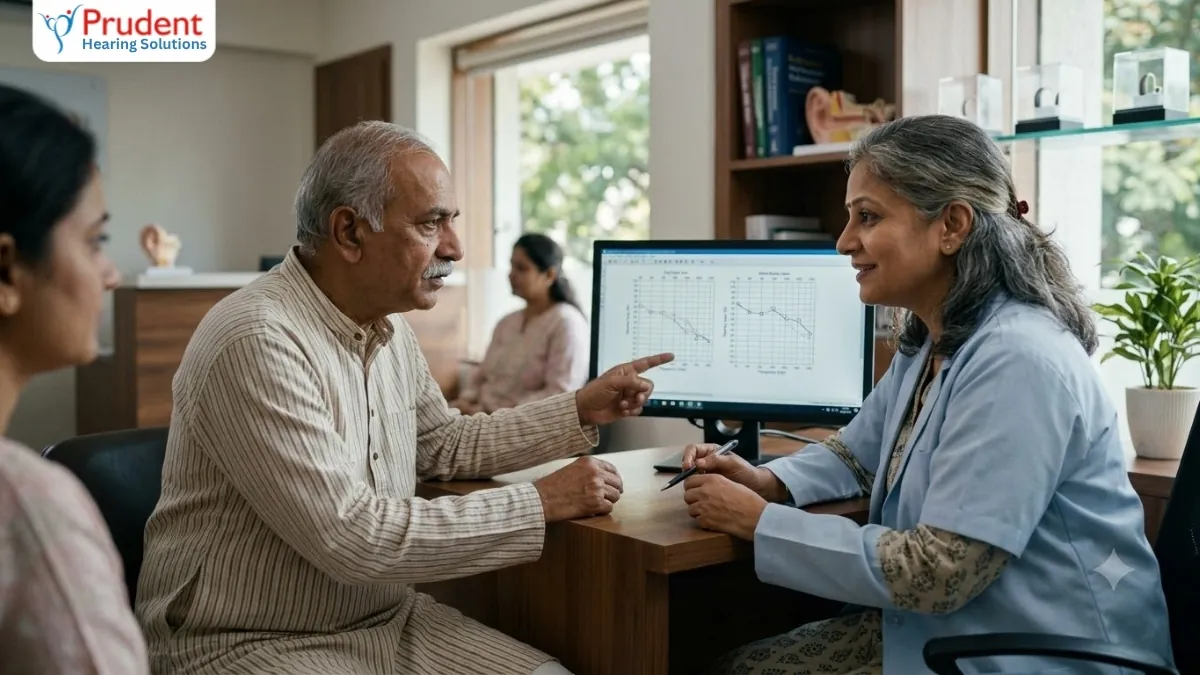
- Ask who runs the test. Your pure-tone audiometry should be done by the audiologist, not a helper who then passes you to a salesperson.
- Ask to keep the audiogram. A real test produces a written graph. If nobody offers you one, no real prescription has happened.
That graph is the whole basis of your fitting, so learn to read it a little. Our guide to understanding your audiogram explains what the lines mean. Once you can see the shape of your own loss, you can check whether any recommendation actually matches it.
Red flags: reasons to walk out
- A price or a model before a test. If someone recommends a specific device before running an audiogram, they are guessing, or clearing stock.
- One brand, always. A clinic that only ever recommends a single manufacturer is working from its shelf, not your ears.
- No trial offered. You should be able to hear the aid in your own ears, in a real room, before you pay.
- High-pressure or 'today-only' discounts. Genuine pricing does not expire at 6 p.m. A real discount is still there tomorrow.
- No paperwork. No written audiogram, no warranty card, no proper bill: that is not a fitting, it is a sale.
- Cash-only, no bill. A refusal to give a proper bill or accept traceable payment is a bad sign, whatever the reason offered.
The quieter problem: overselling
Overselling is harder to catch than a hard sell, because it looks like helpfulness. It is the push towards the most premium tier without a reason drawn from your own audiogram.
A top-tier aid earns its price when your loss is complex, your days are demanding (crowded meetings, restaurants, constant travel), or your audiogram has an awkward shape that needs the finest tuning. If your loss is mild-to-moderate and your life is fairly quiet, the premium tier may be money spent on features you will never switch on.
A trustworthy audiologist explains why a tier suits you, pointing at your graph as they do it. Watch too for padded accessories (remote mics, spare chargers, cleaning kits quietly bundled in) that inflate the total. Ask what each line item does for you, and feel free to decline the ones that do nothing. Our guide on how to choose the right hearing aid walks through matching tier to need.
Which brand do doctors actually recommend?
The honest answer is that there is no single brand doctors recommend. Anyone who names one brand as "the best" for everyone is describing their shelf, not your ears. Signia, Phonak, Resound, Oticon, Widex and others all make excellent aids across every price level. The right one depends on your audiogram, your phone, your dexterity, your power needs and your budget.
A brand-neutral clinic fits whichever brand serves you best, and says so plainly. Our Signia vs Phonak comparison and our rundown of hearing-aid brands in India exist precisely so you can see that neither wins outright. When a recommendation is driven by commission rather than your graph, brand-neutrality is usually the first thing to disappear.
"The patients who regret their purchase are rarely the ones who chose the wrong brand. They are the ones who were sold a device before anyone measured what they had lost. Get tested, keep the audiogram, and the rest of the decision becomes something you can actually check."
The questions to ask before you pay
Print this, or save it on your phone, and take it with you. A trustworthy provider will welcome every one of them.
- Are you an RCI-registered audiologist, and may I note your registration number?
- Will you run a full hearing test and give me the written audiogram to keep?
- Which brands do you fit, and why are you recommending this one for my loss?
- Why this tier and not a cheaper one, and what in my audiogram justifies it?
- Can I trial the aid in my own ears before I decide, and for how long?
- What does the warranty cover, and is programming and after-sales service included?
- Is the price per ear or per pair, and can I decline anything that has been bundled in?
The last three matter more than people expect. Read our guide on the hearing-aid trial and fitting so you know what a real trial looks like, and our guide to warranty and after-sales service so you know what long-term cover should include before you sign anything.
How Prudent measures up against this list
We built the clinic around exactly these checks, because we have watched families get burned by the opposite. Every test at Prudent is run by an RCI-registered audiologist. The hearing test is free, and you keep the audiogram.
We are brand-neutral: we fit Signia, Phonak, Resound, Oticon, Widex and more, and we recommend from your graph, not a commission sheet. You trial before you buy. Genuine devices are sold at up to 30-50% off manufacturer MRP (hearing aids are GST-exempt in India), with 0% EMI where it helps and free lifetime programming. Nothing we quote is 'today-only'.
We have been doing this since 2004, with clinics in Pune (Viman Nagar), Delhi (Rohini and Green Park) and Bengaluru (Jayanagar). New to all of this? Our first-time buyer guide walks you through every step in order.
What to do next
Book a free hearing test, keep your audiogram, and use the checklist above at any clinic you visit, including ours. Compare every recommendation against your own graph. See real prices on our price list, and get in touch on +91 9429690093 to book at our clinics in Pune, Delhi or Bengaluru. - Prudent Hearing Solutions
Continue reading
Frequently asked questions
How do I check if an audiologist is RCI-registered in India?
Ask for their RCI (CRR) registration number and verify it on the Rehabilitation Council of India's public register. A practising audiologist should have one and should share it without hesitation. If a clinic cannot produce a registration number, treat that as a red flag and consider going elsewhere.
What is the difference between an audiologist and a hearing-aid salesperson?
An audiologist is a clinician with a BASLP or MASLP degree and RCI registration, qualified to test your hearing and prescribe an aid. A salesperson may know the catalogue well but is not qualified to measure or read your hearing loss. Insist that the audiologist runs your test, not a helper who then hands you to a seller.
Which hearing aid brand do doctors recommend in India?
There is no single brand. Signia, Phonak, Resound, Oticon, Widex and others all make good aids across price levels. A trustworthy, brand-neutral clinic recommends based on your audiogram, phone, dexterity and budget, not on commission. Be wary of anyone who insists one brand is best for everyone.
Is it a red flag if a clinic recommends a hearing aid without a hearing test?
Yes. A hearing aid must be programmed to the exact frequencies you have lost, which is impossible without an audiogram. A price or model quoted before any test means the seller is guessing or clearing stock. Always get a proper hearing test first, and keep the written audiogram.
Should I get a written audiogram and a warranty paper?
Yes, always. A real test produces a written audiogram that you keep, and a genuine purchase comes with a warranty card and a proper bill. If none of these are offered, no real prescription or protection exists. Keep every document safe for future tuning visits and service claims.
Can I try a hearing aid before buying it in India?
Yes. A trustworthy clinic offers a trial so you can hear the aid in your own ears, in a real room, before paying. Remember that a hearing aid manages hearing loss rather than curing it, so a trial helps you judge the real-world benefit honestly. At Prudent, you trial before you buy.
Free consultation
Ready to hear the difference?
Book a free 45-minute hearing test at any Prudent Hearing clinic: no obligation, honest advice, expert audiologists.