Educational information, not medical advice. This article is written to help you understand common ear and hearing issues. It is not a substitute for professional diagnosis or treatment. If your symptoms are severe, sudden, or persistent, please consult a qualified doctor or audiologist. For urgent symptoms (sudden hearing loss, bleeding from the ear, severe pain with dizziness, or a head injury), seek medical care the same day.
What causes low-frequency hearing loss, why the audiogram slopes upward, the Meniere's and vascular links, and why sudden low-tone loss is urgent.
Quick answer
Low-frequency hearing loss means you struggle with deep, low-pitched sounds (vowels, male voices, background hum) while high pitches stay clearer. Common causes include Meniere's disease, sudden sensorineural hearing loss, and factors that reduce blood flow to the cochlea. Sudden low-frequency loss needs same-day medical care.
Key takeaways
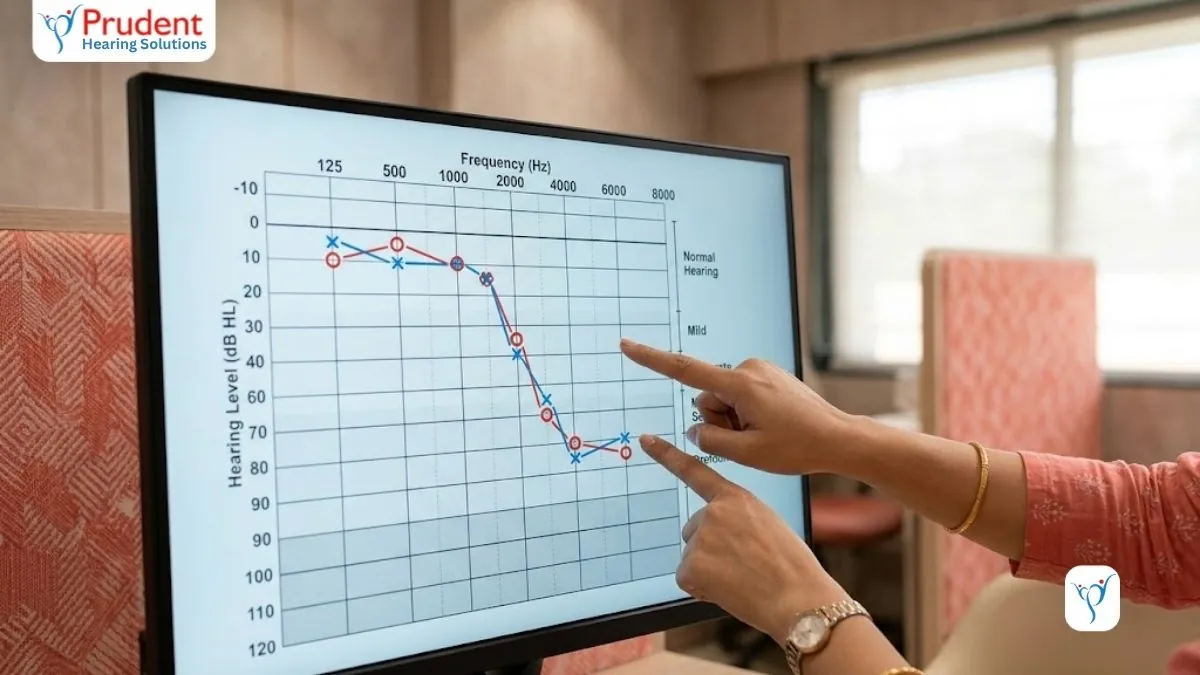
- Low-frequency loss shows as an "upward sloping" or "reverse slope" audiogram: worse thresholds on the left (low pitches), better on the right (high pitches).
- Meniere's disease and cochlear hydrops are among the most recognised causes; the loss can fluctuate.
- The cochlea's blood-hungry stria vascularis may make low frequencies sensitive to circulation, which is why researchers are studying hearing as a possible early cardiovascular signal: emerging, not diagnostic.
- Sudden low-frequency hearing loss is a medical emergency: seek same-day care. Treatment is most effective the earlier it is started, and NIDCD notes that treatment delayed beyond about two to four weeks is less likely to reverse the loss.
- An audiogram plus medical review tells you the pattern and the likely cause; it does not diagnose heart disease.
Low-frequency hearing loss means you struggle with deep, low-pitched sounds (vowels, male voices, background hum) while high pitches stay clearer. Common causes include Meniere's disease, sudden sensorineural hearing loss, and factors that reduce blood flow to the cochlea. Sudden low-frequency loss needs same-day medical care.
What is low-frequency hearing loss?
Hearing is graphed by pitch (frequency, in Hz) and loudness (in decibels). Most age-related and noise-related losses hit the high frequencies first. Low-frequency loss is the opposite: the low pitches (roughly 125–500 Hz) are affected while highs are preserved. On the chart this makes a rising line, sometimes called a reverse-slope audiogram.
People often notice they hear speech but miss its fullness, find phone calls or male voices harder, or say sound seems "thin." Because clarity for high consonants is intact, this pattern is easy to overlook. A full hearing test maps it precisely.
For how hearing patterns connect to whole-body health, see our pillar guide, What Your Hearing Reveals About Your Heart and Kidneys (and When It's an Emergency).
What causes low-frequency hearing loss?
Meniere's disease and endolymphatic hydrops. This inner-ear disorder classically produces a fluctuating low-frequency loss, often with vertigo, ear fullness, and tinnitus. The hearing may recover between episodes early on.
Sudden sensorineural hearing loss (SSNHL). A rapid drop in hearing, sometimes confined to the low frequencies, can happen over hours to a few days. It is treated as urgent because early steroid treatment improves the chance of recovery (NIDCD: Sudden Deafness).
Vascular and circulatory factors. Anything that reduces oxygen-rich blood to the inner ear (small-vessel disease, viral inflammation, or a temporary interruption in cochlear blood flow) can affect hearing (NIDCD: Hearing, Ear Infections, and Deafness).
Other contributors. Genetic reverse-slope loss, some middle-ear (conductive) problems, and pressure changes can also lower the low frequencies. An audiologist distinguishes conductive from sensorineural causes during testing.
Why are low frequencies sensitive to blood flow?
The apex of the cochlea, which processes low pitches, depends on a richly vascular structure called the stria vascularis. It maintains the electrical environment the inner ear needs to work, and it is highly dependent on steady blood supply. When circulation is compromised, this region can be affected early.
This is one reason researchers study whether hearing changes track with cardiovascular health. A 2025 analysis reported an association between hearing measures and cardiovascular factors (Scientific Reports, 2025), and a broad review notes vascular mechanisms in sudden loss (SSNHL review, PMC).
Read this carefully: these are associations, not proof of cause. An audiogram cannot diagnose heart disease, and a low-frequency loss does not mean you have a cardiovascular problem. It is a reason to complete a proper medical review, not a reason to panic.
When is low-frequency hearing loss an emergency?
Treat sudden low-frequency hearing loss as urgent. If your hearing drops quickly (over hours or a few days, in one or both ears, with or without dizziness) seek medical care the same day.
NIDCD advises that sudden sensorineural hearing loss is a medical emergency and that steroid treatment should be started as soon as possible; treatment that is delayed for more than about two to four weeks is less likely to reverse or reduce permanent hearing loss (NIDCD: Sudden Deafness). Do not wait to "see if it clears": the earlier treatment begins, the better the chance of recovery.
Gradual, fluctuating, or long-standing low-frequency loss is not an emergency but still deserves assessment, because the pattern and history guide the cause.
What should you do next?
Start with a diagnostic audiogram to confirm the pattern and rule out a conductive cause. Bring your history: any dizziness, ear fullness, tinnitus, recent illness, or known blood pressure, diabetes, or kidney issues. Kidney disease itself has been linked with hearing loss in research (CKD and hearing loss meta-analysis, PubMed). Your audiologist can then coordinate onward referral if a medical cause is suspected.
You can book a hearing test, contact our clinic with questions, explore hearing aids if a device is advised, or arrange a home visit if travelling is difficult.
Continue reading
Frequently asked questions
Is low-frequency hearing loss reversible?
Sometimes. Fluctuating loss in Meniere's may recover between episodes, and sudden loss treated early can improve. Long-standing sensorineural loss is usually managed rather than cured. No treatment guarantees full recovery.
Does low-frequency hearing loss mean I have heart disease?
No. Research shows an association between hearing and cardiovascular factors, not that one causes the other (Scientific Reports, 2025). An audiogram is not a heart test. Use it as a prompt to complete a medical check-up.
How common is hearing loss overall?
It is very common. WHO estimates over 1.5 billion people live with some hearing loss (WHO), and NIDCD reports rising prevalence with age (NIDCD statistics).
Should I worry if only my low pitches are affected?
Any new or sudden change deserves testing. A sudden drop needs same-day care; a gradual one still merits a diagnostic audiogram to identify the cause and protect the hearing you have.
Sources & further reading
We cross-checked this article against the following authoritative sources. Guidance and figures reflect the most recent public guidance available at the time of last review (September 2026). Clinical review by the Prudent Hearing clinical team.
- NIDCD: Hearing, Ear Infections, and Deafness (nidcd.nih.gov)
- NIDCD: Sudden Deafness (nidcd.nih.gov)
- NIDCD: Quick Statistics About Hearing (nidcd.nih.gov)
- Scientific Reports (2025): hearing and cardiovascular association (nature.com)
- Chronic kidney disease and hearing loss meta-analysis (PubMed) (pubmed.ncbi.nlm.nih.gov)
- CKD and sudden sensorineural hearing loss, national cohort (PMC) (ncbi.nlm.nih.gov)
- Sudden sensorineural hearing loss review (PMC) (ncbi.nlm.nih.gov)
- WHO: Deafness and hearing loss (who.int)
Free consultation
Ready to hear the difference?
Book a free 45-minute hearing test at any Prudent Hearing clinic: no obligation, honest advice, expert audiologists.