Most senior citizens in India can get a hearing aid free or reimbursed through one of three routes: Rashtriya Vayoshri Yojana for low-income seniors, the ADIP scheme with a disability certificate, or CGHS for central-government pensioners. Here is who qualifies for each, what you get and how to apply.
Quick answer
Senior citizens in India can get a hearing aid free or reimbursed through three routes. Rashtriya Vayoshri Yojana gives free aids at district camps to people aged 60+ who are below the poverty line or earn up to ₹15,000 a month. The ADIP scheme gives free or subsidised aids with a disability certificate. CGHS repays central-government pensioners up to ₹30,000 per ear for a qualifying rechargeable aid.
Key takeaways
- RVY: age 60+, BPL or income up to ₹15,000 a month, and hearing impairment certified by a Government Medical Officer; the aid is free with a year of maintenance.
- RVY camps were still handing out hearing aids in October 2026; confirm the next camp date with ALIMCO or your District Social Welfare Office.
- ADIP needs a hearing disability certificate (UDID) and an income below the scheme limit; the subsidy depends on income.
- CGHS pays up to ₹30,000 per ear only for programmable, rechargeable aids with 8+ channels and a three-year warranty, after prior permission.
- Every route starts with a hearing test and an audiogram.
Most senior citizens in India can get a hearing aid free or reimbursed through one of three routes. Rashtriya Vayoshri Yojana (RVY) gives free aids to low-income seniors aged 60 and above. The ADIP scheme gives free or subsidised aids to people with a hearing disability certificate and a low income. CGHS reimburses up to ₹30,000 per ear to central-government pensioners. Which one fits depends on your income, your certificate and your pension.
Scheme rules change, so treat this as a map, not an application form. We note the date each fact was last checked, and the official sources are linked at the end.
Which scheme fits you? A quick comparison
| Scheme | Who qualifies | What you get | Cost to you | How you apply |
|---|---|---|---|---|
| Rashtriya Vayoshri Yojana (RVY) | Age 60+, BPL or monthly income up to ₹15,000, with age-related hearing loss | A free hearing aid (and other aids if needed) | Free; one year of free maintenance | District assessment camps run with ALIMCO |
| ADIP scheme | A hearing disability certificate (UDID) and income below the scheme limit | A free or subsidised hearing aid | Free or part-paid, depending on income | ALIMCO camps, district rehabilitation centres or listed agencies |
| CGHS | Central-government pensioners and employees with a CGHS card | Reimbursement for a qualifying rechargeable aid | You pay first; CGHS repays up to ₹30,000 per ear | Wellness Centre referral, ENT prescription, prior permission |
Rashtriya Vayoshri Yojana: free hearing aids for seniors
RVY is a Government of India scheme, run by the Ministry of Social Justice and Empowerment with ALIMCO (Artificial Limbs Manufacturing Corporation of India) as the implementing agency, that gives physical aids and assisted-living devices to senior citizens free of cost. Hearing aids are one of the devices covered, alongside walking aids, wheelchairs, dentures and spectacles.
Who qualifies
- Age 60 or above, with an Aadhaar card or another accepted identity document.
- Below the poverty line, or a monthly income of not more than ₹15,000.
- An age-related condition the aid addresses; for hearing aids, hearing impairment certified by a Government Medical Officer.
What you get and how
- The hearing aid is free, with one year of free maintenance from ALIMCO.
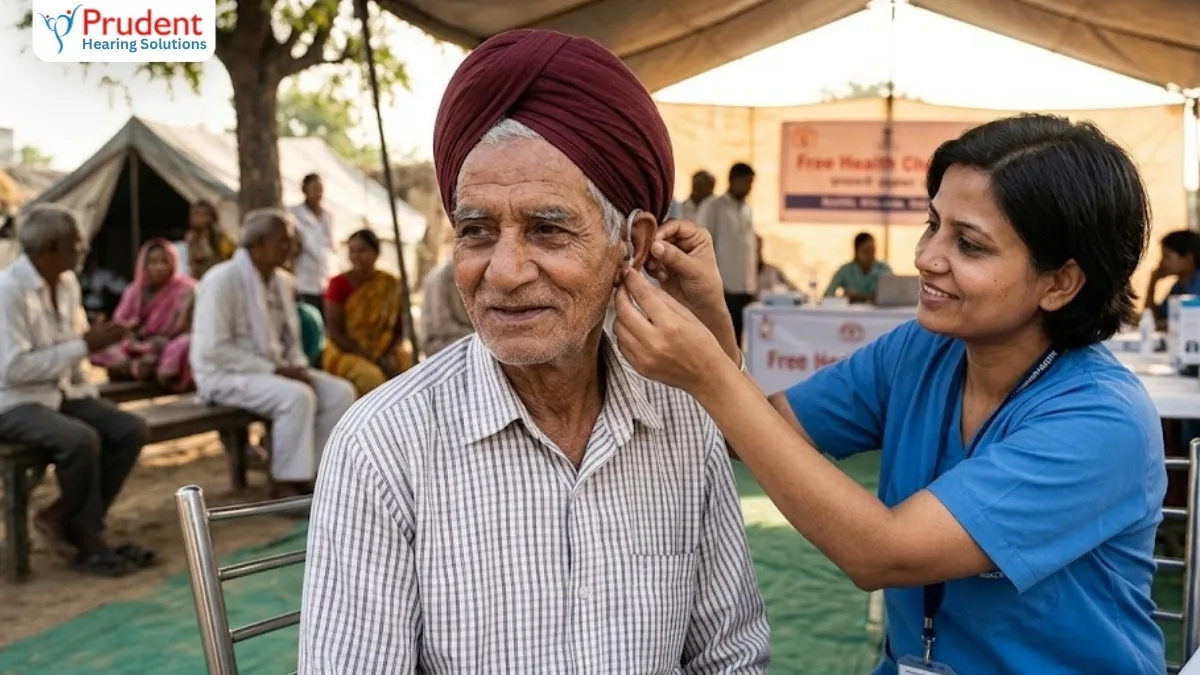
- Aids are distributed at camps. Beneficiaries are identified through assessment camps organised with the state government and district administration.
- For seniors aged 80 or more, devices can be delivered at home.
Documents to keep ready
- Aadhaar card or another identity proof.
- Proof of BPL status or income: a BPL ration card, proof of an old-age pension for BPL seniors, or a certificate from the district authority.
- A certificate of hearing impairment from a Government Medical Officer. An audiogram from a hearing test helps.
Is RVY running in 2026?
Yes. RVY ran as a standalone scheme until 2019-20 and was then folded into the Atal Vayo Abhyuday Yojana (AVYAY), whose approved period ran to 2025-26. Distribution has carried on into 2026: on 1 October 2026 the Union Social Justice Minister handed over 662 aids, including behind-the-ear hearing aids, to 114 senior citizens from Delhi-NCR who had been identified at assessment camps in September (ThePrint).
A formal notice extending AVYAY beyond 2025-26 was not public when we checked on 7 October 2026, so confirm the next camp date with ALIMCO or your District Social Welfare Office before you travel.
ADIP: free or subsidised aids with a disability certificate
The ADIP scheme (Assistance to Disabled Persons for Purchase and Fitting of Aids and Appliances) is not limited to seniors, but many older adults qualify once their hearing loss is certified. You need a hearing disability certificate, usually through the UDID system, and an income below the scheme's limit; the subsidy depends on income. Our guides to the ADIP scheme and the hearing disability certificate explain the steps and the hearing-loss percentage needed.
CGHS: up to ₹30,000 per ear for central-government pensioners
Central-government pensioners and employees with a CGHS card can claim up to ₹30,000 per ear (up to ₹60,000 for both ears, if clinically justified) under the revision of 9 September 2026. The aid must be programmable and rechargeable, with at least 8 channels, its charger in the package and a three-year comprehensive warranty, and prior permission is needed before you buy. See CGHS hearing aid reimbursement and why battery hearing aids don't qualify under CGHS.
What a free hearing aid usually is, and when to consider more
Scheme aids are genuine hearing aids, but the choice of model is limited and follow-up depends on the camp or centre. That suits many people well. If your parent struggles with speech in noisy rooms, has a severe loss, or needs regular fine-tuning, ask the audiologist whether a fitted aid with ongoing programming would help more, and whether a scheme like CGHS can cover part of the cost.
The first step for every scheme: a hearing test
Every route asks for proof of hearing loss. A full hearing test gives the audiogram a doctor, a certifying board or a CGHS ENT will want to see. Prudent's RCI-registered audiologists do a free hearing test at our clinics in Pune, Delhi and Bengaluru and on home visits, and hand you the audiogram to take forward. We do not run any of these schemes.
Not eligible? Lower-cost options
- Spread the cost with hearing aids on EMI.
- Compare genuine budget models in best hearing aids under ₹25,000.
- Check whether you can claim tax relief under 80DD or 80U.
This article is general guidance, not official advice from any scheme. Confirm current rules with the scheme authority before you apply. Sources: ALIMCO's Rashtriya Vayoshri Yojana guidelines, the Department of Social Justice and Empowerment, and CGHS Office Memorandum S.11030/76/2026-EHS.
Continue reading
Frequently asked questions
Can senior citizens get hearing aids free in India?
Yes, through Rashtriya Vayoshri Yojana (age 60+, BPL or income up to ₹15,000 a month), the ADIP scheme (with a disability certificate and low income) or CGHS reimbursement for central-government pensioners (up to ₹30,000 per ear).
What is the income limit for Rashtriya Vayoshri Yojana?
Senior citizens below the poverty line or with a monthly income of not more than ₹15,000 qualify, per ALIMCO's guidelines. Confirm the current limit before applying.
Do I need a disability certificate for a free hearing aid?
For ADIP, yes. For RVY, a certificate of hearing impairment from a Government Medical Officer is needed. For CGHS, you need an ENT prescription and prior permission instead.
Are hearing aids from government schemes rechargeable?
It depends on the scheme and the model supplied. CGHS reimbursement in 2026 applies only to rechargeable aids; camp-distributed aids vary, so ask at the camp.
How do I find the next Rashtriya Vayoshri Yojana camp?
Ask your District Social Welfare Office or ALIMCO. Beneficiaries are identified at assessment camps organised with the state government and district administration, and schedules change, so confirm the date before you travel. Seniors aged 80 or more can have devices delivered at home.
Sources & further reading
We cross-checked this article against the following authoritative sources. Guidance and figures reflect the most recent public guidance available at the time of last review (October 2026). Clinical review by the Prudent Hearing clinical team.
- Atal Vayo Abhyuday Yojana (AVYAY), which includes Rashtriya Vayoshri Yojana (Department of Social Justice and Empowerment, Government of India)
- 114 senior citizens in Delhi-NCR to get 662 assistive devices under Rashtriya Vayoshri Yojana (1 October 2026) (ThePrint)
- ADIP Scheme: aids & appliances for persons with disabilities (Dept. of Empowerment of Persons with Disabilities, Govt. of India)
- Hearing aid reimbursement guidelines and ceiling rates (OM S.11030/76/2026-EHS) (CGHS, Directorate General of Health Services, Ministry of Health & Family Welfare)
Free consultation
Ready to hear the difference?
Book a free 45-minute hearing test at any Prudent Hearing clinic: no obligation, honest advice, expert audiologists.