Educational information, not medical advice. This article is written to help you understand common ear and hearing issues. It is not a substitute for professional diagnosis or treatment. If your symptoms are severe, sudden, or persistent, please consult a qualified doctor or audiologist. For urgent symptoms (sudden hearing loss, bleeding from the ear, severe pain with dizziness, or a head injury), seek medical care the same day.
Meniere's disease links vertigo, tinnitus, hearing loss and ear fullness to inner-ear fluid. Learn the triad, testing and management from RCI audiologists.
Quick answer
Meniere's disease is an inner-ear disorder that causes sudden attacks of spinning vertigo alongside tinnitus, fluctuating hearing loss and a feeling of fullness in one ear. The four symptoms cluster because they share one origin: abnormal fluid pressure inside the inner ear, which houses both hearing and balance organs. It usually affects one ear.
Key takeaways
- Meniere's disease is defined by a triad-plus-one: vertigo, tinnitus, hearing loss and ear fullness, most often in a single ear.
- The suspected cause is a buildup of endolymph, the fluid inside the inner ear that serves both hearing and balance.
- Attacks come in episodes, with vertigo typically lasting from 20 minutes to 12 hours; between attacks, symptoms may partly settle.
- Diagnosis relies on a hearing test plus balance testing to rule out other causes, since no single test confirms it.
- Management aims to reduce attack frequency and protect hearing; there is no cure, and sudden hearing loss needs urgent care.
Meniere's disease is an inner-ear disorder that causes sudden attacks of spinning vertigo alongside tinnitus, fluctuating hearing loss and a feeling of fullness in one ear. The four symptoms cluster because they share one origin: abnormal fluid pressure inside the inner ear, which houses both hearing and balance organs. It usually affects one ear.
Why do hearing and balance symptoms appear together?
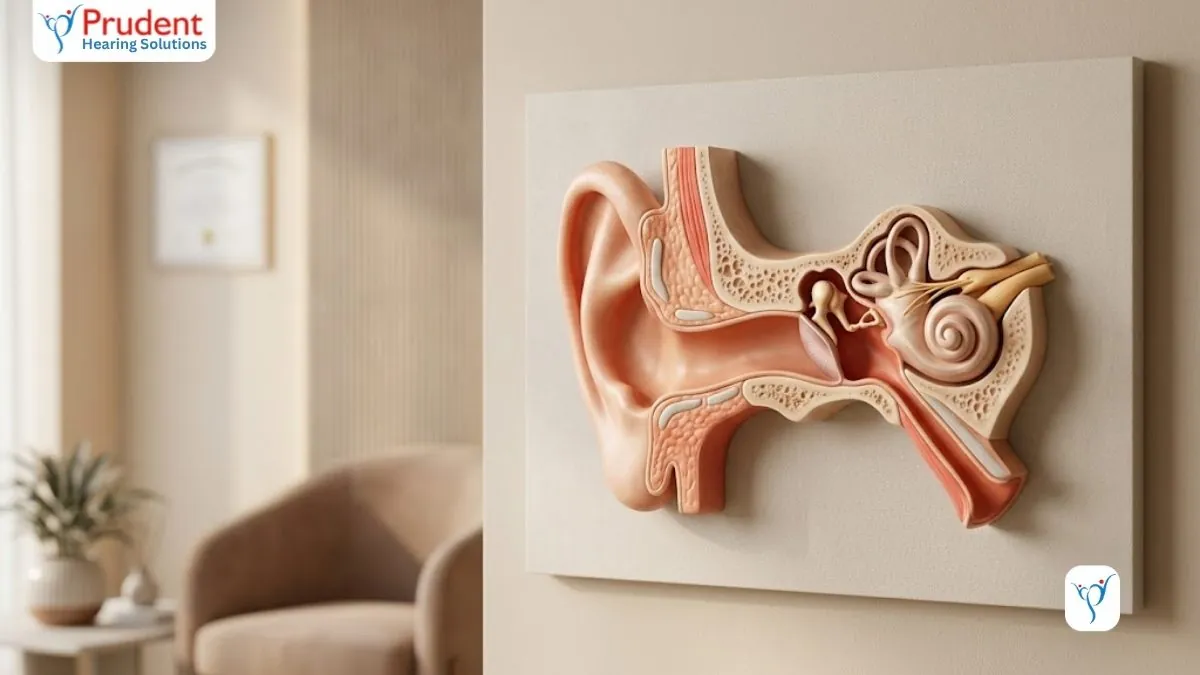
The inner ear is a single, connected structure. The cochlea handles hearing, and the vestibular organs beside it handle balance. Both float in a fluid called endolymph. When that fluid builds up abnormally, it disturbs both systems at once (NIDCD, Meniere's Disease).
That shared plumbing explains the pattern. The balance organs misfire, so the room spins. The cochlea is under pressure, so hearing drops and tinnitus rises. The ear feels blocked or full. This is why Meniere's is discussed as an ear condition, not only a dizziness condition. For the wider picture of how the ears drive balance, see our pillar guide, Vertigo and Your Ears: BPPV, Meniere's, and How Balance Testing Finds the Cause.
What are the four symptoms of Meniere's disease?
Meniere's is recognised by a specific group of symptoms (NIDCD, Meniere's Disease):
- Vertigo: sudden episodes of spinning that can last from 20 minutes to 12 hours. Severe attacks may bring nausea and vomiting.
- Tinnitus: a ringing, buzzing or roaring sound in the affected ear, often louder during an attack.
- Hearing loss: it fluctuates early on, coming and going, and can become more permanent over time.
- Aural fullness: a sensation of pressure or a plugged feeling in the ear.
Symptoms vary between people and between attacks. Some have long gaps of no attacks; others have clusters within a short span. This unpredictability is a hallmark of the condition.
How is Meniere's disease diagnosed?
There is no single test that confirms Meniere's disease. Doctors and audiologists diagnose it by matching the symptom pattern and ruling out other causes of vertigo and dizziness (MedlinePlus, Dizziness and Vertigo).
A hearing test (audiogram) is central. It documents the hearing loss, shows which ear is affected, and tracks whether hearing fluctuates over time. Balance testing assesses how the vestibular system is working and helps separate Meniere's from other inner-ear disorders such as BPPV, which produces brief, position-triggered vertigo without the hearing changes (Johns Hopkins Medicine, BPPV). A full hearing test is a practical first step if you have one-sided hearing changes with dizziness.
Balance disorders as a group are common and have many causes, so a structured work-up matters (NIDCD, Balance Disorders).
How is Meniere's disease managed?
There is no cure for Meniere's disease, and no treatment reverses hearing loss that has already become permanent. Management focuses on reducing how often and how severely attacks strike, and on protecting remaining hearing (NIDCD, Meniere's Disease).
Common approaches, decided by your treating doctor, include dietary changes such as lower salt intake, medicines to control dizziness and nausea during attacks, and other options for cases that do not settle. Because hearing can decline over time, ongoing monitoring with periodic hearing tests helps track changes. Where hearing loss becomes established, hearing aids can support communication in the affected ear; our team can advise on suitable hearing aids and, if travelling is difficult during an active phase, a home visit can be arranged.
When does Meniere's-related hearing change become urgent?
Fluctuating hearing is part of the condition, but a sudden, marked drop in hearing should never be assumed to be a routine attack. Sudden sensorineural hearing loss is a medical emergency, and prompt assessment gives the best chance of recovery. If your hearing falls sharply over hours or a day, seek same-day medical care rather than waiting. New or worsening severe vertigo, or dizziness with neurological symptoms such as weakness or trouble speaking, also needs urgent evaluation.
Frequently asked questions
Is Meniere's disease the same as BPPV?
No. BPPV causes brief spells of vertigo triggered by head-position changes and does not cause hearing loss or tinnitus. Meniere's produces longer vertigo attacks together with hearing loss, tinnitus and ear fullness (Cleveland Clinic, BPPV).
Does Meniere's disease cause permanent hearing loss?
It can. Early hearing loss often fluctuates, but with time some loss may become permanent in the affected ear. Regular hearing tests help track it (NIDCD, Meniere's Disease).
Can Meniere's disease be cured?
There is no cure. Treatment aims to reduce the frequency and severity of attacks and to manage symptoms; it does not restore hearing already lost (NIDCD, Meniere's Disease).
Which ear does Meniere's affect?
It usually affects one ear, though it can involve both in some people over time (NIDCD, Meniere's Disease).
Should I see an audiologist or a doctor?
Both roles help. A doctor evaluates the vertigo and rules out other conditions; an audiologist performs the hearing and balance testing that documents inner-ear involvement. You can contact our clinic to arrange testing.
Sources & further reading
We cross-checked this article against the following authoritative sources. Guidance and figures reflect the most recent public guidance available at the time of last review (September 2026). Clinical review by the Prudent Hearing clinical team.
- Meniere's Disease (NIDCD)
- Balance Disorders (NIDCD)
- Dizziness and Vertigo (MedlinePlus)
- Benign Paroxysmal Positional Vertigo (BPPV) (Johns Hopkins Medicine)
- Benign Paroxysmal Positional Vertigo (BPPV) (Cleveland Clinic)
Free consultation
Ready to hear the difference?
Book a free 45-minute hearing test at any Prudent Hearing clinic: no obligation, honest advice, expert audiologists.