Educational information, not medical advice. This article is written to help you understand common ear and hearing issues. It is not a substitute for professional diagnosis or treatment. If your symptoms are severe, sudden, or persistent, please consult a qualified doctor or audiologist. For urgent symptoms (sudden hearing loss, bleeding from the ear, severe pain with dizziness, or a head injury), seek medical care the same day.
How hearing loss percentage is calculated in India: the dB-to-percent method, four-frequency average, better/worse ear, a worked example, and the 40% benchmark.
Quick answer
In India, a hearing disability percentage is worked out from your audiogram. The certifying medical board takes the average hearing threshold (in decibels) across key frequencies in each ear, gives more weight to your better ear, and maps that to a percentage using notified government guidelines. Higher decibel loss means a higher percentage.
Key takeaways
- The calculation starts with your pure-tone audiogram: the softer the sounds you can hear (higher dB), the greater the loss.
- Assessors use a four-frequency average (commonly 500, 1000, 2000 and 4000 Hz) for each ear.
- Your better ear is weighted more heavily than your worse ear, because it drives everyday hearing.
- The dB figures are then converted to a percentage using the government's notified guidelines; the final number is decided by the certifying medical board, not self-calculated.
- The 40% benchmark that many benefits refer to is applied by the board per those guidelines: treat any figure you calculate yourself as an estimate only.
In India, a hearing disability percentage is worked out from your audiogram. The certifying medical board takes the average hearing threshold (in decibels) across key frequencies in each ear, gives more weight to your better ear, and maps that to a percentage using notified government guidelines. Higher decibel loss means a higher percentage.
What is "hearing loss percentage" and why does it exist?
The percentage is an administrative measure. It translates the audiologist's decibel readings into a single number that a medical board can use for a disability certificate and related benefits. It is not a clinical diagnosis on its own: it is a way of expressing how much hearing you have lost, in a form that schemes and employers can use consistently.
To understand where this fits in the certificate process, see our pillar guide, Hearing Disability Certificate in India: How to Apply.
What does the calculation start from?
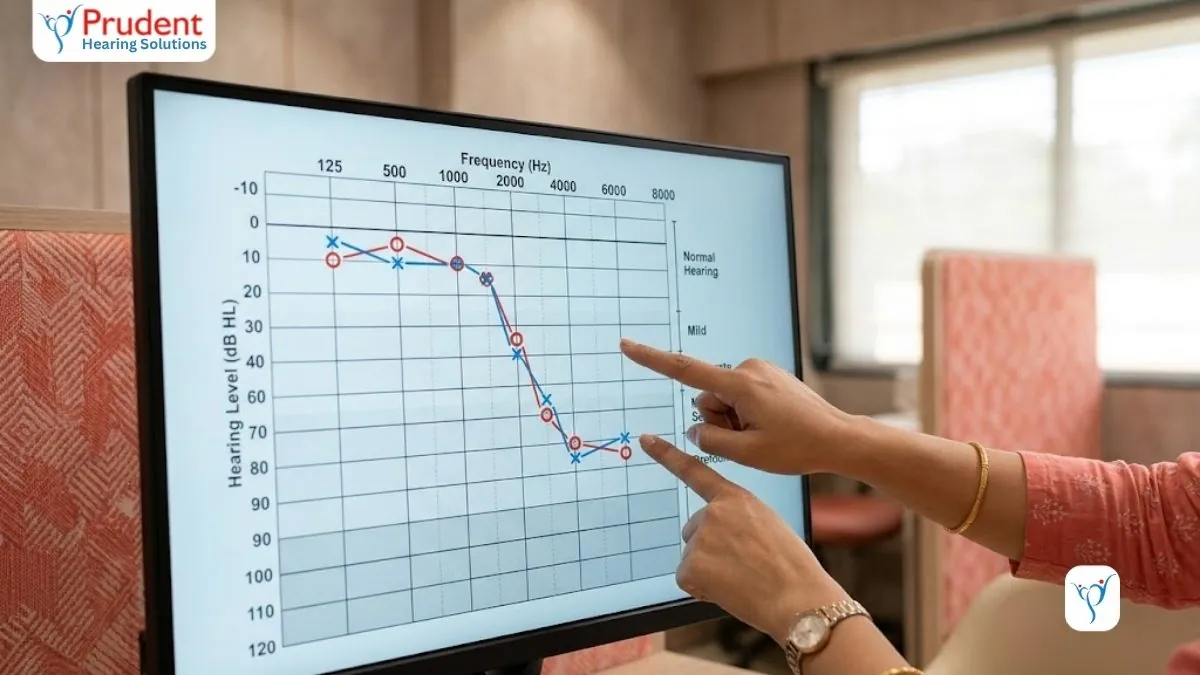
Everything begins with a pure-tone audiogram. During the test, an audiologist finds the quietest sound you can hear at several pitches (frequencies), measured in decibels hearing level (dB HL). A higher dB number means you needed a louder sound, which means more hearing loss.
The World Health Organization describes hearing loss in grades (mild, moderate, moderately severe, severe and profound) based on these decibel thresholds. WHO also defines "disabling" hearing loss as loss greater than 35 dB in the better hearing ear. Indian disability assessment uses the same raw material (your dB thresholds) but applies its own conversion to reach a percentage.
If you do not yet have a recent audiogram, you can book a hearing test to get one.
How is the four-frequency average used?
For each ear, the assessor takes your thresholds at the main speech-relevant frequencies (commonly 500, 1000, 2000 and 4000 Hz) and averages them. This gives one representative dB figure per ear, often called the pure-tone average (PTA).
So you end up with two numbers:
- Better ear average (the ear that hears more)
- Worse ear average (the ear that hears less)
Averaging across frequencies matters because loss is rarely flat. You might hear low pitches well but struggle with high pitches, or the reverse. The average smooths this into a single value the guidelines can work with.
Why is the better ear weighted more heavily?
Because in daily life you function largely through your better ear. If one ear is near-normal, you can still follow conversation reasonably well even if the other ear is poor. The Indian method (like international handicap formulas) therefore gives the better ear far more weight than the worse ear when arriving at a percentage. Two people with the same total loss can end up with very different percentages depending on how the loss is split between the ears.
A worked example
Suppose an audiogram shows:
- Better ear four-frequency average: 50 dB
- Worse ear four-frequency average: 75 dB
Steps the board follows in principle:
1. Confirm the four-frequency average for each ear (50 dB and 75 dB here). 2. Apply the notified weighting, which leans heavily on the better ear (50 dB), so the effective figure sits closer to the better ear than to a simple midpoint. 3. Convert that weighted figure to a percentage band using the government's conversion table.
In this example the better ear sits in the moderate range, so the resulting percentage would fall in a moderate band rather than a severe one: precisely because the better ear, not the worse ear, drives the outcome.
Important: the exact coefficients and the final conversion table are set by the notified guidelines, and the certifying medical board applies them. Treat the above as an illustration of the logic, not a precise number you can quote for your certificate.
What about the 40% benchmark?
Many disability benefits in India reference a 40% threshold. Whether a given audiogram reaches 40% is a decision the certifying medical board makes, applying the notified guidelines to your specific readings. We are deliberately not giving a dB-to-40% shortcut here, because the mapping is set by government notification and can be revised, and because measurement conditions and the board's judgement both matter. Use your calculated estimate only to know roughly where you stand, then let the board issue the official figure.
When should you see an audiologist?
Get assessed promptly if:
- You struggle to follow conversation, especially in noise.
- One ear has clearly become worse than the other.
- Hearing dropped suddenly: sudden hearing loss is an emergency; seek same-day medical or ENT care, as early treatment can matter.
Age is the most common driver of gradual loss, as the NIDCD notes, but any new or one-sided change deserves a professional check. You can talk to our team to arrange an assessment.
Continue reading
Frequently asked questions
Can I calculate my hearing loss percentage myself?
You can estimate it from your audiogram by averaging your thresholds and noting your better ear, but the official percentage is issued only by a certifying medical board applying the notified guidelines. Self-calculation is a rough guide, not a certificate.
Which frequencies are used in the calculation?
Assessors commonly average the speech-relevant frequencies (500, 1000, 2000 and 4000 Hz) for each ear. Your report may show these clearly marked so you can see how the average is formed.
Does the worse ear count at all?
Yes, but far less than the better ear. Both ears are included, with heavy weighting toward the better ear, because that ear determines most of your real-world hearing ability.
Is 40% guaranteed if my loss is severe?
No. Reaching 40% depends on your actual thresholds, how loss is split between the ears, and the board's application of the current guidelines. There is no guarantee, and the number is decided by the board, not calculated by you.
Is the percentage the same as WHO's hearing loss grades?
No. WHO grades (mild to profound) describe severity by decibels. The Indian percentage is an administrative figure derived from those decibels for certification purposes. They are related but not the same thing.
Sources & further reading
We cross-checked this article against the following authoritative sources. Guidance and figures reflect the most recent public guidance available at the time of last review (September 2026). Clinical review by the Prudent Hearing clinical team.
- World Health Organization (WHO) (Deafness and hearing loss)
- NIDCD (NIH) (Age-Related Hearing Loss)
Free consultation
Ready to hear the difference?
Book a free 45-minute hearing test at any Prudent Hearing clinic: no obligation, honest advice, expert audiologists.