If a parent has hearing loss and you want to get government help (free or subsidised hearing aids, tax relief, travel concessions), the UDID card is the single national ID that ties it together. Here is what it is, how it differs from the disability certificate, who qualifies, and how to apply online, in plain language.
What the UDID card is (and why it matters for hearing loss)
Bottom line: if your parent has hearing loss and you want to access government help (free or subsidised hearing aids, income-tax relief, and other concessions), the UDID card is the single document that ties it all together. This guide explains what it is, who can get one, what papers you need, and how to apply online in 2026.
UDID stands for Unique Disability ID. It is a national identity card for persons with disability, issued by the Government of India's Department of Empowerment of Persons with Disabilities (DEPwD), under the Ministry of Social Justice and Empowerment. You apply for it online through the Swavlamban Card portal, also called the UDID portal.
The card carries a unique number and records the type of disability and the assessed level. The point of it is simple: one verified card, accepted across the country, instead of carrying separate certificates and photocopies to every office. For a family managing a parent's hearing loss, it becomes the key that opens the door to several schemes at once.
UDID card vs disability certificate: the difference
These two are often confused, so it helps to be clear. They are related but not the same thing.
You cannot get a UDID card without going through the certificate assessment first. In the current online process, both are handled through the same portal application: you apply once, attend the medical assessment, and the certificate and the card are issued together and linked.
- Disability certificate: the medical document that certifies the disability and its percentage. It is issued by a medical board at a notified government hospital after an assessment. For hearing loss, that assessment includes audiometry (a hearing test) done at the assessing hospital.
- UDID card: the national ID card that is generated once the certificate is approved on the portal. It is linked to the certificate and can be downloaded as an e-card and issued as a physical card.
Who is eligible
The Rights of Persons with Disabilities (RPwD) Act, 2016 recognises a list of disabilities, and hearing impairment, including deafness and being hard of hearing, is one of them. Anyone assessed by the medical board as having a qualifying disability can be issued a certificate and a UDID card.
For many benefits, such as reservations and certain scheme eligibility, a 'benchmark disability' level applies. This is commonly cited as 40% or more. But the exact percentage that applies to your parent, and to any particular benefit, is decided by the assessing medical board and by the rules of each scheme. Please do not assume a number. Confirm the current threshold on the official UDID portal or with the assessing hospital before you count on any benefit.
What a UDID card can help you access
The card itself is an identity document. Its value is what it opens up. For a person with hearing loss, the main ones to know about are below.
- One verified ID accepted across the country, so you do not re-submit paperwork at every office.
- The ADIP scheme: free or subsidised hearing aids and other assistive devices for eligible persons (income limits apply).
- Income-tax relief under Sections 80DD and 80U, where a disability certificate/UDID is the supporting document.
- Reservations in education and government jobs, where applicable.
- Travel and other concessions offered by various departments, where applicable.
- Availability, amounts and eligibility for concessions vary by state, department and scheme, and they change over time, always confirm the current rules before relying on any of them.
Documents you will need
Keep clear, readable scans or photos ready before you start the online form. Blurry uploads are one of the most common reasons applications get delayed.
- Identity proof (for example Aadhaar or another government photo ID).
- A recent passport-size photograph in digital form.
- A scanned signature (or thumb impression, where applicable).
- Any existing medical records related to the hearing loss: earlier audiograms, hospital reports, and a disability certificate if one has already been issued.
- The exact list can vary by state and can be updated, so check the required documents shown on the official portal for your case.
How to apply online, step by step
The whole process starts and ends on the Swavlamban Card / UDID portal. The screens are updated from time to time, so treat the steps below as the shape of the process rather than exact button names.
- 1. Register on the portal with basic details and create a login.
- 2. Fill the application form: personal details, address, and disability type (select hearing/deaf and hard of hearing).
- 3. Upload your documents: ID proof, photo, signature and any medical records.
- 4. Select or confirm the notified government hospital where the medical assessment will take place.
- 5. Submit the application. It is routed to the concerned CMO office / hospital.
- 6. Attend the medical assessment on the date given. For hearing loss, this includes audiometry done by the hospital's board.
- 7. The board records the disability type and percentage, and the certificate is approved online.
- 8. The UDID card is generated: you can download the e-card from the portal, and the physical card is issued or dispatched.
What happens at the medical assessment
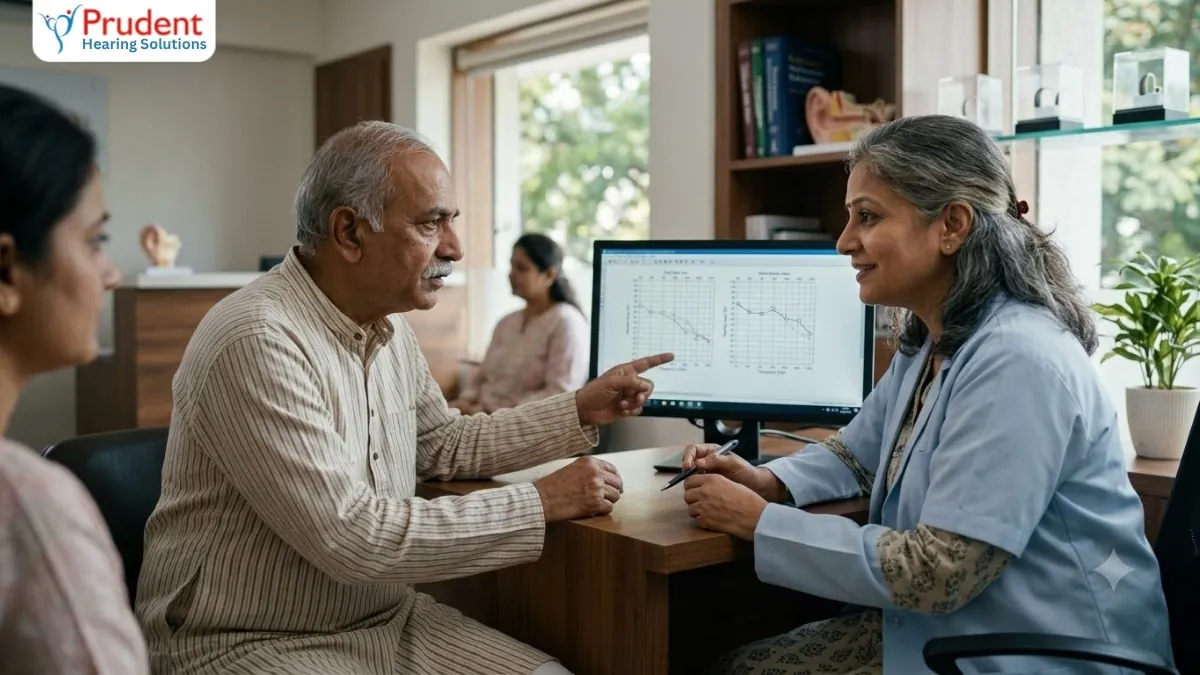
This is the step that decides the certificate, so it is worth understanding. A medical board at the notified government hospital assesses the disability. For hearing loss, this includes a hearing test / audiometry performed at that hospital, and the board determines the percentage of disability using standard guidelines.
You can and should bring prior records, but the official figure on the certificate comes from the board's own assessment, not from a report done elsewhere. Getting a hearing test and audiogram beforehand helps you understand your parent's loss and go in prepared, but it does not replace the board's evaluation.
How the UDID connects to hearing-aid help
For most families, the reason to get a UDID card is the help it opens up for the cost of hearing care. Two routes matter most.
- ADIP scheme: provides free or subsidised hearing aids and assistive devices to eligible persons. Income limits apply, and the device provided is decided under the scheme's own rules. See our guide to the ADIP scheme for details.
- Income tax: Section 80DD (for a taxpayer supporting a dependent with disability) and Section 80U (for the person with disability filing their own return). A disability certificate/UDID is the supporting document. Deduction amounts and eligibility are set by the rules in force, so confirm the current figures: see our guide on 80DD and 80U.
- Other central and state schemes may also apply. Income limits, benefit amounts and eligibility all vary and change, so verify the latest rules before you count on any single one.
Fees, timelines and tracking your application
Applying on the UDID portal and the assessment at a government hospital are generally free or nominal, but we will not put a rupee figure or a number of days on it: these vary by hospital, state and workload, and they change. Please confirm the current position on the official portal.
Once you have applied, you can track the status online using your enrolment / application number. Keep that number safe. If a date is given for the assessment, treat attending on time as important: a missed appointment usually means starting the wait again.
Common mistakes to avoid
A few simple slips cause most of the delays we hear about from families.
- Selecting the wrong disability category: choose hearing / deaf and hard of hearing.
- Uploading blurry or cut-off documents that get rejected.
- Missing the assessment date at the notified hospital.
- Expecting the card instantly: the certificate must be approved first.
- Assuming a fixed disability percentage: the board decides it, and the threshold for each benefit is set by that scheme's rules.
- Losing the enrolment / application number, which you need to track and download the card.
How Prudent Hearing Solutions can help
To be honest and clear: we do not issue the UDID card or the disability certificate. Only the government medical board can do that. What we can do is help you walk in prepared and understand your parent's hearing properly.
We offer a free 45-minute hearing test with RCI-registered audiologists (MASLP/BASLP) and a clear audiogram, so you understand the type and degree of loss before the assessment. We give honest guidance on hearing aids and on which government help may apply to your situation, and we fit brands including Signia, Phonak, Oticon, Widex, ReSound, Starkey, Unitron and Interton, with a trial before you buy, up to 30-50% off MRP, 0% EMI, and hearing aids being GST-exempt in India.
One thing we will always say plainly: a hearing aid manages hearing loss, it does not cure it. To book a test or ask a question, call us on +91 9429690093.
Continue reading
Frequently asked questions
Is the UDID card the same as a disability certificate?
No. The disability certificate is the medical document that certifies the disability and its percentage, issued by a government medical board after assessment. The UDID card is the national ID card generated once that certificate is approved, and it is linked to it. In the current online process you apply once and both are issued together.
What hearing loss percentage do I need for a UDID card?
A benchmark disability level, commonly cited as 40% or more, applies for many benefits, but the exact percentage is decided by the assessing medical board and varies by scheme. Do not assume a number; confirm the current threshold on the official UDID portal or with the assessing hospital.
How do I apply for a UDID card?
Apply online through the Swavlamban Card / UDID portal: register, fill in your details, select hearing as the disability type, upload your ID, photo, signature and medical records, and confirm the notified hospital. You then attend the medical assessment (which includes audiometry for hearing loss), and after the certificate is approved the UDID card is generated for download and issue.
How long does it take and what does it cost?
Applying on the portal and being assessed at a government hospital are generally free or nominal, but the exact fees and timelines vary by hospital and location and can change. We will not quote a fixed figure or number of days: please check the current position on the official portal and track your application there using your enrolment number.
Can Prudent Hearing Solutions get me a UDID card?
No. Only the government medical board can issue the disability certificate and the UDID card. What we do is provide a free 45-minute hearing test with RCI-registered audiologists and a clear audiogram so you understand your parent's loss before the assessment, plus honest guidance on hearing aids and the government help that may apply.
Does a UDID card get me free hearing aids?
It helps you access schemes such as ADIP (which provides free or subsidised hearing aids to eligible persons, with income limits) and tax relief under Sections 80DD and 80U. Eligibility, income limits and amounts vary and change over time, so confirm the current rules before relying on any specific benefit.
Free consultation
Ready to hear the difference?
Book a free 45-minute hearing test at any Prudent Hearing clinic: no obligation, honest advice, expert audiologists.