Educational information, not medical advice. This article is written to help you understand common ear and hearing issues. It is not a substitute for professional diagnosis or treatment. If your symptoms are severe, sudden, or persistent, please consult a qualified doctor or audiologist. For urgent symptoms (sudden hearing loss, bleeding from the ear, severe pain with dizziness, or a head injury), seek medical care the same day.
What speech audiometry adds beyond pure-tone testing, how SRT and SDS/WRS work, and why "I hear but can't understand" matters for hearing aids.
Quick answer
Speech audiometry checks how softly you can detect speech (SRT) and how clearly you can understand it (SDS, also called word recognition or WRS). Pure-tone testing shows the quietest beeps you hear; speech testing shows whether those sounds turn into words you understand. Together they explain the common complaint: "I hear people, but I can't make out the words."
Key takeaways
- SRT (speech reception threshold) is the softest level, in decibels, at which you can correctly repeat simple two-syllable words about half the time.
- SDS (speech discrimination score), or WRS (word recognition score), is the percentage of words you repeat correctly when speech is loud enough to hear comfortably.
- A normal SRT with a low SDS is the classic sign of "hear but can't understand" and usually points to the inner ear or hearing nerve.
- Speech scores strongly guide hearing-aid fitting and set realistic expectations for benefit.
- Speech audiometry is done alongside pure-tone testing, not instead of it.
Speech audiometry checks how softly you can detect speech (SRT) and how clearly you can understand it (SDS, also called word recognition or WRS). Pure-tone testing shows the quietest beeps you hear; speech testing shows whether those sounds turn into words you understand. Together they explain the common complaint: "I hear people, but I can't make out the words."
What does speech audiometry add beyond the pure-tone test?
A pure-tone audiogram maps thresholds for beeps at different pitches, giving the shape and degree of your hearing loss. But everyday listening is not beeps, it is speech in a moving, noisy world. Speech audiometry measures that directly.
It answers two separate questions. First, how loud does speech need to be before you detect it? Second, and more important, when speech is clearly loud enough, how much of it do you actually get right? Those are different abilities. You can meet the first easily and still struggle with the second.
For the full picture of how the beep-based test works and what your thresholds mean, read our pillar guide, PTA Test (Pure Tone Audiometry). Speech audiometry is the companion test that sits beside it.
SRT vs SDS: what is the difference?
Speech Reception Threshold (SRT) is a threshold, measured in decibels. The audiologist presents familiar two-syllable words (spondees, like "baseball" or "cupcake") and lowers the level until you can repeat about half of them correctly. A good SRT should broadly agree with your pure-tone average, which acts as a cross-check on the whole test.
Speech Discrimination Score (SDS) / Word Recognition Score (WRS) is a percentage. Here speech is set at a comfortable, clearly audible level, and you repeat a list of single-syllable words. If you get 46 of 50 right, that is roughly 92 percent. This score reflects clarity, not just loudness.
The pairing matters. A person can have an SRT that lines up neatly with their audiogram, yet a discrimination score that is disappointingly low. That gap is clinically meaningful.
Why does "I hear but can't understand" matter?
This is one of the most common things people describe at our clinic, and speech audiometry is what puts a number on it. When sound reaches the inner ear (cochlea) or the hearing nerve is affected, the ear can still register that speech is present but delivers a blurred, distorted signal to the brain. Turning up the volume makes it louder, not clearer.
That is why a low SDS is such useful information. Age-related and noise-related hearing loss are common, and hearing difficulty rises steeply with age, so this pattern is far from rare (NIDCD, Quick Statistics About Hearing). Speech testing separates a loudness problem, which amplification handles well, from a clarity problem, which needs more careful management.
How do SRT and SDS guide hearing-aid fitting?
Speech scores shape both the recommendation and your expectations.
A high discrimination score (say, in the 90s) suggests the ear can use amplified speech well, so a well-fitted hearing aid tends to give clear, satisfying benefit. A markedly low score signals that even perfect amplification may leave some words fuzzy, especially in background noise. That does not mean aids will not help. It means we set honest goals, may prioritise noise-reduction and directional features, and sometimes consider other options for very poor scores.
Fitting is not guesswork. Your audiogram, SRT and SDS together let the audiologist choose suitable devices, target the right frequencies and verify the fitting. To understand how devices are matched to a loss, see our overview of hearing aids.
What is the process and typical cost in India?
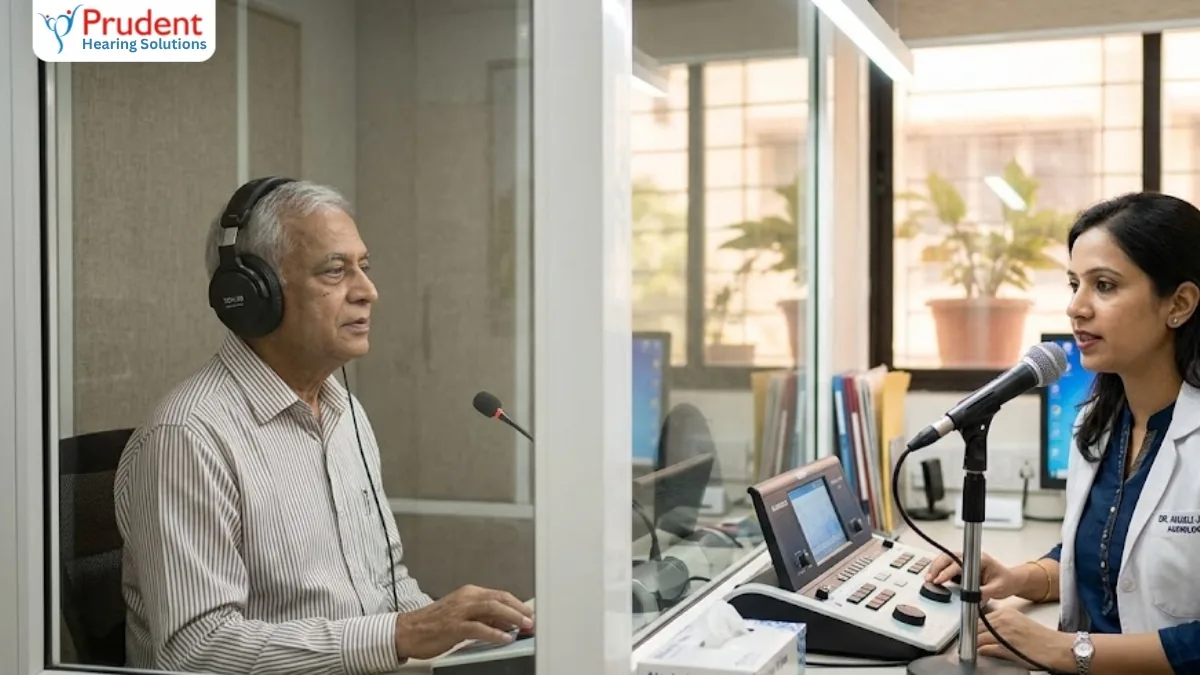
Speech audiometry is quick and non-invasive. You sit in a quiet, sound-treated room wearing headphones. The audiologist plays recorded or live-voice word lists, and you simply repeat what you hear, guessing when unsure. Each ear is tested separately. It usually adds only a few minutes to your appointment and is often bundled with pure-tone testing.
Costs vary by city and centre, but a combined pure-tone plus speech evaluation in India commonly falls in a modest few-hundred to low-four-figure rupee band, and many centres include speech testing within a standard diagnostic hearing test. Always confirm what is included when you book. You can arrange an assessment through our hearing test page or contact us, and a home visit can be arranged where travelling to a clinic is difficult.
When to seek urgent care: if you notice sudden hearing loss in one or both ears, especially over hours or a few days, treat it as a medical emergency and see an ENT specialist or audiologist immediately, as prompt treatment can matter.
Continue reading
Frequently asked questions
Is speech audiometry the same as a pure-tone hearing test?
No. Pure-tone testing uses beeps to find your softest audible levels by pitch. Speech audiometry uses words to measure the softest speech you detect (SRT) and how clearly you understand it (SDS). They are complementary and usually done in the same session.
What is a good word recognition (SDS) score?
Higher is better, with scores in the 90s generally indicating good clarity for amplified speech. Lower scores suggest the ear distorts speech, so understanding may remain harder even with correctly fitted hearing aids. Your audiologist interprets your score against your full result.
Can I have normal beep results but still fail speech understanding?
Yes, and this is exactly the "I hear but can't understand" pattern. It can point to inner-ear or nerve-related issues that a beep-only test may under-represent, which is why speech testing is valuable.
Why does my SRT need to match my audiogram?
Agreement between your SRT and pure-tone average is a reliability check. A large mismatch prompts the audiologist to re-examine the test, so consistency supports a trustworthy result ([ASHA, Understanding your audiogram](https://www.asha.org/public/hearing/audiogram/)).
Does speech audiometry hurt or take long?
Not at all. You simply listen and repeat words. It is painless and typically adds only a few minutes to a standard hearing evaluation.
Sources & further reading
We cross-checked this article against the following authoritative sources. Guidance and figures reflect the most recent public guidance available at the time of last review (September 2026). Clinical review by the Prudent Hearing clinical team.
- ASHA (Understanding your audiogram)
- NIDCD (NIH) (Quick Statistics About Hearing)
Free consultation
Ready to hear the difference?
Book a free 45-minute hearing test at any Prudent Hearing clinic: no obligation, honest advice, expert audiologists.